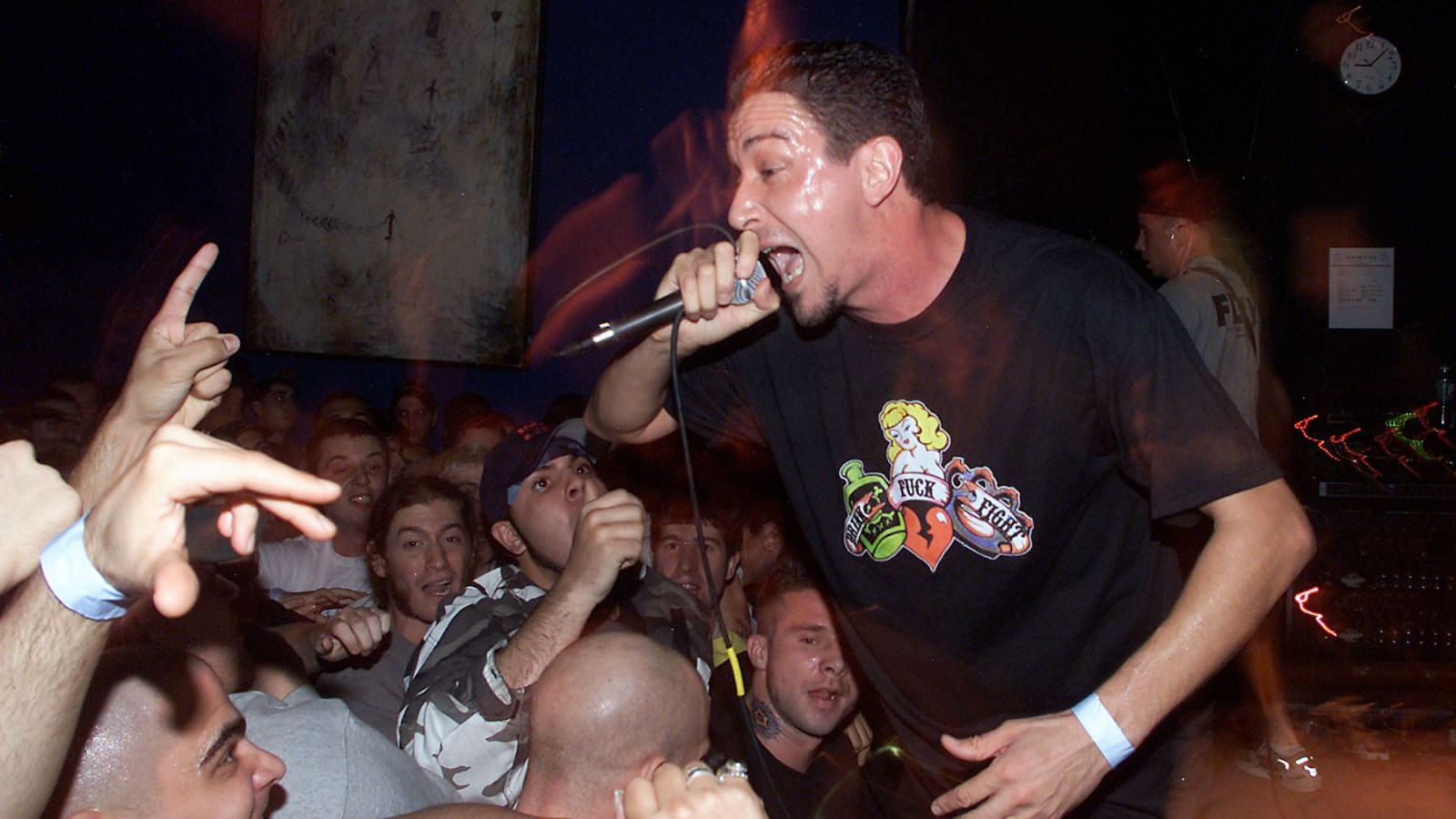
Late vocalist sang about inclusivity and fostering friendship in bleak times, spreading the hardcore reality around the world for decades “We have our mics, but this is your mic.” When I saw Sick of It All play a gig in Denver in 2001, a couple of years before I moved to New York, it seemed like a revelation that a professional band would place a microphone on the Ogden Theatre’s stage for anyone to climb up and sing along with them before diving back into the pit. He also asked for everyone to look out for each other in the mosh pit. I was a metalhead, a few years into college, and still relatively fresh to New York hardcore. Metal bands didn’t do things like that. Little did I know that sense of community had been a staple of hardcore shows in New York for decades at that point. One guy at that show kept requesting “Rat Pack,” a 47-second frenzy about sticking with your friends off the band’s classic debut, Blood, Sweat, and No Tears, and when frontman Lou Koller gave him the crowd’s mic, the guy completely forgot the lyrics. Koller laughed and said something like, “Eh, eh, not so fast. You have to know the lyrics if you’re going to do that.” Then he smiled that impish grin he made famous to show all was forgiven. Even if you publicly embarrassed yourself, he still wanted you here. Sick of It All were NYHC’s most welcoming emissaries, and their mouthpiece was Lou Koller, whose death was announced Friday. Gifted with a golden growl, Koller could both belt the ear-piercing chorus of “Scratch the Surface” and make its message, about striving to live a meaningful life, coherent. Onstage, he wasn’t like other heavy-music frontmen. He was kind of dorky. No matter where he was, he treated every show like a CBGB matinee, where everybody was welcome, and that was the point. “We wanted to show the world what we loved,” Koller told Kerrang! in 2018. “That’s why we didn’t just play with hardcore bands. On our first run down the East Coast in 1988, Exodus asked us to open up for them for five shows. It was a shock to the audience when we walked out: Kids with short hair! As we got more popular some people referred to us as ‘The Kings of New York hardcore,’ and we were always, ‘No, no. We’re the ambassadors.'” Editor’s picks Since forming Sick of It All in Queens, New York with his younger brother, guitarist Pete Koller, in 1986, the band’s best songs were always about togetherness. When I wrote about Blood, Sweat, and No Tears for Rolling Stone’s list of the Greatest Punk Albums of All Time earlier this year, it occurred to me that Koller’s central message was always, “We’re in this together.” “Pushed Too Far” was about fighting back against bullies. So was “Friends Like You.” They kept that message going on their next album with “Just Look Around,” a song warning against racism dividing society while rich politicians prosper, a message that still resounds nearly 40 years later. They were a band for hard-working people just trying to get through the day. The image of New York hardcore, at least in the mold Agnostic Front and the Cro-Mags cast in the early Eighties, has always been something like puffed-chest tough guys screaming about their rage. Sick of It All defied that. In 1999, when I first saw group, which included bassist Craig “Ahead” Setari on bass and drummer Armand Majidi, it was their pure energy and inclusivity that blew me away. They were on a bill between Slayer and Meshuggah, and while I’m a well-documented huge Slayer fan, it was the way Sick of It All that left the biggest impression on me. They seemed to come tumbling onstage with Pete flipping his guitar over his shoulder and, unlike the frontmen of the other bands on the bill, Lou was smiling. This was an everyman’s band. “We’re all black sheep and we know it,” he’d sing on “Hello Pricks” in 2000, and that’s what made them special. “Our music was written [for] total crowd participation” Koller says in an interview from the Live in NYC ’91 VHS that featured footage of Sick of It All playing the Ritz with Agnostic Front and Gorilla Biscuits. “‘Cause that’s how we grew up. Early hardcore was total crowd participation. You know, pile on, sing along, all that stuff. That’s your outlet. It kind of dulls the energy when you have a six-foot barricade from the stage to the audience.” Related Content My newfound love of Sick of It All led me to dig deeper into New York hardcore and find likeminded bands, but my understanding of the scene was still limited for a few years to the bands that toured through Colorado, and there weren’t many in the early 2000s. Fortuitously, two groups that came through frequently were Indecision and Most Precious Blood, which shared the same guitarist, Justin Brannan. He later brought NYHC ideals to NYC politics as a council member, and he captured Koller’s legacy well in a social media post addressed to Koller on Saturday. “You brought hope and positivity to places other bands would never dare go,” he wrote. “You made outcast kids all over the world feel seen, accepted, and a little less alone. Thank you for the music, the friendship, and the example you set — especially these last few years. Your impact will be felt.” I moved to New York in 2003 and saw Sick of It All several times on their home turf, including a rare set at CBGB in ’04. It was there, seeing how everybody packed into this famously dank East Village shithole to have a good time together, that I understood the sense of community that drove the band. There wasn’t much room for anybody to fall in the pit, but if they did, someone would’ve picked them up. The fact that Sick of It All could bring this same ethos to stages in Colorado and around the world is a miracle. They played for any audience, including one time before Wu-Tang Clan at a festival, and were still playing more than 100 gigs a year around the world as recent as 2019. Trending Stories When a friend texted me yesterday that Koller had died, the first song that popped into my head was “Good Lookin’ Out,” a song from their fourth album, 1997’s Built to Last. “You’re not in this all alone/Just look around, and you’ll see,” he sang. “The answer’s right before your eyes: I’m here for you, and you for me.” The chorus culminates with Koller singing, “True friends will always be there.” When Koller revealed he was battling cancer in 2024 and launched a GoFundMe campaign, his many friends showed up. The Dropkick Murphys, Rancid, AFI, and Hot Water Music were among the first to donate. That’s because Lou Koller was New York hardcore’s big brother. He didn’t invent telling audiences to look out for one another in the mosh pit, but the way he preached the unity of New York hardcore all around the world will live on when the many bands Sick of It All inspired carry his spirit forward at their own gigs around the world, and that’s a special legacy. Just look around, and you’ll see.
Remembering Sick of It All’s Lou Koller, New York Hardcore’s Best Ambassador
Full Article
Original Source
Read the full article at Rollingstone →KhanList aggregates and links to publicly available news content. We do not host full articles from third-party sources. Always verify important information with original sources.