
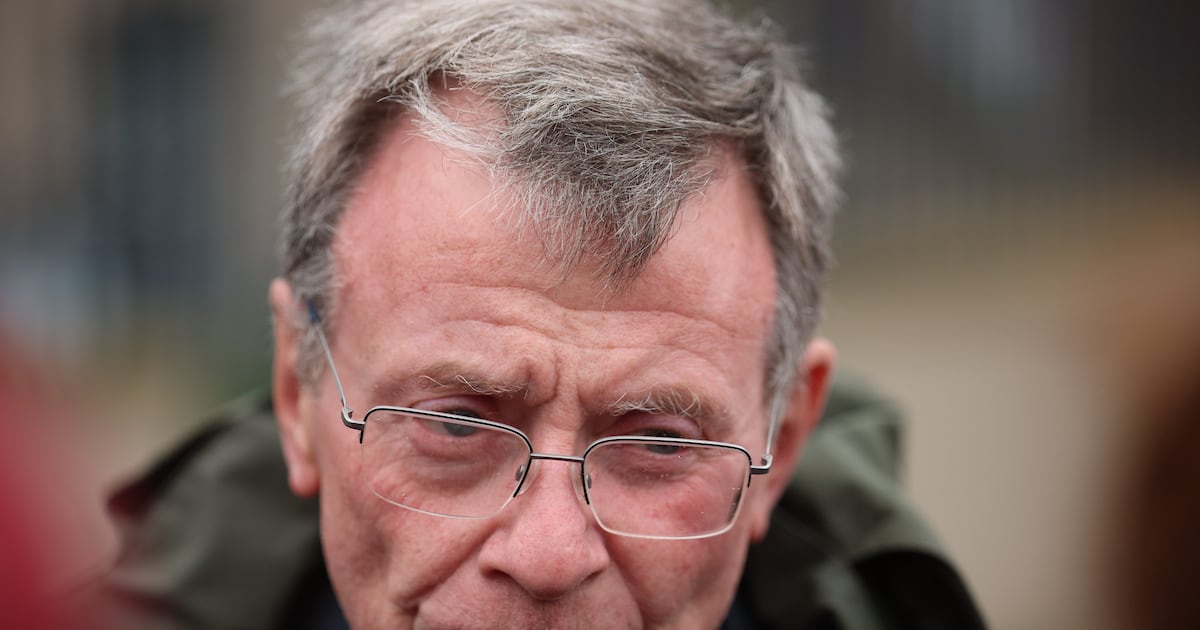
On a wet afternoon in the Drumcree Community Trust centre off Garvaghy Road, Breandán Mac Cionnaith wends his way through tables filled with local residents having a late lunch in search of a quiet room.Thirty years ago, Mac Cionnaith was the face of Garvaghy Road when the Orange Order’s attempt to march from Drumcree made global headlines for four difficult years in a row.Now 69, he is not glad to be back in the spotlight, as some have charged.“Nobody saw this coming. I never thought we’d see this again. It’s like we’ve woken from a bad dream,” he says.READ MOREIn a long conversation, the former IRA man, jailed for bombing a local Orange Order hall, tries to explain to those far away from the town of Armagh the tempers and tensions that govern 2026 attitudes, even drawing upon a 200-year-old example.Twenty-one people were killed in, or around Portadown, or because of the Drumcree crisis in the 1990s.Breandán Mac Cionnaith, head of Garvaghy Road Residents' Association, reacts to the decision to overturn the ban on the Orange Order being allowed to march. “The Orange Order cannot dissociate themselves from that, no matter how much they want to do so,” he says.“They didn’t tell the loyalist Volunteer Force leader Billy Wright and his comrades, or Johnny Adair and his people, to get away from them. They welcomed them with open arms,” Mac Coinnaith says, referring to the loyalist hardmen.The families of some of those killed still live on the route that would be passed by the Orange Order if it manages to make its way from the church at Drumcree into the centre of Portadown through Garvaghy.Marie-Therese Matchett, the mother of 12-year-old Darren Murray, is one of these. He was chased down by a gang of loyalists in 1996 when playing near the Orange hall. He died two days after being struck by a car in the Garvaghy Road area.“They gave him a few slaps around the head. He got away and they came running after him. He was in a panic – you can imagine a 12-year-old boy with a dozen after him. He ran smack bang across the road and into the path of a car,” says Mac Coinnaith.“His mother was here the other night. She doesn’t do interviews. But she got a poster made with her son’s picture on it and marched with us. I don’t know how she had the courage to do that.”Breandán Mac Cionnaith: 'No matter where you walk around, you’ll see the scars in this place.' The family of 29-year-old Catholic council worker Adrian Lampf, who was shot and killed by a loyalist gunman in Portadown on April 21st, 1998, is among others who live on the route.He was singled out because he was a Catholic at the Duke Street council recycling site. A lone gunman wearing a scarf and baseball cap rode up to him on a mountain bike and shot him in the head and neck. No one has ever been convicted for his murder. Mac Coinnaith, a member of the republican political dissident group, Éirígí, lists others.“This is a march in place like no other and it will reopen questions about Orange marches elsewhere where there were no problems,” he says.“No matter where you walk around, you’ll see the scars in this place. Some of the first sectarian murders were carried out here,” he adds, remembering local publican Jack McCabe, killed in 1972.[ Breandán Mac Cionnaith profile: The ex-IRA man who Tony Blair said ‘took unreasonableness to an art form’Opens in new window ]In Mac Coinnaith’s telling, the 48-year-old McCabe was killed by an off-duty Royal Ulster Constabulary officer who chose him because he was a “successful Catholic businessman”.“I met his son and daughter-in-law this week. They joined us, saying they had moved away to get away from all of it, but they couldn’t let this happen again. The memory of their da’s killing is still as strong as ever,” he says.In a place like Garvaghy Road, where memory is searing but often seen through a single lens, a records check shows that McCabe died alongside a Protestant customer, William Cochrane, who was sitting at the bar when hooded killer Ralph Henry, a member of the RUC and UDA, entered and killed both.During the early days of the Troubles, Portadown was known as the centre of “The Murder Triangle”. How will the Drumcree standoff end? Some 52 people were killed in the town or in the surrounding town lands over 30 years. The killings were almost evenly spread: 28 Protestants and 24 Catholics, shot at work, in their homes, on their farms, in RUC or British army uniform.Speaking before heading to Hillsborough for a meeting with Northern Ireland Secretary of State Chris Bryant, Mac Coinnaith says he realised early that this year’s Orange Order application was different from those refused since 1998.“Why this year? I don’t know. There’s no logic behind it. Nothing’s changed,” he says. “The Orange could have challenged in the courts every year up to now; you don’t need to be a top lawyer to know that. Somebody wanted to use it this year.”
Reluctant Garvaghy Road resistance point man Breandán Mac Cionnaith rises to Drumcree challenge
Full Article
Original Source
Read the full article at Irishtimes →KhanList aggregates and links to publicly available news content. We do not host full articles from third-party sources. Always verify important information with original sources.