
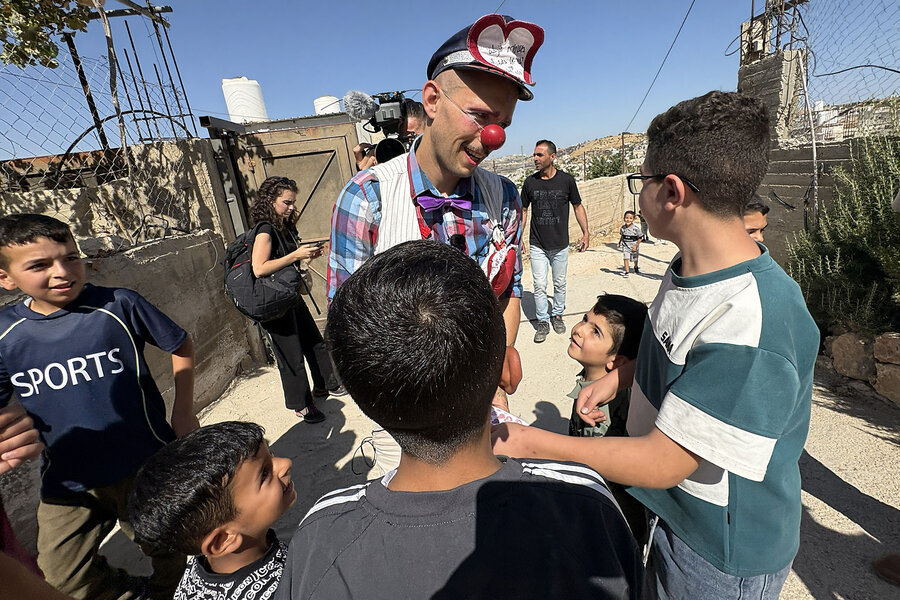
“One at a time,” Odelia Kessous calls out in Arabic, handing out bubble wands as children rush a basin brimming with sudsy water and jostle for their turn.The Palestinian boys and girls shout with delight at the bubbles floating in the scorching air of this hillside West Bank village. Steps away, other Israeli activists fashion animals out of balloons, while a couple in garish wigs and clown makeup wildly wave their arms in a routine that prompts roars of laughter.They are an unusual crew, religiously observant Jews who belong to Bnei Avraham, Hebrew for “children of Abraham,” a group that travels to the West Bank to protect Palestinian farmers from armed attacks and intimidation by Israeli settlers. Because of their observant backgrounds, they are relative outliers among the several left-wing Jewish groups engaged in this brand of action, called “protective presence.” Why We Wrote This Among Israelis engaged in the practice known as “protective presence” to shield West Bank Palestinians from settler attacks, members of the leftist religious group Bnei Avraham are outliers. They are motivated in part, one member said, to display “another face of Judaism.” Armed only with cellphones to document attacks if they occur, they hope their presence can help deter violence.Jewish activists of all backgrounds have been injured, including a pair last spring beaten unconscious by extremist settlers. Their activism on the front lines of a battle over the future of the West Bank is a rare example of Israeli-Palestinian solidarity.On this recent weekend, Bnei Avraham went to a village south of Hebron to do something a bit different. Instead of going out into fields or olive groves with adults, they brought clowns and a circus of sorts to entertain children who, like their parents, live with the threat of settler violence. Jerusalem lawyer Odelia Kessous, an activist with the religious group Bnei Avraham who has developed close ties with the villagers of Ar-Rihiya, talks with children during a circus Bnei Avraham activists organized, in Ar-Rihiya, West Bank. “Another face of Judaism”The gathering, which drew more than 100 children and their parents and grandparents, was part of their efforts to build a sense of solidarity and community with Palestinian residents. To show them, as Ms. Kessous puts it, “another face of Judaism … not nationalism and racism dressed as Judaism.”This is particularly important to them as religiously observant Jews, like most settlers.“It’s really complicated to be a leftist religious person in Israel now. Unfortunately, I feel like Judaism was kidnapped by the right wing,” says Ms. Kessous, a lawyer from Jerusalem whose activism has become a central part of her life. She says she grew up with a “different Judaism, one that focused on justice, on helping the minority and those weaker [in society].”Settler violence against West Bank Palestinians – in an undisguised campaign to drive them from land that would be part of a future Palestinian state – is not a new phenomenon. But what were once occasional attacks are now nearly daily, following the Oct. 7, 2023, Hamas-led attack on Israel and the Gaza war it ignited.Human rights groups and Palestinians say Israel’s far-right government is complicit. They attribute a recent escalation in attacks to upcoming Israeli elections and an effort by settlers and their advocates, wary of a change in government, to secure as much Jewish settlement as possible ahead of the vote.Attacks, originally focused on an area under full Israeli military control, spread more recently to territory where the Palestinian Authority shares security duties. In Qusra village near Nablus, for example, settlers attempting to set up an outpost laid siege to several homes, including one owned by an American citizen. That elicited rare condemnation by U.S. Ambassador to Israel Mike Huckabee, who called it a “horrific act of terror.” Members of the Israeli security forces stand guard as Palestinian, Israeli, and foreign activists try to approach a Palestinian house that was besieged by settlers, in Qusra, West Bank, Aug.14, 2026. Roei Kleitman, a founder of Bnei Avraham, says the showdown in Qusra and recent violence in a neighboring village where four Palestinians and two Israelis were killed, is part of extremist settlers’ mission to ratchet up pressure on Palestinians to succumb to so-called “voluntary emigration.”“They say their best offense is to attack, to keep pushing the boundaries,” he says. “They want to push for an intifada [uprising] before the elections. They want a war.”A group and its missionBnei Avraham is an activist arm of a larger grassroots group of young left-wing religious Jews called Smol Emuni, Hebrew for “left-wing faithful.” Members grew up during the violence of the Second Intifada and under successive right-wing governments, most led by Prime Minister Benjamin Netanyahu, when optimism or a road map for a more peaceful future was almost entirely absent.It’s also when right-wing religious Israelis increasingly gravitated toward the idea of Jewish redemption through expanded power and sovereignty over the West Bank, which they see as their biblical birthright.Mr. Kleitman calls this a “dangerous idea … one that allows them to do terrible things.” He describes Bnei Avraham’s work as one of partnership with, not domination over, Palestinians. He sees it as a “mitzvah,” a good deed, in Jewish teaching.Oct. 7 intensified his commitment. “I had to deal with a theological question: What does God want from me from me in this period?” he says.Where his young religious counterparts in the West Bank believe in exerting power and strength in the name of security and love for Eretz Yisrael, Hebrew for the biblical “Land of Israel,” he says, “I see partnership with the Palestinians as the answer to [Jewish] supremacy. Doing protective presence is like religious work for me.”It also feels like his civic duty.About two or three times a week, Bnei Avraham activists accompany Palestinian farmers in the Hebron and Bethlehem regions to their land, areas that have become dangerous to reach because of nearby settler outposts. A good day, they say, is one in which they help farmers without incident. A difficult day is when violence or threats of it are so dire that they and the farmers are forced to retreat.They also hold “protective presence Shabbats,” in which activists spend from Friday to Saturday evening at a Palestinian village – eating kosher food, praying, and speaking with the local community. If settlers attack on the Sabbath, as they increasingly do, the activists are there to try to protect the community and document the violence.More volunteers have been signing up to join recently. They now number some 200, inspired, members say, by past nonviolent campaigns like the 1960s U.S. civil rights movement.Path to coexistenceAt Ar-Rihiya, a village of squat homes built along the slopes of a steep hill, hundreds have gathered for the makeshift circus set up under a black tarp. There are few organized activities for village children, and amid the recent tensions, everyone seems excited for a dose of happy mayhem. Palestinian Yusef Toubassi, who used to work in Israel, stands with members of his family alongside Bnei Avraham leader Efrat Reubinof, in Ar-Rihiya, West Bank. “We must find a way to live together,” he says. Yusef Toubassi sits with his grandson Masa, looking on as children run by with cheeks painted bright colors and others howling with joy as clowns spin them around.“They want coexistence between our two peoples, and we are here working with them,” he says of Bnei Avraham, whose leaders he has come to know well. “We must find a way to live together.”For decades Mr. Toubassi worked in Israel, mostly in restaurants. Since Oct. 7, five of his sons who worked in construction inside Israel have, like other Palestinians, been barred from entering.“Pressuring the workers like this in the end will bring chaos for everyone, and we don’t want that,” he says.Relations were peaceful for years with residents of nearby settlement Beit Hagai. But in recent months, even though they live in an area of joint Israeli and Palestinian security control, settlers have taken a nearby olive grove that belongs to the village, Mr. Toubassi says.That led to an incident in May, he says, in which he and village elders trying to get to the grove were detained by the military, handcuffed, blindfolded, and forced to lie on the ground for hours on a hot day before being released without charges.The message, he says, was part of the pattern of intimidation.Mr. Kleitman reflects on the Jewish tradition he seeks to emulate, in contrast with some religious settlers. “I identify more with the prophets,” he says. “They always spoke out about the wrongs they saw in society.”
Religious Israelis fight settler violence with a different expression of their faith
Full Article
Original Source
Read the full article at Csmonitor →KhanList aggregates and links to publicly available news content. We do not host full articles from third-party sources. Always verify important information with original sources.