
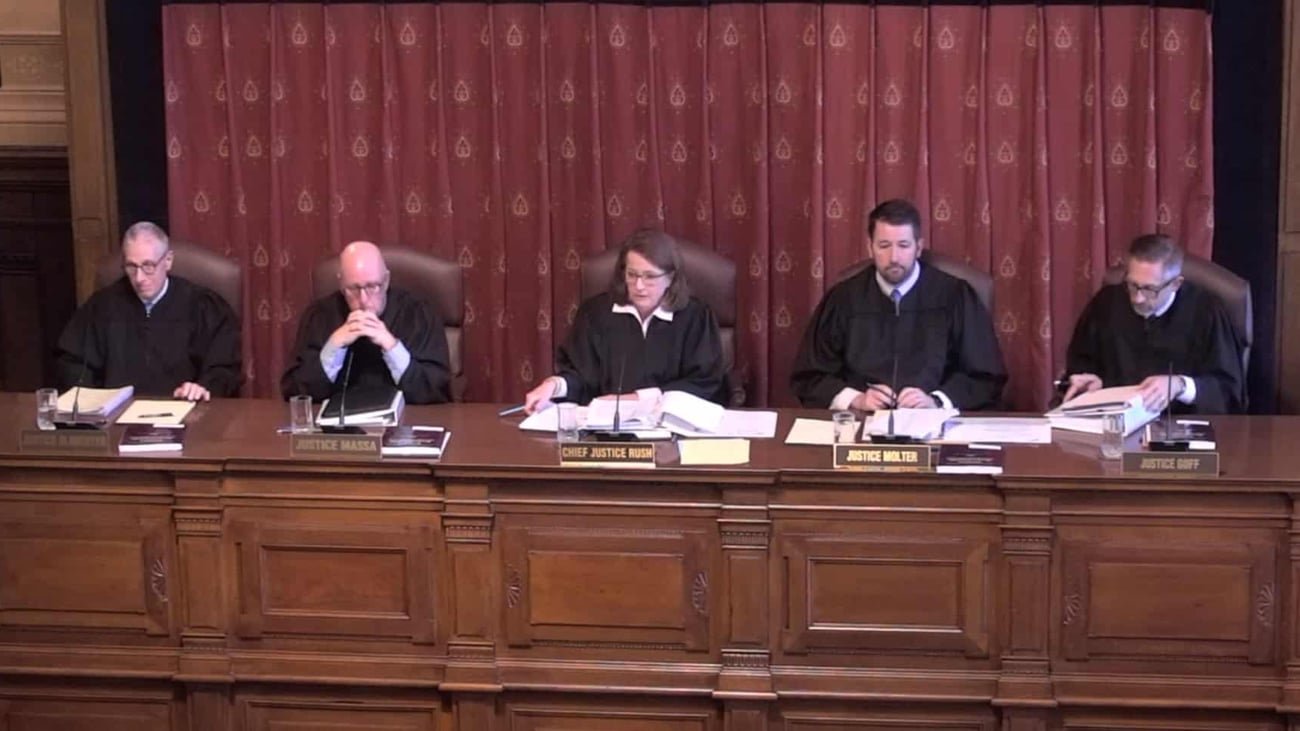
The state's abortion ban provides exceptions in cases of rape, incest and lethal fetal anomalies where the mother might be permanently impaired. But what about individuals with religious objections?INDIANAPOLIS (CN) — The Indiana Supreme Court heard an appeal Thursday seeking to enforce the state’s near-total abortion ban against those with religious objections.Indiana’s highest court previously upheld the law in 2023, but a lower court granted an injunction in favor of anonymous women and the advocacy group Hoosier Jews For Choice, who filed a class action challenging the ban on religious grounds.The state appealed the lower court’s ruling and asked the full five-judge panel of the Indiana Supreme Court during oral arguments to lift the injunction and rule that the state’s abortion law does not violate an individual’s religious freedoms.The law, known as the Indiana Religious Freedom Restoration Act, requires the government to have a compelling interest to burden an individual’s exercise of their religion and must use the least restrictive means it has available.Indiana Solicitor General James Barta appeared on behalf of the state and argued the abortion ban does not run afoul of the law and asked the court to reverse the lower court’s ruling.“The lower court’s ruling that Indiana’s Religious Freedom Restoration Act confers a right to religiously motivated abortions is unprecedented,” Barta said. “Our nation’s long tradition of respect for religious exercise has never been understood to encompass a right to intentionally destroy human life, anymore than a right to abusively punish children.”Barta painted the claims as purely speculative because none of the plaintiffs have been pregnant during the four years of litigation, and the purported injuries are only hypothetical.Indiana Supreme Court Chief Justice Loretta Rush questioned Barta on if the case was analogous to a decision made by the U.S. Supreme Court in Burwell v. Hobby Lobby, where the high court ruled the company did not have to comply with government insurance mandates and pay for the contraceptives of its employees based on religious grounds.“Isn’t this just a flip side of that?” Rush asked.“No, in Hobby Lobby, the plaintiffs were facing an imminent deadline for either offering plans that would comply with the contraceptive mandate or face significant financial penalties that would be in the millions,” said Barta.Ken Falk, from the ACLU of Indiana, represented the plaintiffs during the proceeding and argued Indiana’s abortion law causes his clients ongoing injuries.“The individual plaintiffs in this case are two women whose sincere religious beliefs have compelled them in the past to obtain abortions, but are no longer able to obtain such religiously required abortions because of Indiana’s abortion law,” Falk said. “Because of this they have been forced to change their behaviors today, in the most personal and fundamental ways, to avoid pregnancies they would not be able to terminate even when religiously required.”Under Indiana law, abortions are illegal except in cases of rape, incest and when a life-threatening condition or fatal fetal anomaly is present and poses a risk to the mother.Falk argued the state has failed to present a valid reason for why it has allowed certain exemptions but not ones based on religion.“The state has no answer to that, other than to say, we don’t want one because it undercut our interests,” said Falk. “But the interest has already been compromised by the exceptions that are allowed.”Justice Geoffrey Slaughter asked Falk about how the government could have drawn the law to comply with a religious exception while protecting an interest in preventing abortions.“If the state believes that protecting prenatal life is a compelling interest, and we’ve said it’s a compelling interest, how should the Legislature have drawn this in the least restrictive way?" Slaughter questioned.Falk responded that if the state acknowledged a valid religious exception to the law, it would then have to create a procedure for a pregnant woman to assert their sincerely held religious belief to obtain an abortion.In advance of the oral arguments, co-founder of the advocacy group Hoosier Jews For Choice, Amalia Shifriss, said they are fighting for abortion rights for all religious and spiritual people.“We believe that the Religious Freedom Restoration Act should include all religions, including people who do not have specific religious beliefs but have spiritual or personal beliefs for abortion, because who are lawmakers to decide what religious beliefs are?” Shifriss said.Justices Mark Massa, Christopher Goff and Derek Molter rounded out the panel that heard oral arguments.The court did not provide a date for when the ruling would be issued.Subscribe to our free newslettersOur weekly newsletter Closing Arguments offers the latest about ongoing trials, major litigation and rulings in courthouses around the U.S. and the world, while the monthly Under the Lights dishes the legal dirt from Hollywood, sports, Big Tech and the arts.Additional Reads
Religious freedoms tested in Indiana abortion ban case
Full Article
Original Source
Read the full article at Courthousenews →KhanList aggregates and links to publicly available news content. We do not host full articles from third-party sources. Always verify important information with original sources.