
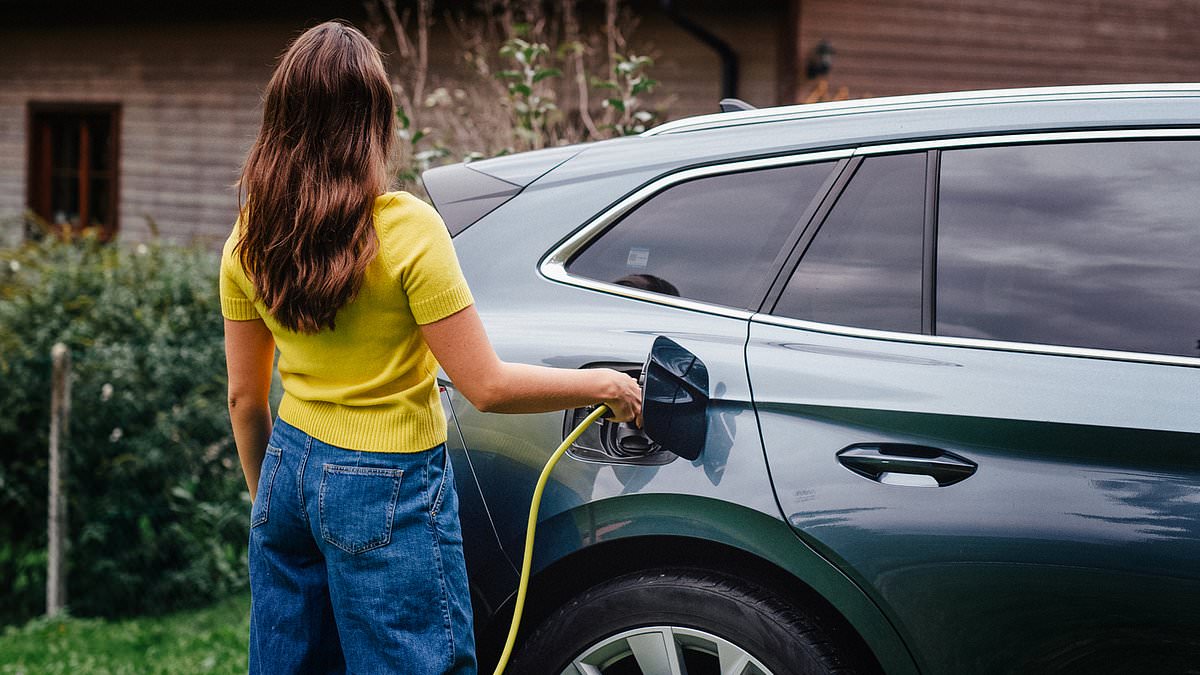
Ministers have been warned that the UK will fall short of its climate objectives if electric car sales targets are watered down.The independent adviser, the Climate Change Committee (CCC), last week wrote to Government officials warning that any relaxation of EV ambitions will carry 'economic and energy security costs' and leave households 'more exposed to volatile fossil fuel prices'.The letter to Transport Secretary Heidi Alexander states that a typical household would miss the opportunity to cut its costs by 'around £800 a year' if EV sales thresholds are weakened.This is Money has also seen calculations by Octopus Energy suggesting drivers could collectively miss out on tens of billions of pounds in savings by 2035 if the targets are eased.However, the motor industry's trade body has hit back at the CCC's intervention, claiming it ignores 'the damaging cost of the targets it defends'.It comes after weeks of speculation that the Government plans to reduce the number of EVs manufacturers must sell under the Zero Emission Vehicle (ZEV) mandate.The framework requires car makers to sell an increasing proportion of fully electric cars each year, a policy that has come under intense lobbying pressure from both manufacturers and the wider motor industry. The CCC has warned the Government that reducing EV sales targets would leave households up to £800 worse off a year and jeopardise Britain's ability to meet climate goals Currently, the ZEV mandate requires manufacturers to ensure 33 per cent of new car sales are fully electric this year, rising to 80 per cent by 2030.By 2035, all new car sales will need to be zero-emission.Companies that fail to meet their ZEV mandate face potential fines of £12,000 per car, although a number of exemptions apply.However, the Government is reconsidering these thresholds, having launched a review of the ZEV mandate in August following intense lobbying from car makers.While the outcome of the now-closed consultation has yet to be announced, the CCC argues that watered-down targets would create a shortfall in projected carbon savings that would have to be made up elsewhere if the Government is to meet its legally binding climate commitments.Join the discussionShould the government prioritize ambitious electric car targets even if it means higher costs for drivers and manufacturers now?What's your view?Climate targets for 2033 to 2037, known as the Sixth Carbon Budget, require Britain to cap total greenhouse gas emissions at 965MtCO2e (million tons of carbon dioxide equivalent) over the five-year period.That would require emissions to fall to around 77 to 78 per cent below 1990 levels by the middle of the next decade.The CCC stresses that the ZEV mandate plays a crucial role in achieving this, saying it 'underpins the largest share of emissions reduction to 2037' in the Government's net-zero strategy.It warns that 'without alternative action at the same scale', those targets will be missed.Surface transport, which includes cars, vans and lorries, remains the UK's highest-emitting sector, CCC analysis shows. It is also one of the slowest sectors to decarbonise.Lord Deben, the former CCC chairman, also highlighted the financial benefits for motorists in his letter, stating that a typical household can save up to £800 a year by switching to an EV.However, the Society of Motor Manufacturers and Traders (SMMT) rejected this argument, insisting the ZEV mandate is deterring investment and is unsustainable.Chief executive Mike Hawes said: 'A successful EV transition needs a strong market and a competitive industry. The CCC, however, ignores the damaging cost of the targets it defends: billions in unsustainable discounts and millions more in Government incentives, yet even with sky-high fuel prices, fewer than three in ten drivers will switch this year.'The industry cannot subsidise the transition indefinitely, which is why it is unified in seeking change.'He added: 'The pace [of the transition to EVs] should be market-driven – and it is worth noting that no major global market ahead of the UK has a mandate.'It must also support local manufacturing, avoiding reliance on imports, especially those with higher embedded carbon. We want to cut emissions, not shift them.'Contrary to the CCC's claims, the mandate is deterring local investment, as however much manufacturers export, without a strong local market there is no business case to build here.'Reform means making the transition work, not disregarding market reality as the CCC's assumptions do.'More broadly, the CCC's letter argues that the transition to EVs shields Britain from dependence on 'costly and volatile fossil fuel markets'.The letter also cites Department for Transport (DfT) impact assessments suggesting that cutting headline ZEV targets would increase UK fuel consumption by the equivalent of up to 15 million barrels of oil a year by 2030.At current prices, that would add more than £1billion to the nation's fuel bill.It also said loopholes in existing ZEV mandate rules have made it easier for Chinese newcomers to exploit the UK car market.Manufacturers earn ZEV credits by selling lower-emission vehicles that reduce their fleet-wide CO2 output against a benchmark set in 2021.However, for brands entering the market after 2024, including a number of Chinese car makers, the ZEV mandate instead uses a CO2 baseline calculated from the industry-wide average in the year before their arrival, giving them a distinct advantage over established manufacturers.A Government spokesman told This is Money: 'We remain committed to the phase-out of all new petrol and diesel cars by 2030 and to all new car and van sales being zero emission by 2035, as well as to our legally binding net-zero targets.'Our consultation on the mandate will not change this and will ensure we are taking a pragmatic and balanced approach to the ZEV transition.' Watered-down EV targets could cost drivers £29billionAnalysis by Octopus Energy, based on DfT and New Automotive figures, suggests UK drivers could collectively miss out on up to £29billion in savings by 2035, depending on how far the mandate is weakened.If the 2030 ZEV threshold is reduced from 80 per cent to 70 per cent, motorists would lose an estimated £12billion in potential cumulative savings from running an electric car over a petrol or diesel alternative, the company calculated.If it is cut further to 60 per cent, the total lost savings would rise to £20billion.And the bill could reach as much as £29billion if the 2030 target is slashed to just 50 per cent.Fiona Howarth, founder of Octopus Electric Vehicles, said: 'The ZEV mandate is ultimately about affordable driving.'Switching to an electric car can save drivers up to £1,400 a year, with those savings continuing for years. The question is not whether we can afford the transition, but how many people can benefit from it.'
Relaxed EV sales targets will see UK miss climate goals and cost drivers £29bn in lost savings, advisers claim
Full Article
Original Source
Read the full article at Dailymail →KhanList aggregates and links to publicly available news content. We do not host full articles from third-party sources. Always verify important information with original sources.