
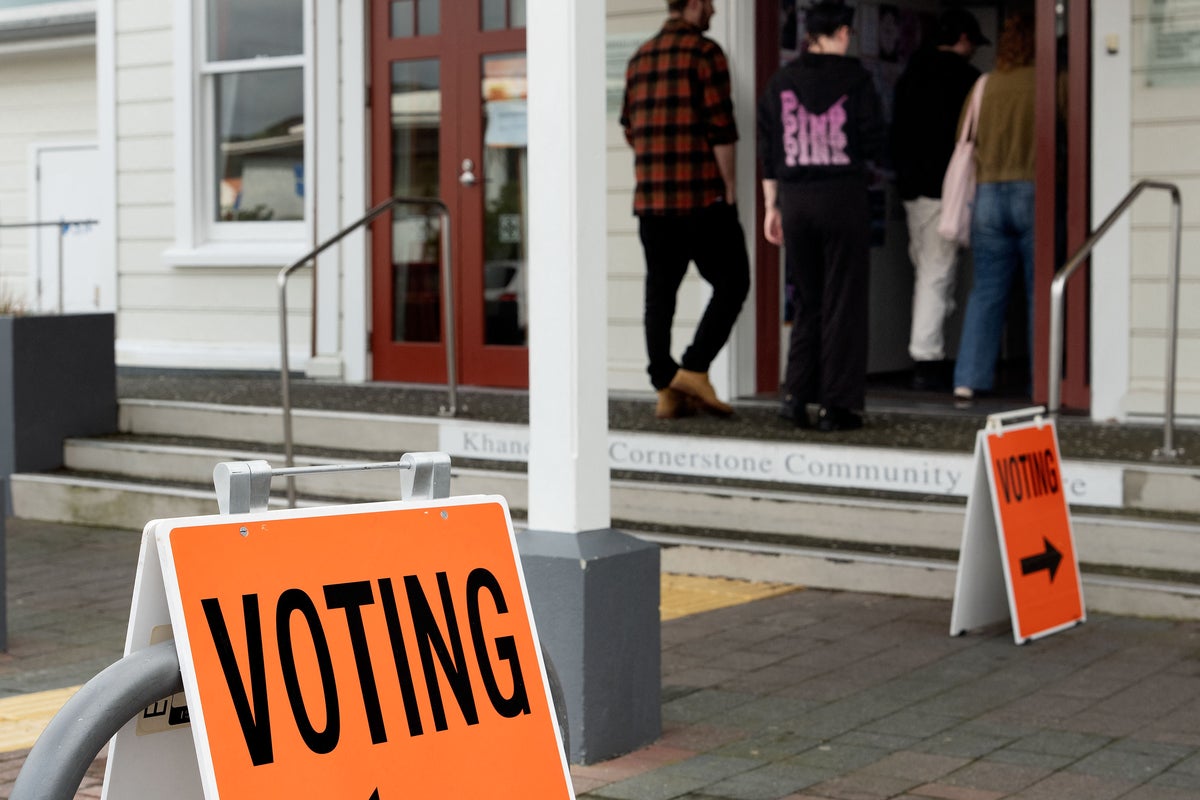
Early results of New Zealand’s general election show the ruling centre-right National Party and main opposition Labour in a tight deadlock, with no clear route to victory for either.More than 90 per cent of the votes had been counted in the election which began on 26 October and ended on Saturday, officials said. At last count, both parties were polling just short of 30 per cent of the popular vote, with only a few thousand votes separating them after an election that was defined by voter disillusionment with the two biggest contenders.The National Party is slightly ahead with 29.3 per cent of the vote as against Labour’s 29.1 per cent.Analysts noted that both parties would prefer a more comfortable margin even for negotiating shared governing arrangements with smaller players.Greens are currently at 13.3 per cent, ACT at 11 per cent, NZ First at 9.8 per cent, Opportunity at 5.9 per cent, and TPM at 6 per cent.Members of the public walk into a voting centre on election day at Khandallah Town Hall in Wellington (AFP/Getty)It appears that Christopher Luxon’s National Party and its minor party coalition partners, libertarian ACT and populist NZ First, may either win with the smallest possible majority or fall just shy as more votes are counted, according to data from the election commission.A coalition of National, ACT and NZ First parties could gain 65 seats in the 130-member legislature but this figure too was likely to change as the night progressed.On the other hand, the left bloc, led by Chris Hipkins and Labour and including the Green Party and the Indigenous group Te Pāti Māori currently seems on course for 58 seats.Labour party leader Chris Hipkins speaks to supporters (Getty)"Tonight New Zealand has spoken. It may take us a little bit longer to figure out what exactly it is that you've said,” Mr Hipkins said, addressing supporters on Saturday.In the lead-up to the election, it became clear from polls that voters had lost faith in the major parties amid frustrations over a sluggish economy and ageing infrastructure.Household budgets remained strained and unemployment rose to nearly 6 per cent in the third quarter, the highest it had been in New Zealand in over a decade.Opportunity Party leader Qiulae Wong reacts as she addresses supporters in Auckland (AP)The tight deadlock also means the country's smaller parties could participate more in a governing coalition.“I think it’s going to take some time before that becomes clear,” ACT leader David Seymour said when asked if the coalition led by the National Party would return to power.A relative newcomer, the Opportunity Party, led by 38-year-old former business consultant Qiulae Wong is expected to make its debut in the parliament with seven seats and may hold the balance of power.Nearly 95 per cent of the ballots are expected to be counted by Saturday night, but no new government will be formed until after official final results are released on 27 November.Special ballots, including from overseas voters, will not be included in the final count until this date.Overseas voters have historically favoured the left, meaning their votes will be crucial in races that remain tight between Labour and National candidates.
Relative newcomer may hold key to balance of power as New Zealand election goes down to the wire
Full Article
Original Source
Read the full article at Independent →KhanList aggregates and links to publicly available news content. We do not host full articles from third-party sources. Always verify important information with original sources.