
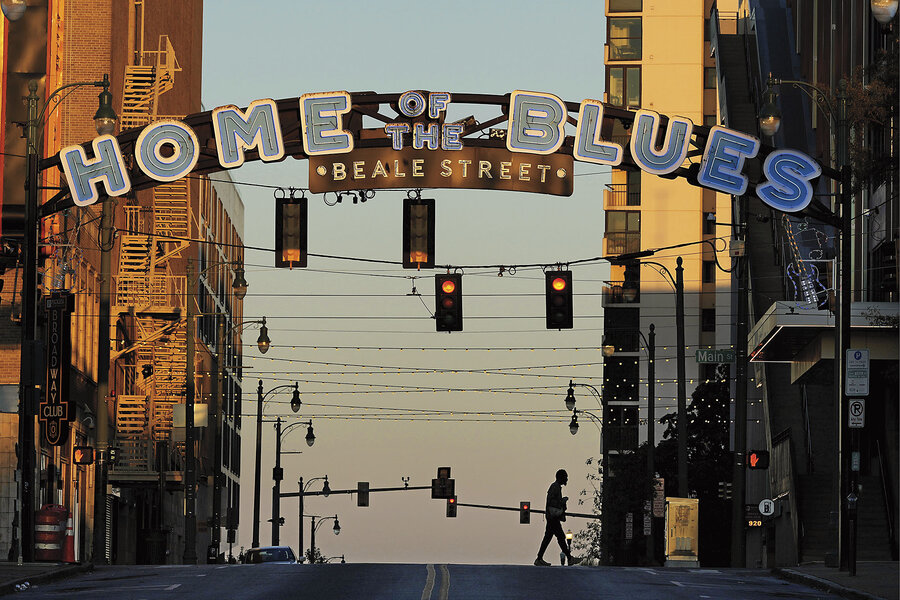
Memphis and Collierville, Tenn. | Oct. 08, 2026, 5:00 a.m. ET | 7 min read Winding south out of Nashville, the Natchez Trace Parkway runs through Middle Tennessee into northwestern Alabama, then plunges into the heart of Mississippi. It passes fields dotted with cattle, roadside churches, and blink-and-miss towns flying Confederate battle flags.It is a world that appears far from Memphis, a global logistics hub and trade gateway that has long served as Tennessee’s sprawling, eclectic economic engine.Memphis is the birthplace of Beale Street and the blues, and is home to FedEx, Graceland, Sun Studio, and the World Championship Barbecue Cooking Contest, where the smoke from pitmasters roasting whole hogs rises and wafts across the Mississippi River at dawn. It’s been hailed as a leading venue in Black entrepreneurship. These two Tennessees – the primarily white, conservative, and traditionalist rural one, and then the progressive, proud, and sometimes tumultuous river city – have for generations been reflected in Congress. As voters throughout the state sent conservative Republican representatives to Washington, Memphis, time and again, sent a Democrat. It was a political pattern so pronounced that locals call the round 9th Congressional District, which encompasses this city of more than 600,000, the “blueberry in a bowl of tomato soup.”But come Election Day this November, Memphis and the Trace will be newly linked. George Walker IV/APA person walks into a polling place to vote in a primary election in Memphis, Tennessee, Aug. 6, 2026. Flipping the scriptThis past spring, the Supreme Court, in its landmark Louisiana v. Callais decision, flipped the racial dynamics of Southern politics. What had been congressional protection for Black voting interests – a rule ensuring that majority Black Memphis was able to elect a representative of its own – was now read by the court as illegal racial gerrymandering.In short, says Shawn Donahue, a political scientist at the University at Buffalo in New York and a voting rights expert, “you can’t use race to draw or maintain Black majority districts, but you can use partisanship to dismantle them.” Republican lawmakers in Tennessee, prodded by the White House, jumped quickly and voted to split the 9th District among three redrawn districts with even Black representation: 29%, 29%, and 31%. The blueberry was now sliced into three elongated pie pieces.Those who supported the move say that, in addition to securing GOP dominance in a GOP-controlled state, this new congressional map better ties Memphis to its rural neighbors. Everyone in the region has an interest in helping the city, they say, where a long history of American music and riverside grit overlay urban problems such as stubbornly high crime in poor neighborhoods, low school achievement rates, and, at times, staggering poverty. The new map also gives voice to those who want a new approach.But many of those living in Memphis, as well as other Democrats throughout the state and region, see in the new map not just a politically problematic maneuver, but also a morally wrong one.Memphis’ 9th District had long been protected by the federal Voting Rights Act, which prohibited states from drawing maps that dilute minority voting power. This protection long ensured Black representation in a region marked by a history of racial oppression, where rural white electorates still rarely vote for Black candidates.Until now. “It’s very possible that you will have nobody from the city of Memphis representing the city of Memphis anymore [in Congress],” says Mr. Donahue. Sophie Bates/APA portion of Shotwell Street in Memphis, Tennessee, is now a dividing line between two newly redrawn congressional districts, May 7, 2026. What does representation mean?All of this has put Memphis at the epicenter of a national debate.Writing 250 years ago, in 1776, John Adams implied that the lower house of the legislature in the nation’s capital should be a cross section of America, people who represent the varied interests of the places they come from. This representative assembly “should be in miniature, an exact portrait of the people at large. It should think, feel, reason, and act like them,” he wrote. “Equal interest among the people should have equal interest in it.”But now, in 2026, what does representation in the United States really mean? The answer playing out here in Memphis has national implications.Since the 1960s, more people have been moving to the South than to any other region in the country. Because the U.S. shifts House seats every 10 years to reflect population changes, analysts, such as the Brennan Center for Justice, predict that the 2030 congressional reapportionment will give fast-growing states such as Texas, Florida, and Tennessee more representation, while slower-growing states such as California, New York, and Illinois will lose seats.That means a partisan tug-of-war between Republicans and Democrats for power in Washington will likely play out in places like Memphis. Gerald Herbert/AP/FileProtesters march on Jan. 28, 2023, in Memphis, Tennessee, after the death of Tyre Nichols, who died after being beaten by Memphis police. For years, court decisions reflected the concept that a liberal democracy has a responsibility to ensure that all people have a right to representation, which might require rectifying past wrongs. Doing so meant that politicians could not draw districts with the intent to disenfranchise any particular group. In the South, once the epicenter of American slavery and institutionalized segregation, this presupposed a particular responsibility to Black people, who still often faced repression and implicit discrimination. But recent Supreme Court rulings – and a growing coalition of policymakers and state lawmakers – envision a race-neutral democracy, or at least one that does not tip the scales against one race to favor others.Relevant remediesIn the 2013 Shelby County v. Holder ruling, in which an Alabama county argued that some of the 1960s-era remedies for racial oppression were outdated, Chief Justice John Roberts wrote for the majority that “things have changed dramatically” in the South.That meant, he wrote, that under the concept of “equal sovereignty,” it was not fair to continue subjecting specific states to extra screening for discrimination. In this and other decisions, the court also contends that all states should be protected by a presumption of “legislative good faith.”The more recent decision in Callais held that the political tool of gerrymandering, long practiced by both parties across the country to draw districts that benefit one party, could now be used to divide cities like Memphis.The recent gerrymander here in the Volunteer State has resulted in an awkward and somewhat counterintuitive situation in which the new 9th District runs longitudinally from parts of Memphis (a river city) and eastern Shelby County to Fayetteville (a ranch town) in rural Lincoln County, a drive of more than four hours and halfway across the state, south of Nashville. Steve Cohen, Memphis’ longtime Democratic U.S. representative, has called the move a “colonization attempt.” Representative Cohen is white, but before him the seat was long filled by Black Reps. Harold Ford Sr. and Harold Ford Jr. George Walker IV/APRep. Steve Cohen is a Democrat serving Tennessee. To be sure, Memphis voters will still elect city and county officials. The city has a Democratic mayor and a predominantly Democratic local government, reflecting a population that is roughly 63% Black – a demographic that has, in the modern era, largely voted Democratic. (Because Tennessee has open voter registration, exact numbers for party affiliation in Memphis do not exist.)But the city’s votes will now be more diluted when it comes to representing Memphis in federal elections. The old 9th District, Tennessee’s last remaining majority-Black and Democratic-leaning U.S. House seat, is now split in three, likely ensuring that Republicans will soon control all nine of the state’s congressional seats.Constituent interestsDirect representation in Congress, says Mr. Cohen, is hugely important – for national relationships, respect, and forging regional concerns into policy and necessary funding.Compromising that puts constituents’ interests at risk, he says. Mr. Cohen chose not to run again in his new district. But Democrats have not given up hope of overcoming the gerrymander with a “blue wave.”In August, local Democrats chose state Rep. Justin Pearson to run against Republican Brent Taylor in a district that, post-redistricting, the Cook Political Report shifted from “Solid D” for Democrats to “Solid R” for Republicans. George Walker IV/AP/FileState Rep. Justin Pearson, a Democrat, is running for the U.S. House in a newly gerrymandered district in Memphis, Tennessee. The majority-Black city is now split among three largely rural districts in which Republicans are favored. But the state’s decision might also push more people to the ballot box. In one poll, 64% of Black voters in Memphis said that the recent redistricting has made them more likely to vote in the upcoming midterms. This week, the Democratic Congressional Campaign Committee, the campaign arm for House Democrats, moved the race into its “Red to Blue” program, giving Mr. Pearson national organizational and fundraising support.Army veteran Willie Burton, asked about the potential impact of the redrawn district as he helped his wife into their car in East Memphis, said the newly gerrymandered district was discouraging.“They definitely won’t understand Memphis, which is where most of the Black people live,’’ says Mr. Burton. “A lot of people served this country, man, and just to see them do that, it’s bad. We are going through a lot, and it seems like it’s cutting our vote down.”Others, including Republicans who live on the outskirts of Memphis, say that the old form of representation failed the city. They are hoping for a change from the status quo of high crime and poor educational outcomes.“Yes, it’s partisan gerrymandering. But I feel like it’s also a sense of doing something to help Memphis,” says Bill Cox, a lifelong Republican who owns a gas station in downtown Collierville, a fast-growing, mostly white Memphis suburb. “Memphis is hard ... but the representation that they’ve had up to now has not helped.” Not far away, on the west side of Memphis, lifelong resident Greg Kinsey says he sees the opportunistic map-drawing across the U.S. and here in Tennessee as part of an upwelling of societal change, from technology to politics.The key, he says, is to stay engaged. Deepen your worldviewwith Monitor Highlights.Politics with respectGet political stories with respectful analysis.There‘s a world of new ideas in everyBooks newsletter.There‘s more to life, enrich yours withCulture & Learning weekly.Follow humanity‘s discoveries withScience & Nature stories in your inbox.Gain a spiritual perspectivefrom the stories in your inbox.Want to understand the deeper impact of critical events? Learn the Monitor‘s insight.Already a subscriber? Log in to hide ads. “They’re looking at Memphis from a distance. But in order to really understand what’s going on here, you’ve got to be from this area,” says Mr. Kinsey, who works at a Memphis car dealership.“So [redistricting] is going to change some dynamics. It’s going to be good. It’s going to be bad. There’s two sides of every coin.” ALREADY A SUBSCRIBER? LoginReal news can be honest, hopeful, credible, constructive.The Christian Science Monitor was founded in 1908 to lift the standard of journalism and uplift humanity. We aim to “speak the truth in love.” Our goal is not to tell you what to think, but to give you the essential knowledge and understanding to come to your own intelligent conclusions. Join us in this mission by subscribing.
Redistricting that cracked Memphis raises questions about the meaning of representation
Full Article
Original Source
Read the full article at Csmonitor →KhanList aggregates and links to publicly available news content. We do not host full articles from third-party sources. Always verify important information with original sources.