
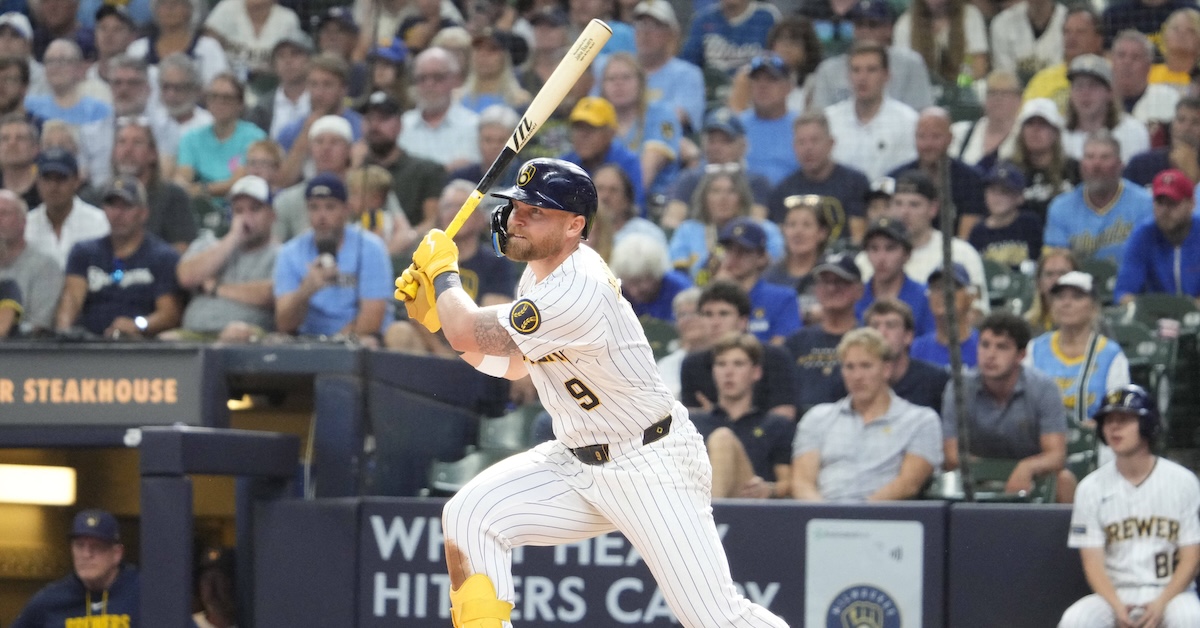
Michael McLoone-Imagn Images Last year, Pete Alonso was second among free agent hitters in wRC+ and seventh in WAR. He signed with the Orioles, entering his age-31 season, for five years and $155 million. In this year’s class, Jake Bauers — another first baseman entering his age-31 season — was second in wRC+ and fifth in WAR in his walk year. The Red Sox jumped on Bauers early in free agency, signing him to a four-year, $58 million contract on Friday. That looks like a huge bargain at first glance. The big risk with sluggers on the free agent market is that they’re often bottom-of-the-defensive-spectrum guys in their early 30s, and players like that tend to age poorly. The Red Sox not only got Bauers for less term than Alonso, but they shelled out less than half of the money per year. An AAV of $14.5 million isn’t cheap, but it’s basically the cost of a good setup guy, plus tax and tip. This for a dude who just finished seventh among qualified hitters in wRC+ and third in OBP, and hit in the middle of the order for the World Series champs. Bauers was one of the best human interest stories in baseball in 2026. After spending the best part of a decade bouncing around the big leagues as a journeyman first baseman/backup corner outfielder, he contemplated retirement two offseasons ago, having reached the reasonable conclusion that he’d gone as far as his talent would take him. He’d planned on being a stay-at-home dad, while his wife went back to work. Those plans went out the window when his wife got pregnant with the couple’s second child. With another baby on the way, they needed health insurance, so Bauers dusted off his spikes and went back to the coalface. Out of nowhere, Bauers became one of Milwaukee’s most important players. He hit .266/.389/.484 in the regular season, with 26 home runs in 144 games. A pair of marathon at-bats in the NLCS won him MVP honors in that series and… you know what? Let’s watch Bauers squeeze Blake Snell for 11 pitches until he got something he could hit for a go-ahead home run. You’ve seen it before, but it bears rewatching: Then came a five-game World Series victory over Tampa Bay, then free agency, and now the biggest payday of his life. From 2018 to 2024, Bauers hit .208/.302/.361 with a 29.2% strikeout rate in 1,744 plate appearances. That’s simply not acceptable for a major league first baseman, even a part-timer. Under normal circumstances, I wouldn’t go within 50 miles of a player who hit like that in his 20s and put up one great walk year campaign at age 30. It’s not just amazing to me that Bauers had this breakout campaign after hitting (or not hitting) like he did for so long. I’m amazed he was still in the majors to get the opportunity. So was he, by the sound of it. But the Brewers built their championship team on developing players at the major league level. Bauers, Brice Turang, Aaron Ashby, Andrew Vaughn — even franchise prospects like Jackson Chourio and Jacob Misiorowski made big waves when they got to the big leagues, only to take another leap once there. And Bauers’ underlying numbers point to major growth in the past two seasons. He’s a more disciplined hitter than he was before; he set career lows for both swing rate (40.5%) and zone swing rate (61.9%) in 2026. He’s also hitting the ball much harder than before: From 2018 to 2024, Bauers posted an EV90 of 104.3 mph, which was 212th out of 425 batters with at least 1,000 plate appearances. This past season, he had an EV90 of 107.5, 22nd out of 135 qualified hitters. His hard-hit rate, 51.9%, was 11th, one spot ahead of Shohei Ohtani. Bauers has never provided much with his legs or glove, but he battled shin splints and a fractured big toe down the stretch in 2026, which took his defensive numbers at first from mediocre to bad, and reduced his ability to play the odd game in an outfield corner. Still, Bauers was one of the premier on-base guys in the league in 2026, and while most career years involve some degree of good fortune, Bauers only outperformed his xwOBA by 10 points. There’s plenty of risk in any four-year contract for a first baseman without elite power, but I don’t think Bauers’ 2026 campaign was a fluke. He’s legitimately a very, very different player than he was two years ago. Add to that Bauers’ postseason heroics — remember, he also hit a massive postseason home run for the Brewers in the 2024 NL Wild Card series — and the fact that nobody on the Brewers seems to have a bad word to say about the guy, and all of a sudden you start to wonder why Milwaukee didn’t even think about bringing him back. Bauers made the putout on the final play of the World Series, and when he presented the ball to manager Pat Murphy after the game, Murphy made an immediate allusion to Bauers leaving in free agency. The Brewers extended a qualifying offer to Bauers after the World Series, but everyone seemed to have taken for granted that he was on his way out. Why? I know the Brewers don’t exactly spend like Real Madrid, but $14.5 million per year is affordable even for an NL Central team. The Red Sox gave him that much money before Thanksgiving, and because of that qualifying offer, hobbled their amateur player acquisition in order to do so. Despite running a payroll of just over $200 million in 2026, the Red Sox are on course to pay the luxury tax this season, according to RosterResource, thanks to a bunch of front- or back-loaded contracts that led to a much higher tax liability than their real-world wage bill in 2026. Therefore, that qualifying offer is going to cost the Red Sox their second- and fifth-highest draft picks, plus $1 million in international bonus pool money, assuming there’s no radical change to the system after the lockout that features an amnesty for free agents signed under the current CBA. I’m also leery in general of long-term commitments to first base types (acknowledging here Bauers’ ability to stand in an outfield corner without posing a threat to public safety) who lack high-end power. Bauers will run into one every so often, and he hits oodles of hard line drives, but even in his annus mirabilis, he only hit 26 dingers, which more than doubled his career high. Bauers is the 21st free agent since the 2022-23 offseason to sign a multi-year contract heading into his age-30 season or older, with zero listed ability to play anywhere but DH, first base, or the corner outfield positions. Here’s the full list, along with their performance under those contracts: Comparable Free Agents Since 2023 Name Year Signing Team Years Total Salary AAV G wRC+ WAR Jake Bauers 2027 BOS 4 $58,000,000 $14,500,000 TBD TBD TBD Kyle Schwarber 2026 PHI 5 $150,000,000 $30,000,000 156 130 2.9 Pete Alonso 2026 BAL 5 $155,000,000 $31,000,000 161 148 5.0 Ryan O’Hearn 2026 PIT 2 $29,000,000 $14,500,000 110 109 0.6 Anthony Santander 2025 TOR 5 $92,500,000 $18,500,000 54 61 -0.9 Jurickson Profar 2025 ATL 3 $21,000,000 $7,000,000 80 123 1.9 Teoscar Hernández 2025 LAD 3 $66,000,000 $22,000,000 259 105 1.9 Christian Walker 2025 HOU 3 $54,000,000 $18,000,000 310 101 2.8 Joc Pederson 2025 TEX 2 $37,000,000 $18,500,000 232 107 0.7 Pete Alonso 2025 NYM 2 $54,000,000 $27,000,000 162 140 3.5 Lourdes Gurrel Jr. 2024 ARI 3 $42,000,000 $14,000,000 313 94 2.0 Jorge Soler 2024 SFG 3 $42,000,000 $14,000,000 310 103 0.3 Hunter Renfroe 2024 KCR 2 $13,000,000 $6,500,000 155 81 -0.9 Rhys Hoskins 2024 MIL 2 $34,000,000 $17,000,000 221 104 1.1 José Abreu 2023 HOU 3 $58,500,000 $19,500,000 176 72 -2.0 Mitch Haniger 2023 SFG 3 $43,500,000 $14,500,000 182 81 -1.2 Anthony Rizzo 2023 NYY 2 $40,000,000 $20,000,000 229 117 3.3 Matt Carpenter 2023 SDP 2 $12,000,000 $6,000,000 76 85 -0.4 Josh Bell 2023 CLE 2 $33,000,000 $16,500,000 295 103 0.3 Trey Mancini 2023 CHC 2 $14,000,000 $7,000,000 79 75 -0.8 Michael Conforto 2023 SFG 2 $36,000,000 $18,000,000 255 105 2.1\ Free Agents signed to multi-year contracts, age 30 or older, 1B/RF/LF/DH-only, past four seasons This is a pretty bleak group. Admittedly, I’ve made it more so by setting the criteria in a certain way. Go back one year further into the past and you pick up Freddie Freeman. Add players who have the ability to play center field occasionally and you add Aaron Judge. Lower the age threshold and you get Kyle Tucker and Juan Soto. But I don’t think the Red Sox, or even Bauers himself, would say that those are appropriate comparisons. There are two absolute, no-doubt slam-dunk wins on this list of contracts: Alonso in 2025 and 2026. I’d say that Schwarber this year and Rizzo in 2023 basically held serve. Downstream of that, the range of outcomes goes from mediocre to comprehensive disaster. Obviously, one or two of these cases involve a physical or moral breakdown (or, in Santander’s case, both!) that I don’t anticipate for Bauers. But for a player of Bauers’ position and offensive profile, this is going to be a really difficult needle to thread. Basically, the Red Sox, and president of baseball ops Craig Breslow, are betting that Bauers hopped off of Rico Brogna’s career path and onto Freeman’s career path around the time he turned 30. Based on his underlying numbers in 2026, that’s not a completely insane conclusion to draw, but make no mistake: That’s what the Red Sox are going to need to happen in order to get their money’s worth. If Bauers chips in 20-odd homers and a slugging percentage in the mid-to-high .400s, that’d be helpful, but it’s not the kind of game-breaking power the Red Sox need. Last season, Boston was 26th in the league in homers and 20th in slugging percentage. As an overall offense, they were 17th in wRC+ and 23rd in runs scored. I think it’s fair to expect some improvement naturally; a torn finger ligament limited Roman Anthony to 55 games. Deadline acquisition Curtis Mead slugged an even .500 with 17 homers in 88 games for Washington, and broke his wrist in his second at-bat in a Red Sox uniform. Boston’s other big midseason pickup, Adley Rutschman, is immeasurably more capable at the plate than what he replaced; having a full season of him will be helpful. But the White Sox had more 30-home run hitters in 2026 than the Red Sox have had in the past five years put together. Boston’s had one 40-homer season, total, in the past 20 years. That’s not likely to change on Bauers’ account. Despite that paucity of power, the Red Sox also have very little need for help at the positions Bauers is capable of playing. They already have a pair of terrific young corner outfielders in Anthony and Wilyer Abreu, plus an All-Star first baseman, Willson Contreras, who’s coming off the best season of his career. Contreras, 34, is due to make $17 million in the final guaranteed year of his contract, with a $20 million team option (against a $7.5 million buyout) for 2028; at that price, he’d be worth keeping even if he doesn’t quite repeat his 2026 campaign. That leaves DH open, assuming Breslow can divest his team of Jarren Duran and Masataka Yoshida. Neither should be impossible to trade; Duran was a headache last year, but he produced 11.0 WAR across 2024 and 2025. Yoshida has one year and $18 million left on his deal, which, man, if you ever wanted an object lesson in the risks of making a long-term commitment to a first baseman without elite power, this is it. Still, with one year remaining that isn’t an unworkable salary to eat, either in a trade or by releasing Yoshida altogether. That said, the current Red Sox depth chart has 34-year-old Trevor Story at short. Just a couple days ago, Breslow hinted that Story might not be Boston’s starting shortstop for long. Maybe that means a trade. If it means a change of position, that would displace Mead from second base, either directly or at the end of a Rube Goldberg-style infield realignment with Caleb Durbin in the middle. In his four-year big league career, Mead has made 99 starts at third base, 42 at first base, and just 36 at the keystone. Even in an ideal world, I don’t know if you’d want Mead playing up the middle, but the Red Sox seem to have built a roster entirely out of first basemen. Again. OK, Yoshida was Chaim Bloom’s boondoggle, not Breslow’s, but still. Didn’t we just do this? Didn’t Breslow just have to ship off Rafael Devers because he loaded up on corner guys without a real plan on how to get them all on the field at the same time? And just as that logjam started to clear, Breslow went out and traded for Mead and signed Bauers, and here we go again. The odds of this contract being an utter calamity are pretty low. The Red Sox even front-loaded the deal, which is a smart play for a rich team. That’ll make Bauers easier to dump in two or three years if he does turn back into a pumpkin. Four years for a first baseman with one 20-homer season might be a slap in the face for the actuarial tables, but if you can get a guy who just posted a .389 OBP with good underlying numbers for $14.5 million a year, you do it, and figure out the rest later. But “figure out the rest later” isn’t just a filler clause. There’s quite a lot left for Breslow and his lieutenants to figure out, and they haven’t exactly earned the benefit of the doubt.
Red Sox Ink Jake Bauers, Start Whole New First Base Logjam
Full Article
Original Source
Read the full article at Blogs →KhanList aggregates and links to publicly available news content. We do not host full articles from third-party sources. Always verify important information with original sources.