
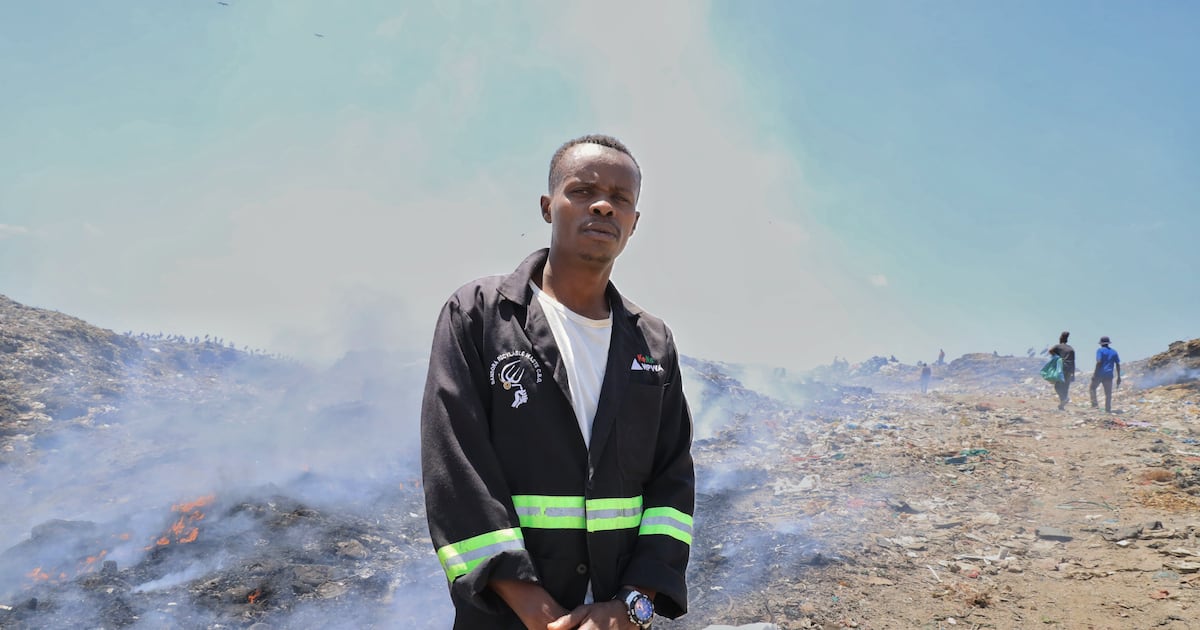
Workers risking their lives to forage through the vast Dandora dump are finding fewer items of value they can sellSolomon Njoroge campaigns for waste pickers at the Dandora dumpsite, on the outskirts of Nairobi. Photograph: Hannah McCarthy Marabou storks circle the smoke-filled sky as a 12-year-old boy returns from the top of a hill of smouldering waste carrying plastic sheets he gathered at Dandora, a sprawling 30-acre dumpsite in the eastern suburbs of Nairobi. An estimated 2,000 tonnes of waste arrive at the Dandora dumpsite in Kenya every day, where it is sorted by local waste collectors. Video: Hannah McCarthy Casey says that for the past six years he has spent most afternoons foraging through waste after finishing classes at a local primary school that shares a crumbling wall with Kenya’s largest dumpsite. Receiving nearly 2,000 tonnes of domestic and industrial waste every day, Dandora sits at the epicentre of a fragile local economy that sustains an estimated 300,000 people living around the dumpsite. The UN estimates that 20 million people around the world rely on collecting, sorting and selling waste for their incomey. At the top of one of Dandora’s rubbish-filled peaks, about a dozen people are sorting through fresh waste unloaded by a truck operated by a private waste company. READ MOREAmong the waste pickers are Peter (26), who started working in Dandora in 2020, and his 22-year-old cousin who has been working here since 2023. They typically work 10 hours a day from 7am, six days a week, for which they earn the equivalent of €4 a day. Casey spends most afternoons foraging through waste after finishing classes at a local primary school. Photograph: Hannah McCarthy Peter has been working at the dumpsite for six years. Photograph: Hannah McCarthy Apart from a few workers wearing gloves and rubber boots, most waste collectors today are working without basic protective clothing or equipment for dealing with hazardous waste or the acrid and carcinogenic fumes from burning plastic. Near one of Dandora’s entrances, a group of women gather for their lunch break beside large bags filled with waste such as glass bottles, scrap clothing, plastic and food containers, which they are sorting through. One 45-year-old woman introduces herself as “queen of the dumpsite” – “my name is spelt ‘Q-U-E-E-N”. She is from neighbouring Korogocho and has worked at Dandora for 20 years. Beside her is Jane Wangechi (30), a single mother who has worked at the dump since she was a teenager. Wangechi’s two children work alongside her at weekends.According to recent data from the Strategic Sector Co-operation on circular economy and waste management between Denmark and Kenya, most waste pickers at Dandora have a primary-level education and care for an average of three or more children, often as single parents.The ‘queen of the dumpsite’ and Jane Wangechi. Photograph: Hannah McCarthy Solomon Njoroge (36), became a waste picker at 14 when his single mother could no longer afford to pay for his school fees. No longer a waste picker, Njoroge is speaking in the Dandora office of his organisation Nairobi Recyclable Waste Welfare Association. “Twenty years ago there were a lot of valuables in the dumpsite, but now segregation is done at source and less valuables come to the dumpsite,” says Njoroge. “Most of the waste, it is waste indeed ... You cannot get much valuables in it.” A combination of improved recycling technology and new regulations requiring manufacturers in Kenya to take more responsibility for the waste they produce, means that less valuable waste is arriving at Dandora for pickers to sort through and sell on to farmers, recycling aggregators and other private companies. Children in the Gitari Marigu neighbourhood next to the Dandora dump. Photograph: Hannah McCarthy Njoroge provided assistance for a 2025 study in which 86 of 100 pickers said their economic situation had worsened “due to increased competition, reduced recyclables from presorting, fewer truck arrivals and rising living costs”.“Many people are losing their jobs,” says Njoroge, who campaigns for better conditions for waste pickers in Dandora, which is owned by the Nairobi county council. “We are also trying to mobilise as many members as we can, so that we can have a solid union,” he says. “As a waste picker, you need to understand your role, your contribution, because many people look down on the work that you do dealing with waste.” Waste pickers are routinely exposed to industrial and medical waste, which is illegally dumped at Dandora. Respiratory illnesses such as asthma and tuberculosis are rife among workers at the dumpsite, as well as skin infections and waterborne diseases such as diarrhoea and typhoid. Njoroge says many of the workers are exposed to chemicals such as methane and lithium from batteries without understanding the risks they face from them. “Some people die without knowing what has killed them,” he says.Respiratory illnesses are common among workers. Photograph: Hannah McCarthy One third of waste pickers are estimated to be members of associations or organisations that can support them. “It is important for waste collectors to be more organised because most of our jobs have been taken by cartels and well-organised individuals who have money and who know [that], in the waste management sector, there are a lot of opportunities,” says Njoroge. “If we don’t get organised, they will get organised ... and we are going to be excluded for good.”With support from the Danish government, Njoroge’s organisation recently organised training for a cohort of waste collectors from Dandora on techniques to create products and compost from recycled waste. Njoroge is also eager to explore a more ambitious plan for a collective of local waste pickers to acquire their own land in Nairobi. With the right investment, Njoroge says these workers could manage their own waste collection activities and be involved in more valuableaspects of recycling and waste disposal. “It is not like we are just collecting for fun,” says Njoroge. “It is a business ... it can be improved.”simon cumbers – Hannah McCarthy’s reporting was supported by the Simon Cumbers Media FundIN THIS SECTION
Recycling boom forcing Kenya’s waste pickers to fight for their future
Full Article
Original Source
Read the full article at Irishtimes →KhanList aggregates and links to publicly available news content. We do not host full articles from third-party sources. Always verify important information with original sources.