
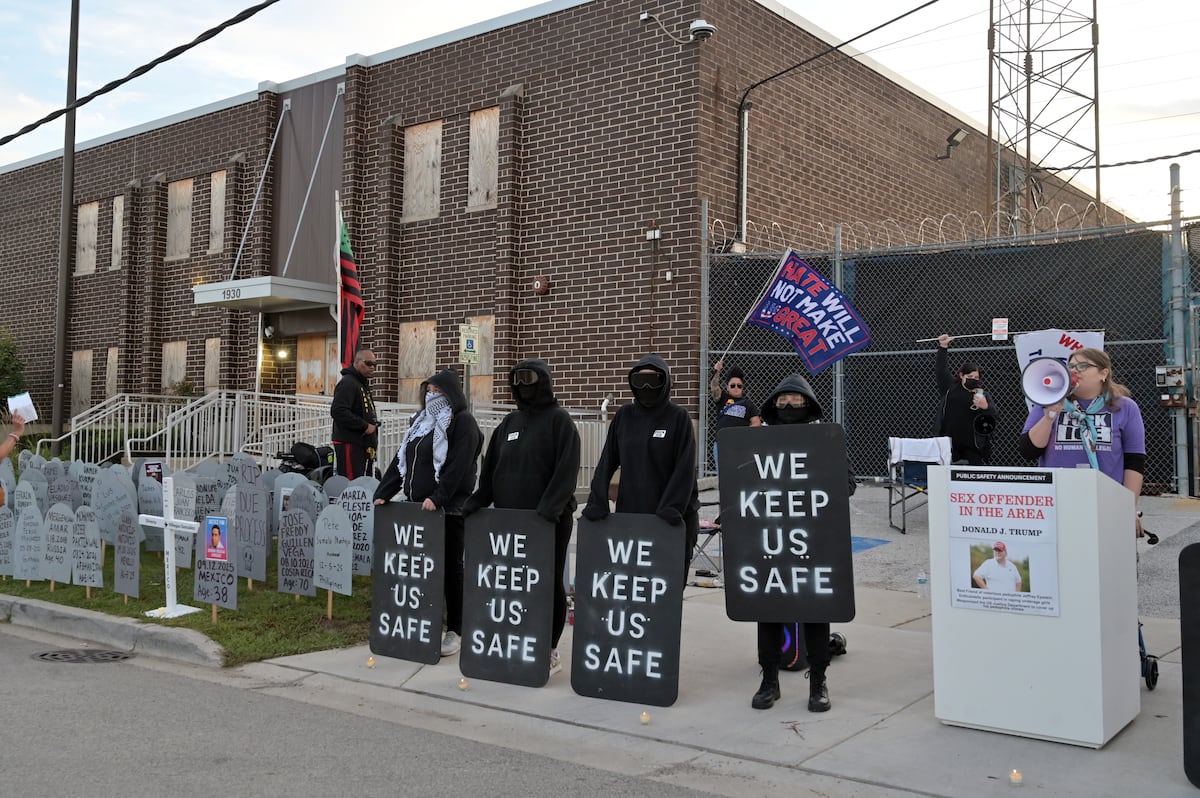
It is a less visible aspect of President Donald Trump’s immigration offensive. But more than 60 people have died behind the walls of immigration detention centers since the Republican returned to the White House for a second term.Medical neglect, physical abuse, excessive punishment, lack of food, filth, contaminated water and a system of mistreatment designed to pressure undocumented people to accept deportation. The list of alleged human rights violations at the over 170 jails run by U.S. Immigration and Customs Enforcement (ICE) and its contractors is extensive.As the number of detained migrants rises, the Trump administration has minimized oversight of these facilities and has at times left verification of conditions to the very multimillion-dollar companies that operate them. Democrats, who will regain control of Congress in January, have pledged to step up scrutiny of ICE jails and put an end to abuses.Democrats have faced obstacles carrying out surprise inspections of these centers and have had to turn to the courts to defend their right to enter without prior notice. That has been the stage for another prolonged showdown between the Trump administration and its congressional opponents. The conflict worsened when the government shut the doors to lawmakers by adopting a policy requiring visits to be requested several days in advance. That requirement, which is no longer in force, limited their ability to see firsthand what was happening in these facilities.“We’ve heard horrific stories: people not receiving medication, not enough food, and the list goes on,” California Congressman Robert García said in October. García is poised to chair the House Committee on Oversight and Reform. After the Democrats’ decisive midterm victory, the Long Beach representative vowed to put the Department of Homeland Security (DHS) — and in particular ICE agents, whom he says he has documented for more than 1,000 abuses — and the facilities that hold migrants under increased scrutiny.In early October, García visited, with other Democratic lawmakers, one of the centers with the highest death tolls during Trump’s second term: Adelanto, in California’s high desert. The four deceased at the facility were Mexican. Upon entering, the congressman was surprised to hear administrators repeat the president’s narrative. “They told us that most people at Adelanto had criminal records, when we know that is not true,” he said.Weak government oversightAnother detention center expected to face increased scrutiny starting in January is Eloy, Arizona, where at least two migrants have died since early 2025. Representative-elect JoAnna Mendoza, whose district includes that facility, is also calling for stricter oversight.“We need clear audits in the detention centers,” Mendoza told EL PAÍS in an interview in August. “Some of these centers are audited by private companies. How can we be sure those audits aren’t being falsified? We need oversight of all this,” she insisted.Nearly two years into Trump’s immigration offensive, oversight mechanisms for ICE jails have weakened. A report published two days after the midterms by the Government Accountability Office (GAO), an independent agency that works for Congress, notes that, through last June, two of the four entities charged with inspecting those centers had reduced their visits or had stopped them altogether.ICE’s own Office of Detention Oversight (ODO) decreased the frequency of its reviews. The Office of the Immigration Detention Ombudsman ceased inspections due to budget cuts and a significant reduction in staff. The other two entities, which maintained their activities unchanged, are the ICE-dependent Institutional Health Services Corps (IHSC) and the Department of Homeland Security’s Office of Inspector General (OIG).The GAO report cites a March 2025 memorandum approved by the then–acting ICE director that formalized reduced regularity of ODO inspections and expanded self-inspection mechanisms. The measure aimed to reduce administrative burdens on private operators of the centers. In other words, the companies themselves would be responsible for monitoring.However, the GAO report warns that the lack of inspections by government officials makes it difficult to identify “deficiencies in their facilities, including those related to the health, life, and safety” of detained migrants.In a statement sent to EL PAÍS, a DHS spokesperson said ICE is subject to periodic audits and inspections by external bodies to ensure its centers meet standards. The spokesperson also said migrants in its custody receive three meals a day, potable water, clothing, access to showers, personal hygiene items, and comprehensive medical care.“ICE enforces stricter detention standards than most U.S. prisons,” the spokesperson said, without directly addressing the warnings from members of Congress that there would be greater scrutiny.A profitable businessImmigrant incarceration has become a lucrative business. During fiscal years 2025 and 2026, ICE received more than $45 billion allocated exclusively to immigration detention. The agency also expanded its network of facilities: it operated 128 in April 2025 and 172 last April, a 34% increase. Meanwhile, it holds about 67,000 people in custody, a 71% rise compared with the start of Trump’s second term.The equation is simple for ICE contractors: more occupied beds means more money. GEO Group, operator of about 20 immigration detention facilities — including Adelanto — currently houses roughly 20,000 migrants in its centers. After the midterms, the publicly traded company celebrated a financial milestone: it announced year-to-date revenue had surpassed $2 billion, a figure it had not reached since it began operating in 1984.The tie between GEO Group and Trump goes beyond the multimillion-dollar donations the company has made to the president’s campaigns and to political organizations that support his movement. Three officials who have held prominent posts in the current administration were on its payroll. Before becoming attorney general, Pam Bondi worked as a lobbyist for GEO Group. David Venturella, the current acting ICE director, was a company executive for 11 years. And Tom Homan, Trump’s border czar, was a paid consultant to one of its subsidiaries.Another company that has benefited from aggressive immigration raids is CoreCivic, which has also made multimillion-dollar contributions to Trump. The company earned an additional $1.5 billion from the sale of two California jails to ICE — one in San Diego and another in California City — both sites flagged by allegations of mistreatment and abuse. The federal agency agreed that CoreCivic would continue to operate the facilities while the contracts remain in effect.“Big corporations and billionaires have profited from every human being sent to these horrible facilities across the country,” Congressman Robert García said in October.GEO Group did not respond to a request for comment from this outlet. A CoreCivic spokesperson, however, said in a written statement that the company has worked with the federal government for more than 40 years under administrations of both parties. “We have always welcomed oversight of our work, and that has not changed,” the spokesperson said.The case of UlisesHolding ICE contractors accountable is not easy. Laura Murchie, an attorney with Disability Law United, compares that struggle to David versus Goliath. “It takes a whole team of lawyers to try to get GEO Group and CoreCivic to answer for their actions,” she told EL PAÍS. “It’s difficult for affected people, and even for the lawyers handling their cases, to get them to assume responsibility,” she added.In July, Murchie launched a legal battle against both companies, ICE, DHS, and the Trump administration. She represents Ulises Peña López, a Mexican immigrant with special needs who, according to a lawsuit filed in the Northern District of California, was the victim of “a violent arrest” by ICE agents in Sunnyvale in February 2025.The complaint alleges ICE officers took Ulises to a secluded alley where they beat him until he lost consciousness, requiring cardiopulmonary resuscitation. Paramedics rushed him to a hospital, but before he recovered, federal agents took him into custody. He spent six months detained in GEO Group and CoreCivic facilities before being deported in October of that year to Mexico, his native country. He now lives there, separated from his wife and young daughter.“During his detention, the necessary accommodations for his disabilities were not made. As a result, he continues to suffer harm primarily stemming from the mistreatment he endured while in custody,” Murchie says.The aftermath has affected Ulises’s daily life and employment prospects: in Mexico he is now limited to part-time work. In California he earned a living in construction.“After the violent arrest he suffered loss of vision and hearing, as well as numbness and paralysis on the right side of his body, affecting his mobility. He needs a cane to walk and suffers severe headaches,” the attorney explained.The lawsuit seeks compensation for the physical and emotional damages Ulises suffered. His return to California is not among the remedies requested in the case, because, his lawyer explains, they consider that a lost battle. Murchie acknowledges the litigation will be an uphill struggle, largely because of the power and influence of ICE contractors. “We are talking about multibillion-dollar companies,” she stresses.Sign up for our weekly newsletter to get more English-language news coverage from EL PAÍS USA Edition
Record revenues, over 60 deaths, and little oversight: Democrats target Trump’s immigration jails
Full Article
Original Source
Read the full article at English →KhanList aggregates and links to publicly available news content. We do not host full articles from third-party sources. Always verify important information with original sources.