
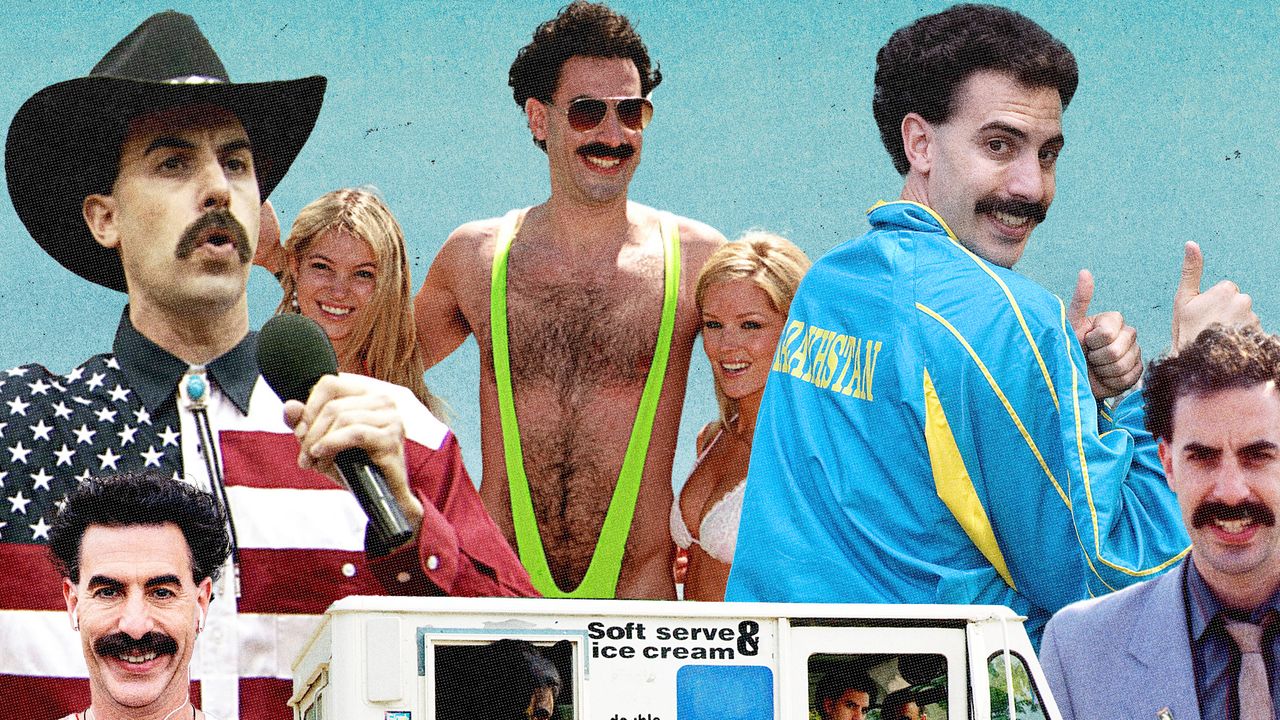
Sacha Baron Cohen's proudly inflammatory Kazakh journalist was a cultural phenomenon in 2006. The actor's subsequent output, including his new Ali G follow-up, suggest it might've been his peak.Everett Collection; GQLast month, I sat in a packed-to-the-gills movie theater to experience the latest release from a controversial comedian whose work regularly blurs the line between docu-reality and narrative fiction. I am, of course, referring to Ali G: Who Iz I?—the cinematic return of Sacha Baron Cohen’s once-and-still-somewhat-beloved durag-doffing titular character.Before the film was unceremoniously dumped on Prime Video last week, I managed to snag a ticket to the only New York City screening that wasn’t totally sold-out, booking a seat—last row, tucked in an alcove of the theater—with the intention of isolated note-taking and (gasp!) the occasional phone-glance should the movie prove tedious. The recliners next to me were eventually claimed by a gentleman decked in a very Ali G-esque skull cap and wraparounds, who unleashed a deafening “BOOYAKASHA!” after Nicole Kidman’s AMC intro.Cohen’s brand of confrontational cringe comedy continues to attract a level of interest, thanks in part to a certain mustached-and-mankini’d Kazakh journalist. The cultural explosion that was Borat! Cultural Learnings of America for Make Benefit Glorious Nation of Kazakhstan (has any movie title so padded the word count?) turns 20 years old this week, and it remains a curious artifact of the 2000s: impossibly dated and slightly better than you might remember, even as its creator’s talent has slowly and unmistakably eroded.If you were just old enough to purchase a ticket to an R-rated movie in 2006, Borat felt like a truly out-of-nowhere phenomenon in terms of mass impact. But the character, armed with little more than a shabby suit and an aggressive cheer, emerged from Cohen’s cult favorite Da Ali G Show, which ran for one season on BBC’s Channel 4 in 2000 before making the leap to HBO in 2003. Alongside Ali G and the gay Austrian fashion correspondent Brüno, Borat Sagdiyev was just one of the many personalities Cohen regularly deployed in the thorny thickets of gotcha-mentary, trading in culturally oblivious and antisemitic observations supposedly inherited from his Kazakh homeland, often to the shock and dismay of his unsuspecting subjects.These fool-me-once hijinks weren’t necessarily groundbreaking, even for HBO’s then-provocative late-night programming. Several years prior, The Chris Rock Show engaged in similar man-on-the-street shenanigans (once, he polled residents of NYC’s notoriously hate-crime-prone Howard Beach region about renaming a street after Tupac Shakur). But segments in which Ali G addressed Buzz Aldrin as Buzz Lightyear, or the one where Borat led a bar full of Arizonans in a rousing chorus of “Throw the Jew Down the Well,” were practically reverse-engineered for virality in the internet’s pre-social-media infancy, and the appeal of Cohen’s approach—how far will he go, and will ordinary folk follow him?—was easy to understand, regardless of the visceral discomfort it may have generated.Straying from the sketch-based format of Da Ali G Show, Borat embraced a loose narrative structure, with its titular inquirer setting out for America to make a documentary on the country’s social peccadilloes with the intent of eventually romancing Pamela Anderson. If you want to get highfalutin about it, the plot itself situates Borat within the legacy of films about Europeans attempting to understand America—a small-but-fascinating subgenre that includes Paul Verhoeven’s fairytale-cum-nightmare Showgirls, the post-hippie pessimism of Michaelangelo Antonioni’s Zabriskie Point, and Kristoffer Borgli’s social-mores rom-dramedy The Drama.©20thCentFox/Courtesy Everett CollectionDon’t get it twisted, though: Borat was and still is best enjoyed as a showcase of physical comedy and inflammatory non sequiturs. It’s no less funny in 2026 to watch a grown man wash his face in a toilet bowl, or gesture toward a tortoise while sincerely asking, “What type of dog is this?” The scene in which an etiquette coach attempts to guide Borat through the intricacies of comic timing is itself an excellent study in comic timing; the notorious full-frontal hotel chase sequence between Borat and his producer Azamat (portrayed by steadily-working character actor Ken Davitian) is a marvel for its sheer escalation alone. This stuff killed in a massive Northern New Jersey movie theater when I was 19, and it still kills from the confines of my couch 20 years on.Unlike much of Cohen’s subsequent work, Borat is not an explicitly political film. Nonetheless, a good deal of its “GREAT SUCCESS!”—$262 million in box receipts off an $18 million budget, with a Best Actor Golden Globe for Cohen himself—is undoubtedly owed to a different sort of comic timing. The film came out in the throes of George W. Bush’s second presidential term, with the US mired in two wars abroad and a hell of its own making. Americans were thirsty for easy targets to shoulder the blame and, if possible, provide some cheap laughs in the process.Their thirst was quenched in the form of Borat’s many unsuspecting subjects. Some of this was low-hanging fruit: Borat telling a group of feminists to smile more, or acting like a literal bull in a china shop amidst Confederate memorabilia. But the film’s more sensational material depicted rough corners of the American psyche long hidden in plain sight. Most memorably, Borat encounters a group of rowdy frat boys who huff about white pride and express dismay at the abolishment of slavery before engaging in a viewing of Anderson’s infamous leaked sex tape with ex-husband Tommy Lee.Said frat boys, embarrassed by their unsavory portrayal, were one of several Borat subjects who took unsuccessful legal action against the film’s producers. Indeed, the avalanche of litigation became its own phenomenon; another suit was filed by a New York City subway rider who alleged invasion of privacy after Cohen-as-Borat unleashed a live chicken on the subway. (Even Anderson, one of the film’s few in-on-the-joke participants, has since said that her participation in the film exacerbated issues in her relationship with then-husband Kid Rock.)Not everyone was displeased at their portrayal, though. Joe and Miriam Behar, the Jewish couple who offered Borat and Azamat room and board, were good-natured in a 2006 interview with the Boston Globe. For her part, Miriam shrugged off Borat’s naked antisemitism. “To me it's an anti-Muslim movie, not anti-Jewish, because Kazakhstan is mostly Muslim,” she offered.Behar’s observation underlines the casual bigotry that otherwise stains Borat. The film’s portrayal of Kazakh culture is undoubtedly offensive, and provoked mixed reactions from the country’s government for years to come. For what it’s worth, Cohen pushes back—intentionally or not—on anti-Muslim sentiments during the film’s rodeo sequence, in which Borat tells a particularly racist attendee that he is indeed “not Muslim.”But given the post-9/11 climate into which Borat was launched, the implications of a foreign correspondent from a majority-Muslim country espousing antisemitic and misogynistic viewpoints are crystal-clear, and Cohen himself seems too smart to sincerely profess a lack of awareness as to how this might be received. It doesn’t help that his subsequent projects resulted in exponential escalations of offense: 2012’s more narratively-focused The Dictator spared no quarter when it came to stereotypes of Arab culture, while the astoundingly homophobic Brüno, from 2009, was loaded with gags about anal sex and resulted in an out-of-court settlement with a Palestinian grocer who was falsely credited as a former terrorist in the film itself.After 2016’s box-office bomb Grimsby, which is most notable for the allegations of on-set sexual harassment co-star Rebel Wilson later brought toward Cohen, his work went in a more explicitly political direction. There was his 2018 docu-satire series Who Is America?—two episodes of which featured writing and directing contributions from Nathan Fielder—and 2020’s Borat Subsequent Moviefilm, a second-verse-same-as-the-first sequel which earned several Oscar nominations and brought a truly bizarre “October surprise” to that year’s presidential election involving actress Maria Bakalova, Rudy Giuliani, and the former New York City Mayor’s pants zipper.Both of those films were more explicitly message-y than they were riotously funny. Cohen’s latest, Ali G: Who Iz I?, is neither, carrying the all-too-familiar stink of a comedian insisting that their capacity to offend amounts to protected speech. At 55, Cohen is clearly not as willing to submit himself to the ragdoll physics he once deployed; in its place is an often-sullen-looking Ali G, his dreads now gray, weighing the merits of cultural appropriation and sparring with a DEI coordinator about the origins of the durag. The entire affair is belabored and depressing.It made me think of the Who Is America? character Dr. Nira Cain-N'Degeocello, a send-up of Rachel Dolezal-flavored liberals in the form of a Berkeley professor who dons dashikis and keffiyehs. Early in the film, he rages against Ali G’s culturally appropriative ways to a majority-Black community meeting in Oakland. “We don’t care!,” shouts one participant. In hindsight, it’s as much an expression of exhaustion with the dictates of capital-D discourse as it is a referendum on Cohen’s confrontational method, which now yields far less interesting insights about the national psyche than it did when Borat arrived on American soil in 2006.
Reckoning With Borat, 20 Years Later
Full Article
Original Source
Read the full article at Gq →KhanList aggregates and links to publicly available news content. We do not host full articles from third-party sources. Always verify important information with original sources.