
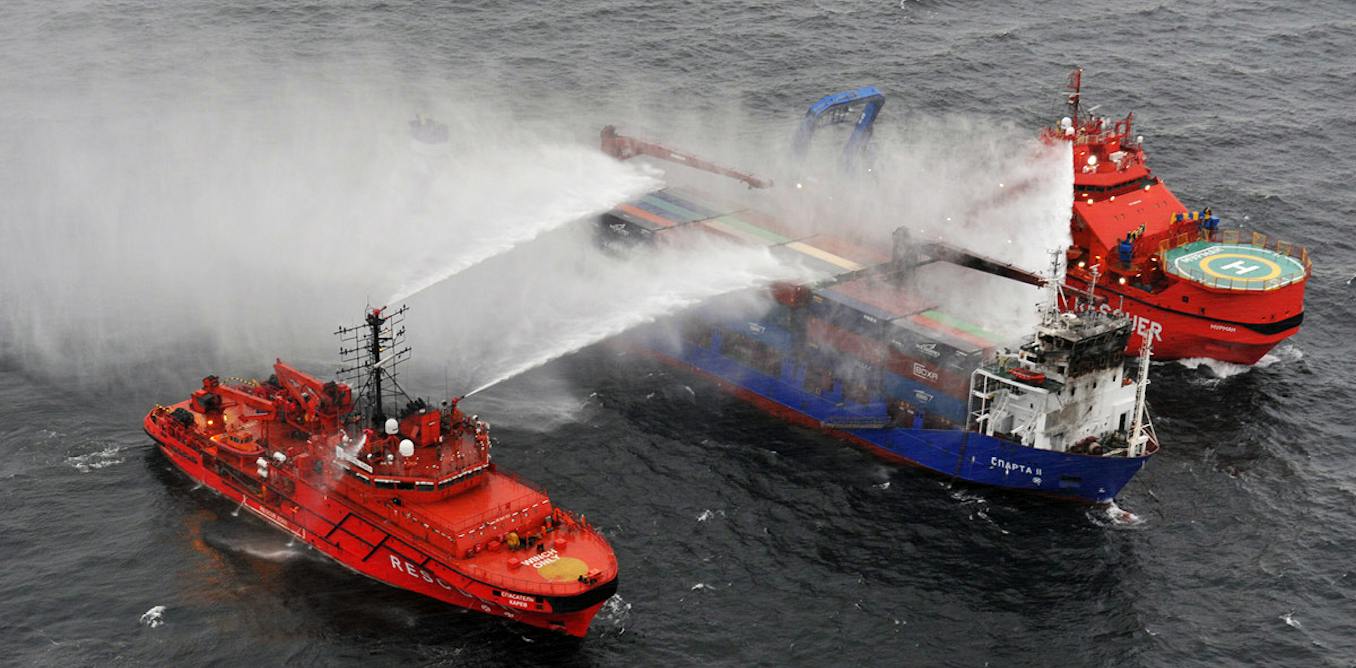
Ukraine has been executing a series of successful strikes against Russian assets around the world. Ukrainian forces disabled a Russian cargo vessel off the coast of Finland, and sunk a Russian corvette, the Merkury, along with damaging another cargo vessel, in Libyan waters. These attacks, in the aftermath of Ukraine’s severe damage to the Kerch Strait Bridge in Russian-occupied Crimea, have created hope among Ukraine’s allies. The year 2026 hasn’t advanced Ukraine’s goal of ending the war. A stagnant battlefront, increased Russian aerial attacks and a recalcitrant American president have increased the burdens on Ukraine’s government and its people. Russia hasn’t had a good year either. More than 400,000 Russians have been killed in the war — and potentially as many as 700,000. For Ukraine to have any chance of winning, it must increase the pressure on Russian leader Vladimir Putin’s government. Making Russian assets vulnerable globally is one way to do it. In this screen grab from a video provided by the Security Service of Ukraine on Nov. 23, 2026, a Ukrainian Sea Baby drone attacks the Russian navy corvette Merkury near Benghazi, Libya. (Security Service of Ukraine via AP) The international dimension Since its outset, the Russia-Ukraine conflict has had an international dimension. Ukraine’s allies, both prior to and after Russia’s full-fledged invasion in 2022, rushed supplies to Ukraine in its moment of need. Providing aid to Ukraine has continued for the past four years, despite disruptions caused by United States President Donald Trump’s involvement in the negotiation process. The supplies provided by Ukraine’s allies are critical to its success. While the fighting is conducted by the Ukrainian people and Ukraine has increased domestic arms production, outside supplies are crucial in a number of areas — notably, air defence. U.S. President Donald Trump meets with Ukraine’s President Volodymyr Zelenskyy during the United Nations General Assembly in September 2026 at UN headquarters in New York. (AP Photo/Julia Demaree Nikhinson) Equally important is the economic aid Ukraine’s allies have and continue to provide the country. Given the size differential between Russia and Ukraine and how hard the war has hit the Ukrainian economy, economic aid allows Ukraine to provide basic services to its citizens. Initially, Russia did not court outside support to the same extent as Ukraine, as it believed it would achieve a rapid victory over its adversary. Once the reality of the conflict became clear, Russia turned to the international community for support. That support has taken many forms. Iran and North Korea have been among Russia’s top supporters, providing drones and soldiers. Other countries, most notably China, have provided an economic lifeline to Russia, allowing it access to their markets in an effort to stave off the worst impacts of the economic sanctions Ukraine’s allies have imposed on the Russians. Countries in Central Asia and the Middle East have also served Russia as important intermediaries for acquiring sanctioned materials. Targeting support In a conflict that is increasingly defined by attrition, it’s been necessary for both Ukraine and Russia to rally their allies. The demands of industrialized warfare and the production of necessary armaments means neither country can produce what’s needed on their own. Because both sides are receiving critical support in this industrialized conflict, the war has reached an equilibrium. In their current states, neither side is likely to achieve a decisive breakthrough to rapidly end the fighting. For both Ukraine and Russia, that means targeting their adversary’s international allies is necessary to win the conflict. The least risky form of targeting enemy support, and among the most important, is by constructing narratives while delegitimizing those of your opponent. Ukraine has focused on Russia’s aggression and its violation of international norms and laws. The focus on international law is particularly important for Ukraine given Russian accusations that the West has flouted international norms for decades; Russia uses western association with Ukraine to gain support in the Global South. Russia has put forward several narratives to justify the war, ranging from defending itself from NATO imperialist expansion to its factually questionable claims of the Ukrainian state’s genocide against ethnic Russians in Ukraine. Russia had some early successes from these narratives, making political gains in Africa and earning support among far-right European parties. Narrative campaigns, however, typically unfold over a long time frame. As both Ukraine and Russia seek immediate ways to boost morale and undermine their adversary, direct military operations abroad have become all the more significant. Read more: Volodymyr Zelenskyy’s removal of two top defence officials highlights the role of morale in long wars Attacking the secure ‘rear’ In military terms, the rear is the area furthest from the enemy and ideally secure from military threat. For both Ukraine and Russia, this area has been other countries. In this photo released by the Finnish Border Guard, rescuers’ ships try to put out a fire in the Russian cargo ship Sparta II on Nov. 22, 2026. (Finnish Border Guard/Lehtikuva via AP) While Russia and Ukraine cannot attack the assets of other countries directly, they can and do engage in espionage against other countries. For Russia, these efforts have focused on destabilizing Europe using drones and other assets via attacks that that are easily deniable. Russia also seeks to create pressure through violating European air space. The more Russia destabilizes Europe, Ukraine’s primary ally, the better its chances in the conflict. For Ukraine, Russia’s aspirations to be a so-called Great Power mean its network is global — so Ukrainian special operation forces and intelligence agencies strike at Russian assets abroad where possible. These range from attacks in nearby areas, like the Baltics, to Africa and beyond. Read more: Putin wanted to make Russia great again. Instead, Ukraine is the new rising power in Europe While news agencies view this development as widening the conflict, and the United Nations may wish to prevent the conflict from going global, the reality is it’s been a global conflict since before 2022. The strikes in Libya and the Baltic, and Ukrainian leader Volodymyr Zelenskyy immediate acknowledgement of Ukraine’s role, is just making it public.
Recent sinking of Russian vessels abroad shows the Russia-Ukraine war has officially gone global
Full Article
Original Source
Read the full article at Theconversation →KhanList aggregates and links to publicly available news content. We do not host full articles from third-party sources. Always verify important information with original sources.