
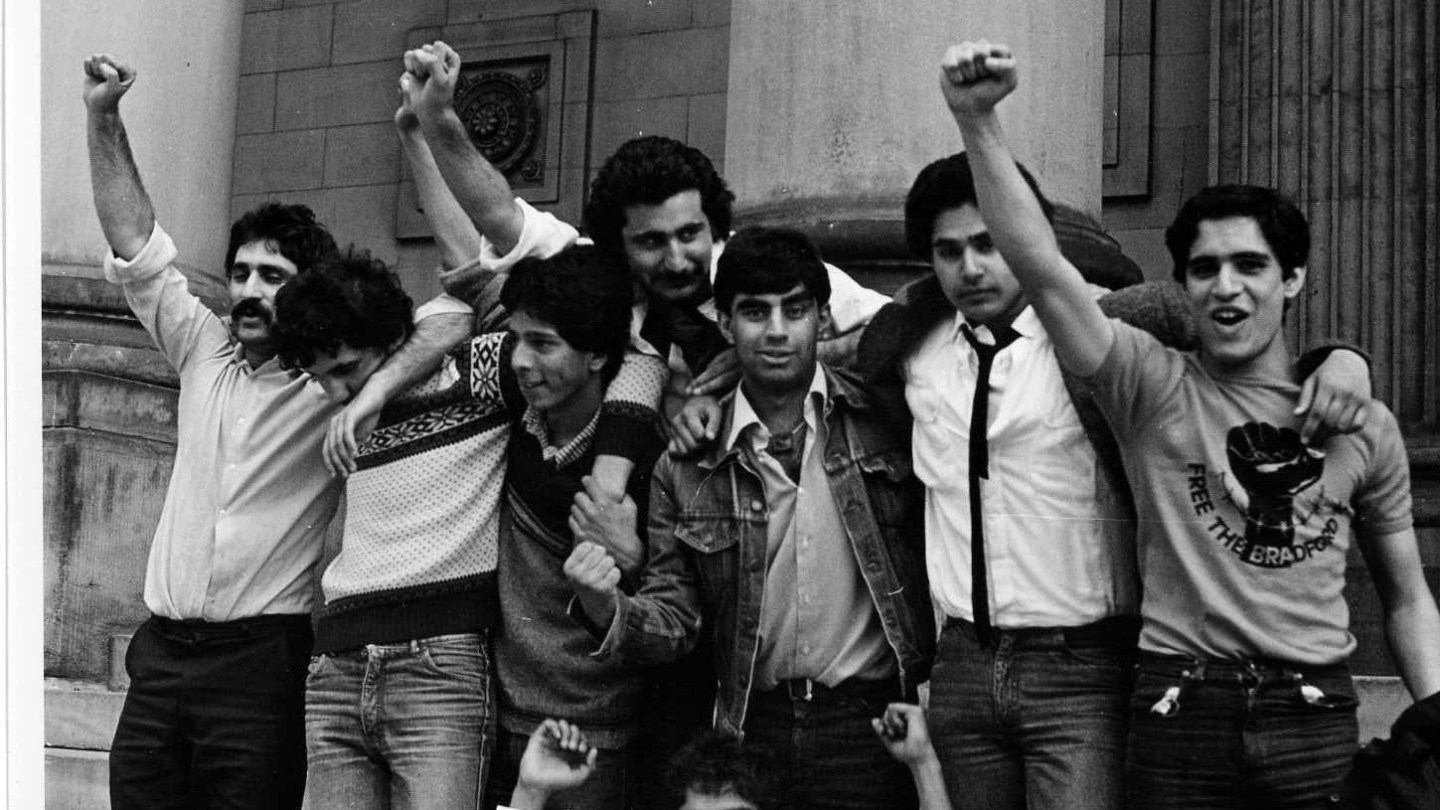
Bradford, near Leeds, is a city in the north of England. During the Industrial Revolution, it was known as THE place for wool manufacturing. Nowadays, it has a reputation for its South Asian food scene, among other things. And in the early 1980s, it made national and global headlines when 12 young South Asian men stood trial on terrorism charges for preparing to defend their community from a racist attack. Activist filmmakers Ken Fero (Ultraviolence) and Tariq Mehmood’s documentary Rebellion, from Migrant Media, a collective of radical documentary filmmakers with a focus on stories about race, class and resistance, retraces their story and broader impact. Mehmood is, in fact, one of the Bradford 12. Rebellion world-premieres as part of the 70th edition of the BFI London Film Festival (LFF) on Oct. 14. “Revolution is the beat that drums through this electrifying story about the landmark case against the Bradford 12,” the festival website notes. Fero talked to THR about how timely Rebellion feels today amid a renewed rise of far-right politics, why it was a journey of more than 30 years, the importance of involving the community in making the film and why cinema can be a weapon. Rebellion feels very timely. How long did you work on it, and did you know early on that this would be a historic film that also reflects on our presence? I met Tariq Mehmood in 1991, making another film called Britain’s Black Legacy, which was looking at the history of self-defense against racist attacks in the U.K. from ’61 to ’91. Tariq told me about the Bradford 12, and I thought, well, I’ve never heard of the Bradford 12. I’ve heard of the Mangrove Nine; I’ve heard of the Birmingham Six; and I’ve heard about all these miscarriages of justice. But the Bradford 12 were really not very well known. So he said we should make a film about it. Fast forward 33 years later – we got busy in the meantime making films: we decided now’s the time to tell [this story]. It took about 30 years because we wanted the story to percolate and see what happens. As time passed, we began to see and get a sense that the political situation in the U.K. was changing. [Just look at the] growth of the far-right, for example, and the vilifying of migrants, trying to create a scapegoat for the political problems. S, we decided, let’s make the film. The time is right. It took three or four years to make, and obviously the fact that it’s coming out now when the far-right, or proto-fascist groups, are beginning to take to the streets, [makes it timely]. There have been groups of people dressed in black with masks on roaming the streets of the U.K., trying to target migrants. When fascists and racists take to the streets, they don’t differentiate between someone who has a U.K. passport and is a citizen and who isn’t. It could be anyone who looks different. That’s what people have to realize – this is a serious question around race, but it’s actually also a question of all our liberties; it’s a question of all our lives, and it’s a question of all our hopes and dreams that these people want to crush. ‘Rebellion,’ courtesy of Migration Media/Max Farrar Courtesy of Migration Media/Max Farrar The film gives one a sense of history repeating itself… There’s a line in the film which goes something like: The grandchildren of the people who marched in the ’80s with the far-right are now burning down hostels with asylum seekers. There’s a fundamental problem here of the lack of political activity in working-class communities. There hasn’t been any effort to go into white working-class communities and say, “Your problems are created by Elon Musk, not by migrants,” and I think that’s one of the things the film politically tries to do. Tell me more about how you see Elon Musk’s role, who has expressed support for various right-wing European politicians … It’s a complex area to discuss, but fundamentally, if you take [Reform UK head and right-wing British politician Nigel Farage], for example, and if you take any of the far-right groups that are becoming popular in Italy, in Germany, in France, and if you see what’s happening on the streets in France with police attacking children, there is a huge shift politically internationally. Let’s not even talk about Trump. There’s a huge shift to the right, and the shifts to the right historically have always happened when there’s a sense that people are getting organized. Over the past few years, there’s been so much growing resistance, particularly among young people. You can talk about many countries where there have been revolutions against very established governments, and we’ve seen many countries in the Global South falling, and that’s a threat to capitalism, and it’s a threat to imperialism. I think they want to generate friction within their own countries, so it distracts people from what’s really going on. So people are trying to pit people against each other, creating “the other,” whether the other is in any European country or whether it’s Iran, and we must have international solidarity. We must have communities working together. We have to take on capitalism and defeat it. Rebellion is just a film. It’s a documentary. It won’t cause a revolution. It may cause some small rebellions, which would be great in some places. There is a vibe of activism but also hope to the film. How important is that for you?Of course, the other side of this [story] is that this was an incredible victory. It’s a story of hope. It’s a story of unity, and it shows that in any situation, whether it’s the 1980s, 2026 or whatever happens in the future, if people actually organize and support each other, it is possible to defeat the forces of evil, whatever you want to define them as. ‘Rebellion,’ courtesy of Migration Media/Max Farrar Courtesy of Migration Media/Max Farrar Tell me more about how key the idea of resistance is to your filmmaking and Migrant Media films. If you see any documentary that we’ve made, it’s always been about resistance. It’s always about hope. The situations are deadly, serious and painful. But within any painful situation, when there’s any oppression, there are always people who are fighting, and that’s what we want to do. We want to give people hope. We want to give the young generation hope. They’re on the streets, whether it’s about environmentalism, whether it’s about Gaza, whether it’s about Black Lives Matter, and there are connections between all these struggles. So, you see Rebellion and the Bradford 12 as a possible inspiration for them? For 12 young [South] Asians in 1981 to take on the British establishment, to take on not just the police, not just the government, but the security services, and for a jury to find them all not guilty is an incredible feat. And if you make a parallel again to today with, for example, the question around [the activist group] Palestine Action [that has been designated as a terrorist organization in the U.K. since 2025], where people are taking a stand and they are being accused of being terrorists as well. The difference now, of course, is that terrorism is enshrined within the legal system in a way where it’s been politicized to an extent that has never been done before. So now we have 95-year-old ex- preachers who are protesting around Palestine and getting put into prison. We’re not alarmists. We don’t want things to be tragic. We don’t want there to be this kind of political violence. But if we ignore it, it’s at the peril of all of us. So we have to raise these issues. But have to give people hope. I noticed how the resistance movements we see in the film cut across activists from various backgrounds: South Asian folks, whether Muslim, Catholic or other, groups of Black people, Jewish activists, and so on. Given today’s divisions around Gaza, I was fascinated to see this. Yes, Tariq in the film mentions how much support the Bradford 12 got from progressive Jewish organizations and how they really learnt a lot from progressive Jewish organizations. Many Jewish people supported the Bradford 12 and vice versa. ‘Rebellion,’ courtesy of Migration Media/Max Farrar Courtesy of Migration Media/Max Farrar There has been much debate about how political or not cinema can and should be… I think it was Wim Wenders who once said something like, “The news tells you every day that there’s no hope.” You watch it every day, and eventually you believe it. And of course, many filmmakers have taken that position, not just documentary filmmakers, but fiction filmmakers as well. But for us, this is a political subject for sure. The film was made politically as well, and for us, that’s really important. Lots of people who were in the Bradford 12 were editorial consultants, and they took part. We organized a kind of Third Cinema event. [Third Cinema, which originated in Latin America in the 1960s, focuses on social justice and resistance against imperialism and uses guerrilla filmmaking techniques.] So the trial scene in the film, which takes up about a third of the film, was actually all shot on one day with the community. There were no [professional] actors involved.We made a callout and had about 120 people coming, which included people from the Bradford 12, their grandchildren, their children, people from the community. We had some filmmakers, we had bakers, we had street cleaners, we had everybody coming because they were really interested in the story, and then they became part of history and part of the film’s history. That was our first venture into reconstruction, but it was done using a Third Cinema approach, where you involve people and tell the story as you go along. What’s your hope for the film? The hope we have is that whoever watches the film can come away and feel that wherever there’s injustice, they should fight it within their lives, that it’s possible to have hope. Some of the lessons from the Bradford 12 are that you can’t do this on your own. You have to organize – whether it’s around an issue in your local community, whether it’s an international issue, whether it’s a national issue. And it is not just organizing through social media, but it’s [important] to meet, to eat together, to dream together, to fight together.
‘Rebellion’: Why the Bradford 12 Doc Is So Timely and Its Directors Want People to Know “Your Problems Are Created by Elon Musk, Not Migrants”
Full Article
Original Source
Read the full article at Hollywoodreporter →KhanList aggregates and links to publicly available news content. We do not host full articles from third-party sources. Always verify important information with original sources.