
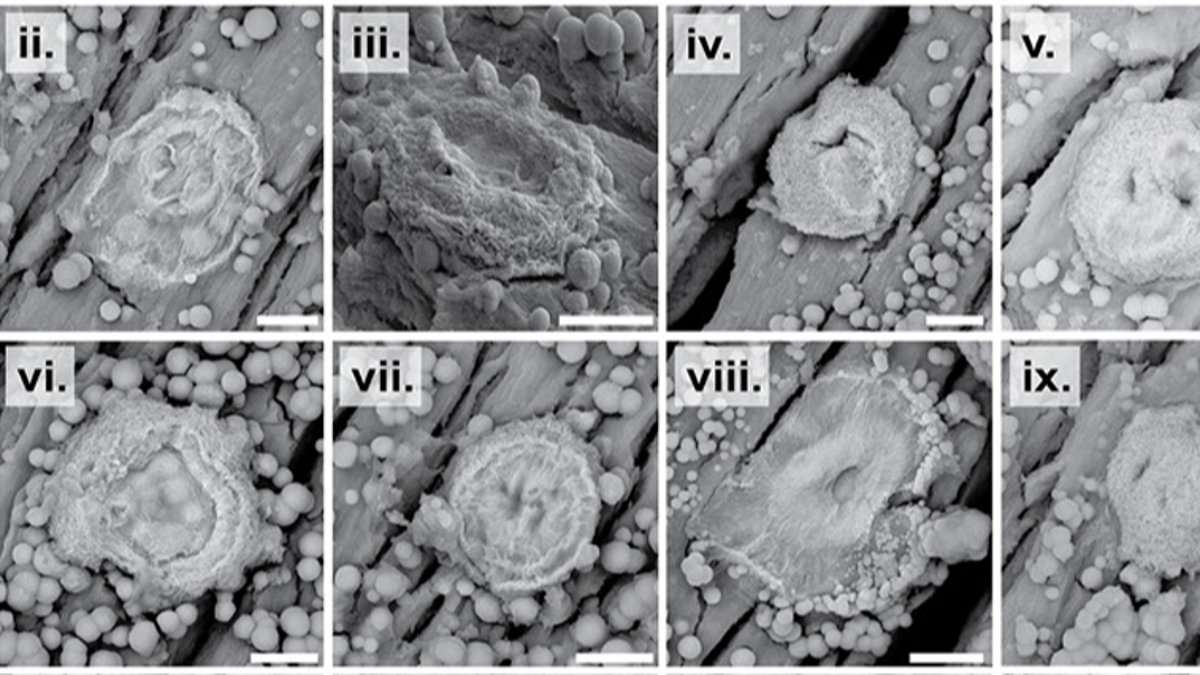
Scientists have discovered molecular traces of blood inside the bones of a dinosaur that roamed the Earth 115 million years ago.A team from Curtin University found fossilised red blood cells containing heme – the oxygen–carrying component of haemoglobin – inside the leg bone of a small meat–eating dinosaur from Brazil.The extraordinary find suggests ancient fossils may preserve far more of an animal's original biology than scientists ever imagined.While the discovery might evoke visions of a real-life Jurassic Park, unfortunately scientists say bringing back the dinosaurs is not possible, as no recoverable DNA was found. Speaking to the Daily Mail, Professor Kliti Grice, lead author of the study, said: 'We haven't recovered dinosaur DNA, but we have recovered something remarkable: a molecular fingerprint of blood from an animal that lived 115 million years ago.'It shows that fossils can retain a chemical memory of the living animal.' Scientists have discovered molecular traces of blood inside the bones of a dinosaur that roamed the Earth 115 million years ago While the discovery might evoke visions of a real-life Jurassic Park (still from the 1993 blockbuster, pictured), unfortunately scientists say bringing back the dinosaurs is not possible, as no recoverable DNA was foundThe dinosaur, known as Aratasaurus museunacionali, lived during the Early Cretaceous period and was recovered from the fossil–rich Romualdo Formation in northeastern Brazil.The ancient cells were discovered within tiny vascular canals running through the bone.Previous studies have reported possible blood–cell–like structures in dinosaur fossils, but this is the first time researchers say they have chemically confirmed the presence of haemoglobin–derived compounds.'To detect intact heme–derived molecules in 115–million–year–old red blood cells is astonishing,' Professor Grice said.'It not only extends the known fossil record of blood, but also offers a direct molecular window into the physiology of long–extinct animals.'Professor Grice admitted she was surprised any recognisable biochemical traces had survived for so long.However, she said the dinosaur appears to have benefited from an extraordinary series of circumstances after its death.Researchers believe the animal was rapidly buried in a low–oxygen environment, while a mineral known as hausmannite acted like a natural time capsule, helping to protect delicate biological structures from degradation.The discovery, published in the journal Proceedings of the National Academy of Sciences, could allow palaeontologists to extract new information from ancient fossils, shedding light on the biology and behaviour of long–extinct creatures.But dinosaur fans hoping for a real–life Jurassic Park should not get too excited. The known remains consist mainly of part of a hind limb, but the animal is thought to have been a fast–running predator Palaeontologists found fossilised red blood cells containing heme, the oxygen–carrying component of haemoglobin, inside the leg boneProfessor Grice stressed that the team had not discovered dinosaur DNA and that the finding brings scientists no closer to cloning the prehistoric beasts.'The Jurassic Park idea depends fundamentally on having recoverable dinosaur genetic information,' she said.'We have not found dinosaur DNA or a dinosaur genome.'Darren Griffin, a Professor of Genetics at the University of Kent, agreed that the prospect of finding usable dinosaur DNA is effectively negligible because of how long ago they lived.'Unless something completely appears out of left field in the DNA world, then the likelihood of ever finding DNA from extinct dinosaurs are very slim indeed,' he told the Daily Mail.He added that de–extinction would require far more than traces of biomolecules, saying: 'I think we're so far away from that at the moment, it's not really worth thinking about.'Meanwhile Steve Brusatte, Professor of Palaeontology and Evolution at the University of Edinburgh, and a consultant on Jurassic Park, said: 'This could be a groundbreaking discovery, and it suggests there could be a lot of things hidden in dinosaur fossils that we never knew were there.'But I need to be clear that these scientists have not found dinosaur DNA. I will repeat that: no dinosaur DNA.'But maybe, just maybe, if it is red blood cells today, might there be fragments of DNA found tomorrow?'Even if there was fossil DNA though, I hate to be the buzz killer, but turning little DNA snippets into a real live cloned dinosaur would shock me.' Aratasaurus museunacionali was a small theropod dinosaur, meaning it belonged to the same broad group of meat–eating dinosaurs that later gave rise to giants such as T. rex and modern birdsProfessor Grice explained that the findings provide chemical information about the original animal, not the complete genetic instructions required to create it.Instead, the researchers say the real significance of the discovery lies in proving that fossils can retain far more biological information than previously thought.'We may not be bringing a dinosaur back to life, but we are developing ways of extracting information about the biology of an animal that died 115 million years ago,' she said.'That would have seemed extraordinary not very long ago.'Now that we know what to look for, the really exciting question is how much more biological information is waiting to be discovered in fossils already held in museums around the world.'Aratasaurus museunacionali was a small theropod dinosaur, meaning it belonged to the same broad group of meat–eating dinosaurs that later gave rise to giants such as T. rex and modern birds.The known remains consist mainly of part of a hind limb, but the animal is thought to have been a fast–running predator.Scientists estimate it measured about 3.1m (10ft) long and weighed roughly 34kg (75lb), making it more the size of a large dog than a giant predator.However, the specimen studied was not fully grown. Researchers believe it was a juvenile or young adult about four years old, meaning it could have become larger later in life.HOW THE DINOSAURS BECAME EXTINCT AROUND 66MILLION YEARS AGODinosaurs ruled the Earth around 66million years ago, but suddenly disappeared in what is known as the Cretaceous-Tertiary extinction.It was believed for many years that the changing climate destroyed the food chain of the huge reptiles. However, in the 1980s paleontologists discovered a layer of iridium - an element that is rare on Earth but found in vast quantities in space. When this was dated, it coincided precisely with when the dinosaurs disappeared from the fossil record. A decade later, scientists uncovered the massive Chicxulub Crater at the tip of Mexico’s Yucatán Peninsula, which dates to the period in question. Scientific consensus now says that these two factors are linked and they were both probably caused by an enormous asteroid crashing to Earth.With the projected size and impact velocity, the collision would have caused an enormous shock wave and is likely to have triggered seismic activity. The fallout would have created plumes of ash thought to have covered the whole planet, making it impossible for dinosaurs to survive. Other animals and plant species had a shorter time-span between generations which allowed them to survive.There are several other theories as to what caused the demise of the dinos. One early theory was that small mammals ate dinosaur eggs and another proposes that toxic angiosperms (flowering plants) killed them off.
Real-life Jurassic Park? Scientists discover dinosaur BLOOD inside 115-million-year old bones
Full Article
Original Source
Read the full article at Dailymail →KhanList aggregates and links to publicly available news content. We do not host full articles from third-party sources. Always verify important information with original sources.