
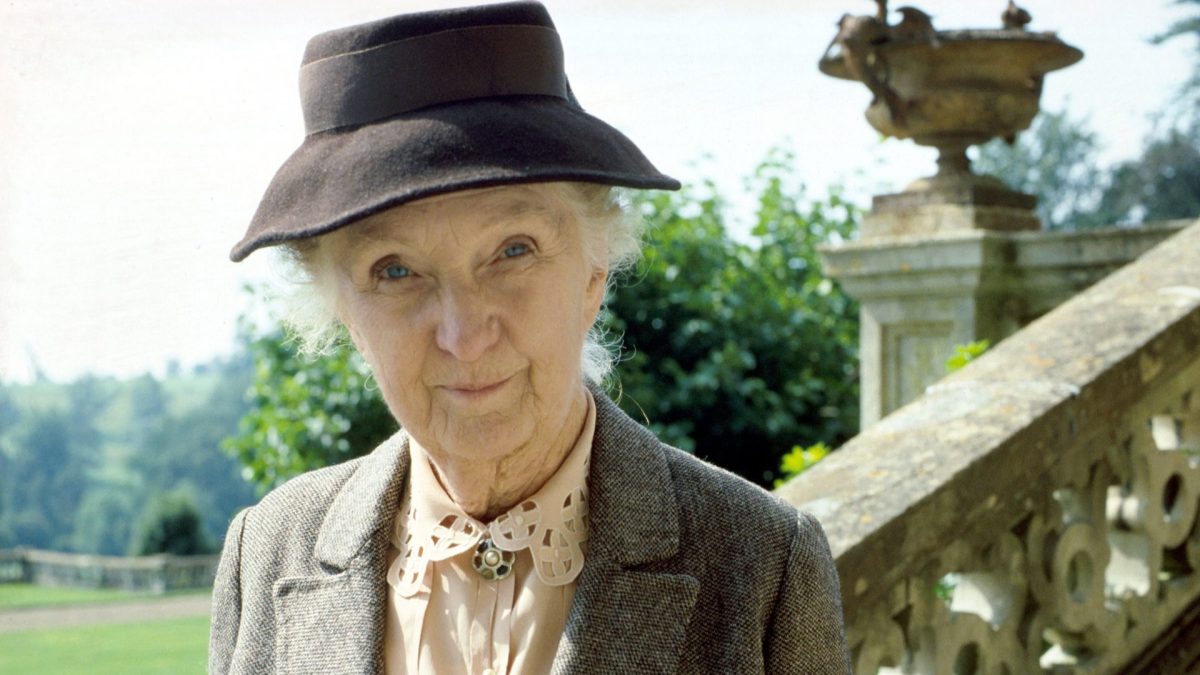
“That’s what I love about these high school girls,” Matthew McConaughey’s character, David Wooderson, famously observed in Dazed and Confused. “I get older, they stay the same age.” The same, it strikes me, could be said about Miss Marple. From her introduction in 1927 to her final appearance in 1976, Agatha Christie’s spinster sleuth has been an implacable constant in British fiction. “Miss Marple is a white-haired old lady with a gentle, appealing manner,” wrote the Reverend Leonard Clement, narrating the first Marple novel, The Murder at the Vicarage, in 1930. She stayed much the same until 1971. “She’s elderly, I gather, and much more punctilious than the young scatterbrains of today,” a young lawyer remarks, awaiting Marple’s arrival in Nemesis, chronologically her final novel. Time, it seems, operates differently in Miss Marple’s world. Now, she is back, suspended in resin somewhere between the past and the present. Lucy Foley – a crime writer best known for the thrillers The Guest List and The Hunting Party – has been allowed to resurrect the character. Murder at the Grand Alpine Hotel is the first authorised continuation novel in the series, which follows Sophie Hannah’s six novels featuring Hercule Poirot. Murder at the Grand Alpine Hotel is set in 1950, with the shadow of the Second World War still hanging over Europe, and finds Miss Marple accompanying her friend and regular sidekick Dolly Bantry to a resort in the Swiss Alps. Naturally, of course, death follows her there. Her reappearance is strikingly familiar. “Mrs Bantry’s friend is the perfect image of a little old lady,” one of the novel’s narrators, Diana Glass, observes. Marple has “china-blue eyes, her head tilted slightly to one side”, just as she did when Christie was behind the narrative reins. “She might be a little mad,” another narrator, whose husband has just been murdered, remarks, “[but] I find her a reassuring presence.” This timeless quality is essential to Miss Marple’s appeal. Even as her popularity has declined, her fame has endured. In the 60s, MGM made a series of lavish film adaptations, starring Margaret Rutherford, including two films – Murder at the Gallop and Murder Most Foul – which were based on Poirot novels, After the Funeral and Mrs McGinty’s Dead respectively, with the sleuths swapped. In 1981, Angela Lansbury took over the knitting needles for The Mirror Crack’d, which featured an all-star cast including Elizabeth Taylor, Tony Curtis, Kim Novak and Rock Hudson (the last of whom is name-checked by Lucy Foley, in an unusually meta moment). But since the 80s, Marple’s star has waned and Poirot, who has been the subject of countless TV and film adaptations, has been in the ascendancy. Lucy Foley, best known for ‘The Hunting Party’ and ‘The Guest List’, is a bestselling thriller writer in her own right (Photo: Jesse Dittmar) Why? It is true that the very best of Christie’s puzzles – The Murder of Roger Ackroyd, say, or Murder on the Orient Express – belong to the Poirot series. But it is equally true that Miss Marple remains the world’s most famous female detective, whose mysteries have proven every bit as influential as her Belgian counterpart’s. The difference seems to be that crime fiction, for many years, was trending towards greater darkness, more gore and starker manifestations of evil. Marple was “cosy crime” before the term had been coined. St Mary Mead, her home village and the backdrop to many of her cases, was the proto-Midsomer, whereas Poirot, let loose in London and beyond, was more cosmopolitan. She was dismissed as twee, almost a parody of herself. So, the decision to bring her back now, when cosy crime – led by writers like Richard Osman, Janice Hallett and Robert Thorogood – is booming, makes sense. The plot of Murder at the Grand Alpine Hotel unfurls like a warmed blanket. Set in a snowbound hotel, complete with a spa with hammam and Finnish sauna, it has its characters sip viscous hot chocolates, drink tots of cherry brandy and puff Cuban cigars. The murders are bloodless: a poisoning, a coshing, a fall from a balcony. “People do like to try and protect the old,” remarks Miss Marple, “as though we really were in a second childhood, with the innocence of infants who have just been born.” But the reader, too, is protected from anything too unsettling. It is odd to read, in the novel’s publicity materials, Miss Marple described as “the trailblazing detective” while Lucy Foley is called “the pioneer of the modern mystery”. Foley’s work has always cribbed heavily from the Golden Age of detective fiction, embracing conventions like the locked room and the limited cast list. In fact, her appointment to the Marple role (following a successful audition as one of 12 writers contributing to a short story anthology, Marple, in 2022) made sense precisely because she is a throwback, a demonstrable enthusiast for early-20th century whodunnits. Which isn’t to say that Murder at the Grand Alpine Hotel doesn’t update Christie’s sensibilities. There’s some exploratory feminism. “Men are the ones with the power in this world,” one character, an ageing bombshell, declares. “I had the goods, they were selling and buying.” There are also occasional risqué moments. “Bet your little wife doesn’t offer to li–” a politician’s mistress declares, before being cut off. (I remain genuinely unsure where that sentence was going.) Agatha Christie had a mastery of plot and structure that is hard for another writer to replicate (Photo: Bettmann Archive) But for the most part, Murder at the Grand Alpine Hotel is reverent and referential. Nuggets from previous Marple books are strewn through the narrative, either broadly – “After that murder at the vicarage we had a sudden expansion of the congregation”, “I still shudder to remember… the discovery of a body in the library at Gossington Hall” – or more subtly. “There was a – situation – in Dillmouth, a few years ago, where I found simply pulling out some bindweed in someone else’s garden most edifying.” More immersed readers will recognise the plot, there, of Sleeping Murder, the last Marple novel to be published. All of this serves as a sop to the fact that Murder at the Grand Alpine Hotel exists to further appease readers’ desire for familiarity, and the publishing industry’s preoccupation with safe bets. Restoring Miss Marple to window displays will guarantee sales to readers anticipating the next retirement home potboiler or bored with slim novels about Japanese bookshops. This is benign cynicism. But, judged on its own, the novel largely works – even if the solution has more holes than Swiss cheese – and the mystery could, in another world, stand on its own feet. Here, however, it will be compared with Christie. Foley produces a confident facsimile of the tone, but the structure is more uncertain. First person narration (by four of the novel’s many characters) introduces a vexing unreliability. “I pull the pistol from my pocket now,” a character narrates, moments before they are murdered. “Want them to know I’m no fool.” Even as the interior monologue describes this final confrontation, the pronouns remain studiously neutral. It is a trick of convenience that Christie – whose narrators are either omniscient or recollecting post-hoc – wouldn’t have pulled. And that is the challenge for continuation novels, whether that’s Miss Marple or Hercule Poirot, Sherlock Holmes or James Bond. They will be compared, unfailingly unfavourably, with the source material. It is a risk that Agatha Christie’s estate seems willing to take, so they can squeeze more revenue out of her work. With a new Poirot prequel, Hercule, due to air soon on the BBC, and 20th Century Studios committing to a slate of new Christie films including And Then There Were None and Witness for the Prosecution, finding fresh audiences for Miss Marple is a no-brainer. She is trapped in time like a fly in amber: the perpetual spinster, aged but unageing. And, for a backwards-looking entertainment complex, that quality of being unchangeable in a changing world remains deeply appealing. ‘Murder at the Grand Alpine Hotel’ by Lucy Foley is published by HarperCollins on 22 September
Real Agatha Christie fans won’t be fooled by the new Miss Marple
Full Article
Original Source
Read the full article at Inews →KhanList aggregates and links to publicly available news content. We do not host full articles from third-party sources. Always verify important information with original sources.