
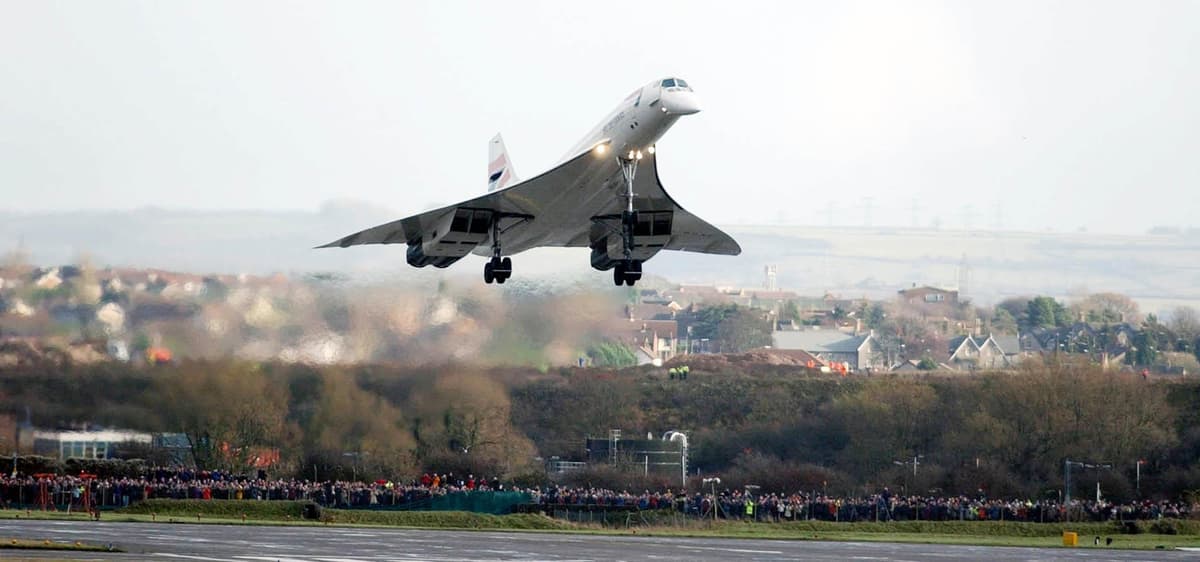
In 2007, Blake Scholl, a twentysomething US software engineer from the early days of Amazon, climbed into a retired Concorde. “I remember thinking, why is this amazing machine not at an airport?” he tells me. He then put a Google alert on “supersonic flight” — wanting to be the first to know when he could buy a ticket. Years went by and no alert came through. “Nobody was making any credible effort,” he says. “So I thought I would get into the research and realise there was a good reason that nobody was doing it.” He found none. Scholl then took matters into his own hands: spending only a year between quitting his job and starting his supersonic flight company, Boom, in 2014, he went from knowing nothing to teaching himself the fundamentals of aerospace engineering and learning how to model the aeroplane.This month, his company finished assembling the core of Symphony, the first engine built to bring back supersonic passenger flight. It’s set to be turned on for the first time next month. “This is the first large-scale supersonic core since the Olympus 593,” Scholl explains. The Olympus 593 engine was built by Rolls-Royce in Bristol. So why did we stop in Britain? And why is the next one being built in America?British Airways’ last commercial Concorde landed at Heathrow in 2003. The immediate causes were clear enough. In 2000 an Air France Concorde ran over debris on the runway at Charles de Gaulle. A burst tyre ruptured a fuel tank and the plane crashed into a hotel, killing 113 people. Concorde returned to service just as 9/11 gutted transatlantic premium travel, and both airlines retired it in 2003.For Scholl, that is only the surface. “Imagine you went back to 1969. We flew Concorde for the first time, and we landed on the Moon for the first time… I don’t think you could find anyone who would say, oh, we won’t be able to go back to the Moon. And yet that’s what happened, for really no good reason.”‘Concorde was like Ryanair’The deeper problem, he continues, is that Concorde was built for national prestige, not for passengers. “It was a taxpayer-funded project without any commercial voice saying, hey, does this make any sense?” What they built was, he explains, “very much an impressive tech demo”. It was also “a 100-seat aeroplane with 100 uncomfortable seats”, and by its final years a return ticket to New York cost £8,292 (£16,000 in today’s money). “It was too expensive for its size, or too big for its cost.” Scholl puts half of the blame on “socialism and politics”.Concorde 002 takes off from Filton Airfield on its maiden flight, Bristol, April 9th 1969Getty ImagesBut America, he admits, played its part too. With no supersonic jet of its own, it banned supersonic flight over land and “told everybody the sonic boom was terrible and unsolvable”. The result was “50 years of no f***ing progress”. With speed no longer something to compete on, the industry settled into two giants. “Boeing doesn’t do anything unless Airbus does it. Airbus doesn’t do anything unless Boeing does it… the whole industry just gets fat and dumb.”That explains why Concorde stopped. It doesn’t explain why Britain has made no serious attempt to build its successor. Talent has never been the bottleneck. The barrier, it seems, is money, and also the appetite for risk. “Every passenger wants supersonic flight so long as it is safe, comfortable, affordable and quiet”Rolls-Royce, Boom’s original engine partner, walked away in 2022, saying it had completed its contract, and Boom said its design wasn’t the right fit. Reaction Engines, the Oxfordshire firm behind SABRE, a hypersonic engine once seen as Britain’s great hope, went into administration in 2024. British aerospace is dominated by the kind of incumbents Scholl blames. In America, software money routinely pays for hardware bets. Scholl had sold his start-up, Kima Labs, to Groupon in 2012, so he started Boom with an exit behind him and contacts among the kind of investors who back founders.“We need young companies trying bold new things,” he says. Boom is his attempt to become such a company, and to fix everything Concorde got wrong. “Every passenger wants supersonic flight so long as it is safe, comfortable, affordable and quiet… Concorde was miraculous, but it missed on four out of four.” On comfort, he is blunt: “Concorde was like Ryanair.” It was for “rock stars and royalty. It’s literally for the Queen.” Boom claims it is only about 15 minutes slower across the Atlantic, at a quarter of the cost.Concorde’s noise was notorious. It “had extremely loud afterburners that would rattle the windows at Heathrow”, and a sonic boom that rolled across the ground beneath it like thunder. Anything travelling faster than sound pushes shock waves ahead of it, and when they reach the ground they are heard as a boom.Silencing the sonic boomThe first fix, Scholl says, was the easy part. Concorde’s engine came from a military lineage; Symphony is a modern turbofan with no afterburners. “You just need a big enough fan… It’s not that hard.”The boom, he thought, would be harder, “but actually wasn’t”. Sound travels faster in warm air than in cold, and the air near the ground is warmer than at cruising altitude. Fly high enough, and only just faster than sound, and the shock waves bend back upwards before they land: “the boom makes a U-turn in the sky and never hits the ground.” The safe speed, around Mach 1.2, shifts with the weather, so a computer works it out for every flight. On Boom’s test jet, XB-1, “six times we predicted no sonic boom, and all six times we were right”. Over the ocean, Boom’s airliner, Overture, will fly faster (Mach 1.7), booming only at the fish.United, American Airlines and Japan Airlines are among those holding ordersBoom’s financial strategy is clever. Before Symphony carries a single passenger, it will power AI data centres. The engine needs no water and keeps running in the heat, and power-hungry data centres want their own supply. Every hour it runs is test data: “Our answer can now be: this is the most tested engine in history.” Every turbine sold is cash: “By shipping to data centres first, we become independent of investors quite quickly.” Reaction Engines ran out of money waiting for its moment. Boom found a customer for its engine before it had a plane.Read MoreThere is still a long way to go. Overture has yet to fly, but United, American Airlines and Japan Airlines are among those holding orders and pre-orders for 130 jets. “Imagine”, Scholl says, “as a Londoner, explaining to your kids that it [New York] used to take eight hours. I want to live in a future where we have to explain to our kids that we didn’t always fly supersonic.”
Ready that gin and tonic — because once again we’re going supersonic
Full Article
Original Source
Read the full article at Standard →KhanList aggregates and links to publicly available news content. We do not host full articles from third-party sources. Always verify important information with original sources.