
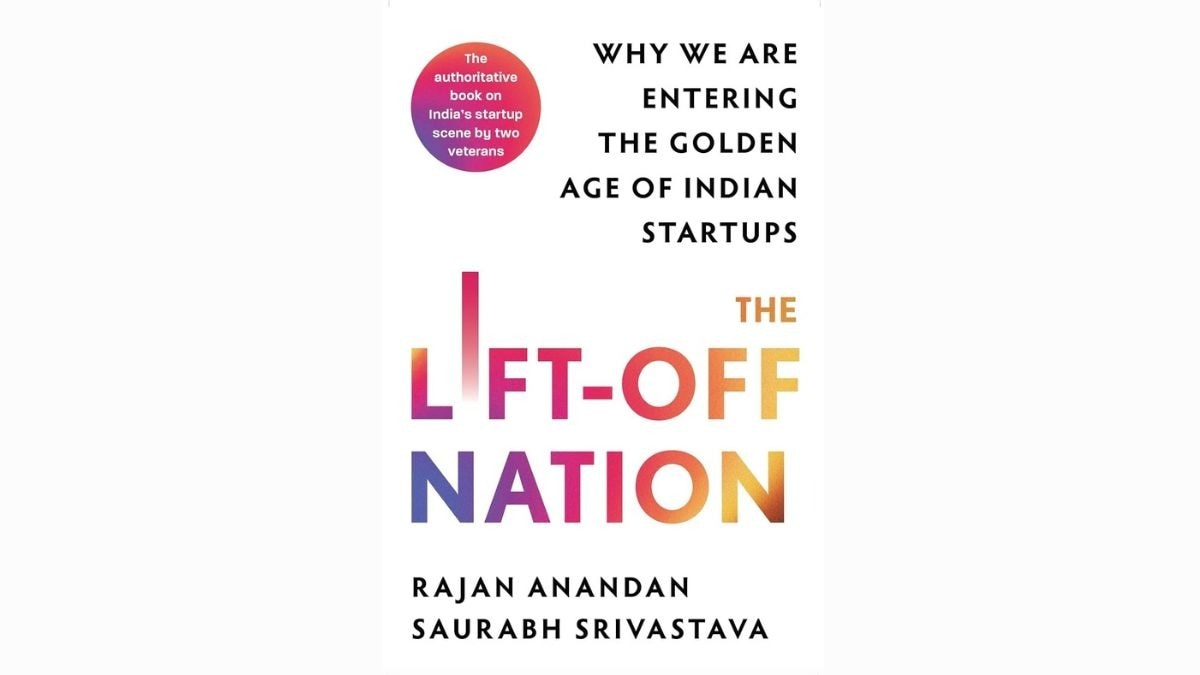
Sometime in the second century, a financier in Alexandria signed a contract with a merchant from Muziris, a port on India’s Malabar coast. The cargo—ivory and textiles among it—was worth 131 talents, enough to make the Indian trader one of the richest men of his age.The papyrus that recorded the deal surfaced in Egypt in the late 1970s, and it is where Rajan Anandan and Saurabh Srivastava begin their book, The Lift-Off Nation: Why We Are Entering the Golden Age of Indian Startups, published by Juggernaut. The duo collaborated to write the book. India once made a quarter of the world’s goods, they remind us; the book asks whether a generation of founders can win back that weight.Srivastava has been asking versions of that question for most of his working life. In 1988, he helped launch NASSCOM, the trade body for a software industry that barely registered back then. A NASSCOM-McKinsey report later forecast that the industry would grow from $2 billion to $50 billion within a decade, and it turned out to be almost exactly right.That report is this book’s model. Srivastava and Anandan, who ran Google India before joining Peak XV Partners, began in January 2023, expecting six months of work. It took three and a half years and more than 180 interviews. The people in those interviews are the book’s real achievement. Take Ram Anant. After nearly two decades in the United States, he came home to Bengaluru in 2007 to run Texas Instruments’ power-management design for Asia, and grew the centre from three engineers to about 150. Then he grew restless.“I was cooked with corporate life,” he tells the authors. In 2023, he regrouped with three former Texas Instruments colleagues. Their company, C2i Semiconductors, designs power-management chips for AI data centres, has filed nine patents, and taped out its first chips in May 2026.Anant’s life is the book’s argument told as a story: an apprenticeship inside a global company, a homecoming, hard technology, a world market. The authors find the same arc everywhere. India’s first startups, Flipkart, InMobi, Zoho and Freshworks, mattered as much for whom they trained as for what they built; the authors call them “founder factories”.Silicon Valley was the other factory. The line runs from Junglee, sold to Amazon in 1998 for $250 million, to Rubrik and Perplexity, and Indian immigrants founded 72 of the 648 American unicorns created between 2018 and 2023, more than any other nationality. Now, some are coming back. Mohak Nahta left Delhi for Carnegie Mellon in 2013, at 18, sure India had too little to return to; he is in the book because he changed his mind.Every chapter opens with a founder before a trend, and Anandan makes no apology: the book, he says, is “not a PhD thesis”. The space chapter follows Skyroot and Agnikul through a sector that had one startup in 2015 and has about 400 now. Mamaearth goes from idea to listing in seven years; PhonePe carries the fintech chapter. By the time the five forces arrive—talent, breadth, global ambition, capital and an enabling state—they read less like a thesis than like the landscape these founders have walked through.Indian business writing has told parts of this story before. In 2008, Nandan Nilekani’s Imagining India argued that technology could leapfrog the state’s failures, and Rebooting India (2015, with Viral Shah) made the case for the digital rails of India Stack. Dan Senor and Saul Singer’s Start-up Nation (2009) made Israel the world’s model and lent this book its title.Then came the sceptics: Kashyap Deorah’s The Golden Tap (2015) read the first funding boom as a poker game played with foreign money, and Mihir Dalal’s Big Billion Startup (2019) told of Flipkart's rise with a reporter’s eye. In 2023, Raghuram Rajan and Rohit Lamba’s Breaking the Mould told India to stop chasing China’s factories and bet on ideas and services.What none offered was the view from inside the machine. Anandan and Srivastava financed what was built on Nilekani’s platform, and they are the first practitioners to argue at book length that startups are India’s road to Viksit Bharat. If Rajan and Lamba said bet on ideas, this is the prospectus for the bet.It is also franker than its title. The research chapter visits brain-mapping work at IIT Madras, an artificial heart at IIT Kanpur and Wockhardt’s drug laboratories, then calls research “quite possibly our biggest Achilles heel”: India spends 0.65 per cent of GDP on it, against 2.6 per cent in China and 3.5 per cent in the US. The last chapter takes on the angel tax that hung over founders for 15 years and governance failures at venture-backed companies.The book went to press in a better season than the one it was launched into. Tech funding fell 17 per cent in 2025, to $10.5 billion, while American funding rebounded 43 per cent. This year’s money held up through September, $10.3 billion and 7 per cent higher, but across 38 per cent fewer rounds. Then came October, the month of the launch: Indian startups raised $678 million, 61 per cent less than a year earlier, and not one round reached $100 million. The exits are real, 18 listings in 2025 and about 15 this year, but most of this year’s debuts have been flat, and by March more than half the 2025 class traded below issue price.On AI, the authors pull in different directions. Anandan wants sovereignty across the stack, down to the chips, and Sarvam’s $234 million raise this year shows some investors agree. Srivastava calls India the “use case capital of the world”, which is closer to where the money goes: AI took 35 to 40 per cent of American venture funding in 2025 and 4.5 per cent of India’s.The prescriptions raise harder questions. The authors want research spending at 3 per cent of GDP, lifting it from $18 billion to $100 billion a year, yet in India the state, not business, pays for most research, and the country has missed its own 2 per cent target every year since 2013. Their remedy for weak demand, reserving at least half of government tenders for Indian products, is the protection Rajan and Lamba warned against.On self-interest, they answer well enough: PhonePe, Skyroot and Agnikul are not their investments. Readers should still know that Srivastava chairs the Technology Development Board’s investment committee for the research fund the book praises. And though he argues a healthy failure rate is nearer 50 per cent, this is a book of survivors.The Lift-Off Nation is the best account yet of how India’s first $400 billion of startup value was made, and a weaker guide to the next two trillion Anandan forecast at its launch. Srivastava expects that by 2030 they will say they were not ambitious enough. Perhaps. But the book’s own opening holds a warning it does not dwell on. The merchant of Muziris had the goods; it took a financier in Alexandria to send them to sea. Ram Anant has his chips. Whether India’s financiers and the boardrooms the authors need to fund a fivefold rise in research will wait as long as the work takes is the chapter still unwritten. Subscribe to India Today Magazine- Ends
Ready for lift-off or still on runway? India's startup story
Full Article
Original Source
Read the full article at Indiatoday →KhanList aggregates and links to publicly available news content. We do not host full articles from third-party sources. Always verify important information with original sources.