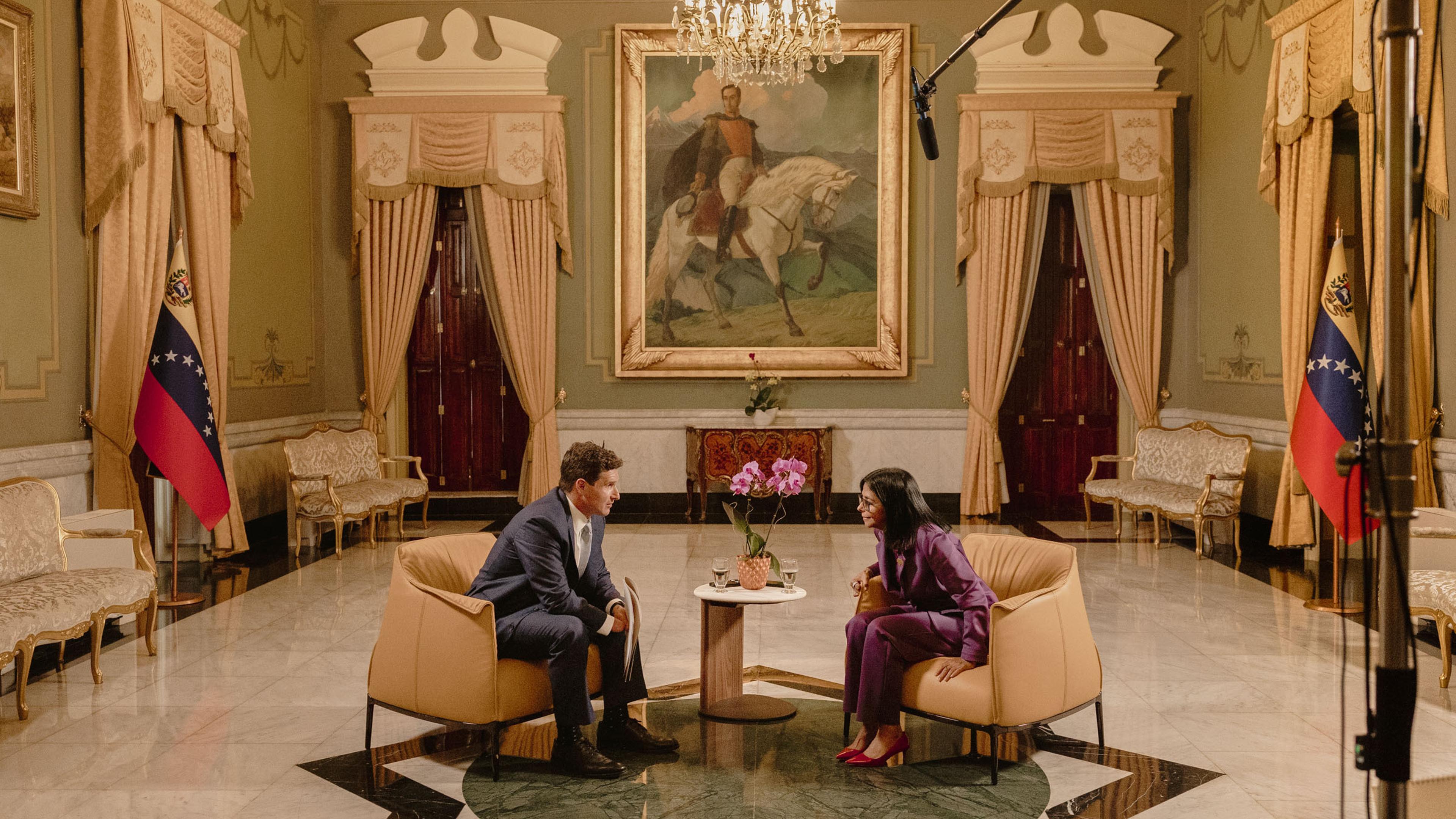
Acting Venezuelan President Delcy Rodríguez sat down with TIME for an interview at Miraflores Palace in Caracas on June 16.Rodríguez discussed the U.S. raid that captured her predecessor, Nicolás Maduro; her relationship with President Donald Trump and Secretary of State Marco Rubio; Venezuela's economic future; and the prospects for a socialist autocracy to transition toward democracy.Below is the transcript of Rodriguez’s interview with TIME Senior Political Correspondent Eric Cortellessa, lightly edited for clarity: TIME: We're in a transitional moment, perhaps a transformational moment. How would you describe your vision for Venezuela, post-Maduro? Rodríguez: I prefer not to label political moments. January 3 marked a turning point for Venezuela. Personally, I felt it was a time of great change. The first thing to change was the political landscape. We needed to seek a new Venezuela, to correct the mistakes of the past so we could move forward into the future. I believe that is the main focus: to drive economic transformation to address the most pressing needs of the Venezuelan people. So all this political and economic change, which seeks to meet socioeconomic needs, is paving the way for a new political era in the country. My daily work leads me to believe that there is a bright future for Venezuela. We’ve accomplished a great deal in just a few months. The reform of laws, legislative changes, and changes in the criminal justice system, and for me, the flagship moment—the program for democratic coexistence and peace—seeks to build a different kind of society. It aims to steer Venezuelan society away from hatred and intolerance and toward a time of understanding and coexistence rooted in diversity. That’s how I see the present and the future. We’ll get into a lot of the points you just raised. Where were you the day of the Maduro raid, January 3, 2026? I was meeting with him until 8 p.m. Then I left for Margarita Island, where my brother and my nephews were. I arrived at Margarita at 11 p.m. The attack took place at 2 a.m., but I was worried because my oldest niece and my mom were in Caracas. How did you find out about it? What was your reaction? My first reaction was that I was keeping a close eye on the radars, and before the attack happened, I saw many planes and called the person in charge of one of the posts of the vice president. If I’m completely honest, we never thought the capital of the country would be attacked, much less imagined what happened to the president and the first lady at that moment. What do you say to people who suggest that you might have known in advance about the attack? No. There’s absolutely no way to say that because I’m telling the truth. When and how did you learn that you would be Venezuela's interim president? Take me into that moment where you realize you're going to take over? First, I have to say that we went through a moment of great anguish when we thought they had killed the president and the first lady. And then there came a moment when we learned that they were taking him to the United States—that changed the situation completely. At that time, I spoke with a leader from another country and he told me ‘Now the responsibility rests on your shoulders, and you have a responsibility to preserve Venezuela.’Who was that leader?The Emir of Qatar. Wow, interesting. Did he reach out to you? How did that conversation happen? No, I sent him a message because I was worried about the situation. And he was in touch with the Trump administration? As I understand it, yes, his prime minister held talks with the government of the United States.Do you consider Maduro to be the legitimate president of Venezuela today, even in absence or do you think it's time for the country to move on? I am the acting president because I was the executive vice president under President Nicolás Maduro. Do you still consider him the legitimate president though? The thing is, I’ll repeat the answer I gave you. It’s within the constitutional framework of a legitimate president who had an executive vice president, and in a situation like the one that arose, which is identical, it falls to me to assume the role of acting president. I understand. You spent decades as one of Maduro's closest allies. What do you say to those who say, who believe, that your government represents not a break from the Maduro government, but its continuation? What do you say to those Venezuelans? Look. Sai Baba. Do you know who Sai Baba is? You know who Sai Baba is? I don't. He is a religious figure. He says that holy acts are known more by the hands that act than by the lips that pray. I believe it’s clear that there’s a different Venezuela. There’s a change that’s evident regardless of whether I say it, you say it, or anyone else says it. There are new laws, there’s a program for peaceful coexistence, there have been significant releases, and there’s an amnesty law. I believe there is a process of transformation underway. Venezuelan society itself is different from what we experienced in the past, and I say that this should be recognized by its actions. This is different than we have in the past. What in your view was Maduro's greatest mistake? We should have been more open geopolitically. As I said in my first actions as acting president, we are moving toward a new relationship with the United States, and I believe that Venezuela’s international relations should be more open and diversified. I also understand that there was a lot of pressure on Venezuela. So I think that was a mistake. Interesting. So the mistake was that he left Venezuela too internationally isolated? And that's part of what you're correcting, it seems like, with these relationships forged with other nations? I am working in good faith and with trust. We must build trust in international relations. Last question on Maduro. Tell me about your final conversation with him? What was it like? What did you talk about? And have you been able — we'll have a quick follow up. My last meeting with him took place, and I’ve said so publicly, we discussed the economic plan for the year 2026, taking into account that Venezuela was under a naval blockade. During the month of December and part of January, Venezuela was unable to sell a single barrel of oil. So we were working hard with the economic team, and that was what I presented to him. Have you been able to have any communication with him since he's been in American federal prison?Very little communication.But you have spoken? You have had communication? No. I’ve received some messages.He sends emails or letters or—how? No, no, just with the lawyers.And have they told you anything of importance? What have they shared? He sees what is happening in Venezuela as very positive. How many people are currently imprisoned for political reasons in Venezuela? There's a recent report that says it’s down to 389. Is that true? On the subject of—quote ‘political prisoners’ unquote, it’s a topic with far too many different versions. We passed an amnesty law to address political violence from 1999 to the present. For example, in 2002, there was a coup against President Chávez. In 2014 and 2017, there were very violent protests; people were burned alive, motorcyclists had their throats slit, health centers were set on fire, schools were set on fire. Before the amnesty law, nearly 900 people were released, and with the amnesty law, nearly 9,000 people were released—more than 400 of them with full freedom, while the rest were subject to court-ordered reporting requirements. In parallel with the amnesty law, there has also been a process of granting relief to those who cannot benefit from the law, and there are more than 500 such people. Just so I understand, more than 500 people have been released since the amnesty law? No, roughly 9,000 under the Amnesty Law; of those 9,400, some were granted full freedom—physical freedom—while the rest were individuals subject to court appearance requirements. However, in addition to the amnesty law, there are more than 500 people who benefited from the law but were not eligible for its provisions. Would you allow an international body to audit those cases? Definitely. I asked the Human Rights Commission about it. And would you commit to releasing all political prisoners, not the ones who committed violence you described, but people who are in prison because of their political beliefs or positions?The fact is, no one is imprisoned for their political beliefs—for example, those who used a drone to [try to] assassinate the president. The drone incident is a well-known, widely reported public fact. That is not a political belief—attempting to assassinate a head of state or planting a bomb in a public square. In other countries, this is considered terrorism and cannot be regarded as a political belief. When will Venezuela hold elections? Venezuela will hold elections when it is ready to do so. And if you think about what I said earlier, after January 3, we had to change our policy. Why? Because there are extremist groups that called for military aggression against Venezuela, and the Venezuelan people—especially those who experienced the attack first hand—felt a great deal of fear. The mothers who feared for the children, the children who were simply afraid. And that’s when I realized we had to change our political approach—that we had been mistaken in our policies—and that’s why the program for democratic coexistence and peace is, for me, fundamental. Because it must lead us to a different political reality where extremists don’t believe that violence is the path to political power, and where we, as a government, recognize that we have political opponents and that those differences will be resolved at the ballot box. You spoke about this but I just want to clarify. What exactly has to happen for those elections to be held? You have to eliminate the threat that you were just describing? What is the criteria for—now we are ready? What has to happen for Venezuela to be ready? I feel that moment will come when all of the country’s political actors reach an understanding and we can tell the nation that we, as politicians, are ready. I always say Venezuela as a country is much greater than the differences among politicians. I would ask young people what they think of politicians, and I hope that the people of Venezuela—the citizens—truly believe that politics is what can help them overcome many challenges in their daily lives. What do you say to those who worry that this is sort of a recipe for endless procrastination? I’ll say it again for you. January 3 marks the beginning of a new political era, and we’re all shaping that era together. For example, the Coexistence Program has already held meetings with more than 30 economic, political, and social sectors across the country. It doesn’t depend on any one person. In this case, it doesn’t depend on any one woman. I hope we can build it together. When that day comes, would you allow international organizations, the EU, the United States, to monitor the elections? The Venezuelan electoral process must, first and foremost, be a national process. Venezuela has a tradition of having international observers in its electoral process, but that international observation must be respectful of the country. It should not involve groups that come to make decisions on behalf of the country.So the answer is yes, but with the caveat that they have to respect your national control and sovereignty over the election. Will you run? I don’t know. Let's talk for a moment about María Corina Machado. Will you allow her to return to the country? Look, I believe that Venezuela belongs to all Venezuelan men and women, and there will come a time, and I dream of that time, when Venezuela will not have a single sanction in place, a time when we can all come together. Extremism has cost the country dearly. From a congressman who proclaimed himself president of Venezuela and spoke of Venezuela’s assets as if they were the King of England, to those who called for sanctions and this invasion. We have to move onto a new political era. So it sounds like the answer is no. No. My question isn’t—my answer isn’t no. My answer was that there will be a political moment when coexistence and peaceful coexistence will be possible. And that this political moment will not involve economic sanctions against Venezuela. Would she be allowed to run for president? I believe, and I’ll say it again, that the situation in Venezuela goes far beyond who participates in an election. The most important thing isn’t who participates. The most important thing is the groundwork we’re laying for this new political approach. Let's move onto the economy. Exciting topic. Venezuela's oil sector has been opened to private investment for the first time after years of state control. Would you say the model of state control over the Venezuelan economy is effectively over? The economic blockade has led Venezuela to adopt innovative mechanisms for private-sector participation. We have incorporated new business models, but our constitution provides for private property and private participation in investments. The legal reforms have been aimed at increasing the return on investment and also providing greater legal certainty. We have just signed a new agreement with Repsol to expand its presence in Venezuela, and I’m going to share some data with you that will be useful for us. According to the International Energy Agency, 80% of the world’s oil wells are in decline, and 90% of global investment is directed toward halting that decline. But here’s the most important fact: Venezuela has 303 [billion] barrels of oil reserves. But of those 303 [billion, many] are green fields, which means that Venezuela represents one of the most significant opportunities for the world’s future energy. That is why my proposal to President Trump and the U.S. government was to develop a long-term energy agenda. Well we're going to certainly get to that in just a moment. But tell me in a story, you become interim president, all of a sudden now there's all this opportunity, potential, for oil investment, how did that begin? How did you get started on having these kinds of agreements and driving in this kind of foreign investment? I was also set to become the minister of hydrocarbons, and I had all these ideas in mind to attract more investment to the country. It was pointless to have those reserves if we couldn’t guarantee benefits for the people of Venezuela, and that’s why we were able to pass the reform of hydrocarbons law so quickly, as those investments that are about to start flowing into the country will translate into income for workers in healthcare, education, and public services. I am very hopeful that everything we are signing, which has been quite a lot, will have a positive impact and bring great benefits to the country. Beyond oil, what is your strategy for rebuilding an economy that saw millions of Venezuelans emigrate? And then to that point, what would you say to the Venezuelan engineer or doctor living in Miami, about why they should come back? Look, I’d like them to come back today. I set up a registry so that young professionals and entrepreneurs who want to join this economic initiative can sign up there. More than 56,000 young Venezuelans have registered in just one month, and right now the system is routing those who want to start a business to the “Emprender Juntos” program. We’re collecting data on professionals to make it available to the companies we’ve partnered with. We’re working toward Venezuela in 5, 10, 20 years. Venezuelan migration was an economic migration. Venezuela has always welcomed immigrants, nearly six million Colombians arrived in Venezuela, and Venezuela has always been welcoming and has incorporated and integrated Spaniards, Italians, Portuguese, Ecuadorians, and Colombians. I want those migrants to return to Venezuela, which is why I was telling you that this country belongs to all Venezuelan men and women. I was a migrant for 10 years, but the country always calls you back. Can Venezuela diversify beyond oil or will it always remain an energy state? Venezuela has an economy with great potential due to its diversity—not only in the area of hydrocarbons such as oil, but also natural gas, which will allow us to develop the petrochemical industry, which will have a major impact on the national economy. But we also have mining operations with some of the largest reserves of gold and diamonds. We have iron reserves sufficient for 350 years, and we have aluminum. In other words, Venezuela possesses a very significant diversity of minerals. We also have water for agriculture, millions of hectares available for food production, and a tourism sector that we would like to develop. Venezuela boasts a diverse range of landscapes, including deserts, plains, snow, beaches, mountains, forests. Of course a big mark of progress where you got commercial flights to and from the U.S. Made life easier for me, certainly. Trading, too. Retail. The United States is a key driver of digital retail commerce.I want to talk about the U.S.-Venezuela relationship and work that you're doing with the Trump administration. Can you explain—let's just start with oil and then branch out—how the U.S. is managing Venezuela's oil reserves? What exactly is the agreement that was reached after you took over for Maduro? The most important thing is that companies from the United States are returning and arriving. The first hydrocarbon operation in Venezuela took place 114 years ago. It was the New York and Bermúdex Company, an American business. We’re not doing anything out of the ordinary. Chevron has been in Venezuela for over a century. What’s happening here is that companies that were here in the past are returning, but also new companies are arriving. Halliburton, for example, has returned. Haliburton came back. Can you give me two or three of the new ones? Oof. There’s a lot. Haliburton is a good company. It’s significant that companies that attended the meeting with Trump are here. But there are also companies that came with Secretary Burgum and Secretary Wright. We are currently negotiating 30 agreements. Is this done with the government's cooperation? We are always in communication and dialogue.Well it's not just energy, oil, and trade. It’s also security. Recently, the U.S. and Venezuela participated in a joint operation to kill a leader of the Tren de Aragua gang. Can you just tell me: How did that come about? It was not a joint. It was a combined … Well, it was a joint operation. What are we combining? Intelligence information, and on the ground, we have our security forces. The important thing is that there are opportunities for joint cooperation—joint cooperation against drug trafficking, for example, against transnational organized crime. That is very important to us, so I believe, and as we said, we congratulate the officials who participated in this operation. So you supplied intelligence to the United States that helped them locate—And vice versa. And vice versa. Your forces were on the ground but the United States authorized an airstrike. YesObviously, Tren de Aragua is a big preoccupation of President Trump’s. Should we be expecting more of this kind of cooperation? Look, we have, I repeat, anti-narcotics cooperation with European countries, such as France. We’ve also spoken with Colombia. Will you and the Trump administration continue to target more of Tren de Aragua together? Yes… it’s also transnational, but again, that’s nothing out of the ordinary. It’s just part of judicial, police, and security cooperation with other countries. Mexico and the United States have cooperation agreements. I'm not saying it's unusual. I'm saying it's a factor in terms of bringing people back to Venezuela, getting tourism, because obviously security is a concern for many people. Another Latin American leader who has driven down crime and opened up their economy, President Bukele in El Salvador. Are you considering adopting any of the tactics he has to reign in gangs and violence? As for what has been done in El Salvador, I’d rather not comment on other countries. I’ll just say that I wish things were different in Venezuela. How often do you speak with Secretary Rubio? My understanding is that you both talk a lot. What are those conversations like? As many times as necessary. Why do you think he took such an interest in Venezuela?Well, we’re talking about a country that is a major player in the hemisphere. And what I see is that Secretary Rubio is interested not only in Venezuela, but also in the rest of the countries in our continent. He serves as secretary of state and is responsible for international affairs, that is the world. I was foreign minister and [unintelligible].Tell me about the first time you spoke with President Trump? I think it was January 4, but I don’t remember. What did he say to you? Tell me about that conversation? He was very kind and very respectful, for which I am grateful, and from the very beginning, during my first conversation with President [Trump], I asked that our relationship be based on mutual respect. What did he say?He responded respectfully. We discussed how diplomatic relations between Venezuela and the United States could be established and what areas of common interest might be identified. And what were they? What was the path of establishing diplomatic relations? Look, I think we’ve moved quickly because just a few days later—I think 12 days later—the first Chargé d'Affaires arrived for two hours, and then Barrett arrived, who I think has been here for five weeks and has been very active as well. Just like the former Chargé d'Affaires, and our diplomatic staff who went to the United States and are currently here. Yeah well the United States' relationship with Venezuela right now was unimaginable a year ago. What changed? I’m starting out by acting in good faith and trusting that these relationships can develop in good faith; and on the side, there’s a very full cooperation agenda that needs to be addressed. Do you and President Trump have a personal rapport, relationship now? and what has surprised you the most about him in private? I’ll say it again. He was straightforward when we spoke. Let me give you an example. One morning, Secretary Rubio called me and said ‘I’m going to put you on the line with someone who wants to say hello.’ It was President Trump, calling to tell me that he was going to approve commercial flights to Venezuela. So everything was very specific and focused on our agenda for work and cooperation. I want to get into your legacy. But are you worried if a Democrat wins the next election and reverses Trump's Venezuela policy, what happens to your strategy for the country's future? Look, my current and future strategy has always been to ensure peace and tranquility in the country—tranquility and social and economic wellbeing. I try to ensure that another country’s domestic policy does not affect Venezuela, and I hope that Venezuela does not become a pawn in any other country’s political agenda.If Hugo Chavez were alive today, do you think he would recognize the Venezuela that you're building? Yes, absolutely. He maintained relations with the United States—for example, the country’s largest oil exports went to the United States—and there was cooperation on security matters. So Chávez always—and this is enshrined in the constitution—promoted the coexistence of the public and private sectors, and most importantly, the program of social protection and social and economic support for the people.And so when you look back over all broadly with the Chavez era, do you feel pride, regret? Both? How do you look back? I think Chávez left a very important legacy during the Fourth Republic, large segments of the population–espeically the poorest—were excluded from the country’s political and social life. And I believe that is the legacy Chávez left Venezuela through the Democratic Coexistence” program. I have said that today everyone can sit at the table—on the republican side, that is–so now it’s up to us to bring everyone together.So what from the Maduro-Chavez era do you want to keep and what do you want to get rid of? Look at the social protection programs. They show that the Venezuelan government is looking out for those who need it most, that there’s room for all of us here, and that just as the economic sectors are supported, so too are the most vulnerable. Let me give you an example. No one could explain how, in an economy that contracted as severely as Venezuela’s, such immense efforts were made to guarantee food for the most vulnerable—for 4 million families truly impacted by the economic blockade. In 2020, during COVID, Venezuela had no access to its financial resources, yet we administered 70 million doses of free vaccines to the population. I believe in a country where the president or government officials do not consider themselves the owners of the country. I believe in a Venezuela for everyone, regardless of who is here. Final question because I know you have to go. What is the single hardest decision you've made since taking office? And what does success look like for your presidency five years from now? I think the cooperation that we’re receiving has made me very happy to sign agreements with the company IMPSA, and General Electric makes me very happy to negotiate with them because you can’t imagine the relief the people will feel when their electricity service is up and running, regardless of the political dynamics. The people of Venezuela will feel the impact of what’s being done. This makes me happy. Thank you. I appreciate your time. Thank you.
Read the Full Transcript of TIME’s Interview With Venezuelan President Delcy Rodríguez
Full Article
Original Source
Read the full article at Time →KhanList aggregates and links to publicly available news content. We do not host full articles from third-party sources. Always verify important information with original sources.