
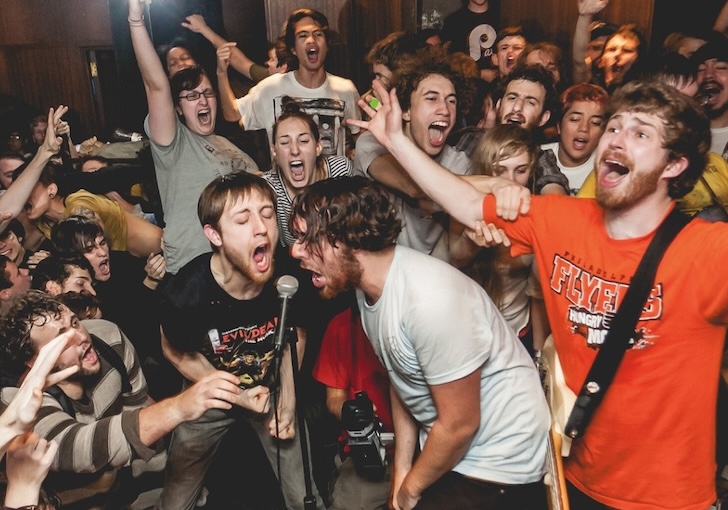
For years, Andrew Sacher served as the resident emo aficionado at BrooklynVegan, shedding light on up-and-coming bands that other sites weren't covering. He first announced his emo revival book back in 2023, and the anticipation has been ramping up in recent months as the publication date approaches. But just last month BrooklynVegan — along with Alternative Press, Revolver, and Goldmine — were hit with massive layoffs by their parent company Veeps. Sacher will continue championing emerging acts on his Substack, and his book, Emo Revival: Community, DIY, And Rebirth In Post-Hardcore And Emo (2008-2018), hits shelves next week. Below, read an excerpt that centers on Stereogum faves Joyce Manor.***A few months before Algernon traversed the US with Snowing and 1994!, they did a West Coast run in January of 2011 with the Oakland-based Topshelf band Big Kids. It was on that tour that Algernon played their first shows with Joyce Manor.“I’ll be honest, when I first heard the [Algernon] record, I was like, This is just Cap’n Jazz,” admits Joyce Manor’s Barry Johnson. “But my friends were so into it, and it was just being played all the time, and I was like, ‘Alright, this song ‘Some Kind Of Cadwallader’ is pretty good, that’s a banger.’ And then we played some shows with them and I was like, ‘Okay they’re fucking sick.’ I saw it live and I got it.”“Those guys are just the best. They’re so fun, and funny, and talented,” Barry says, adding with a laugh: “I don’t know why they like us.”The feelings truly were mutual, and Joe Reinhart was just as floored by Joyce Manor at those shows as Barry was by Algernon. “I honestly remember being like, Holy shit. I instantly loved it,” Joe says. “As soon as they started playing — they were halfway into the first song and I was like, ‘I fucking love this.’ And then we became friends, and have done a lot of things together since then.”Algernon and Joyce Manor’s first show together was at San Diego’s legendary DIY spot Ché Café on January 4, 2011, the same day that Joyce Manor premiered an early stream of their self-titled debut album on Punk News, prior to its official release.After signing to 6131, Joyce Manor were feeling the pressure to deliver something great. They were given a budget of about $800 — still a small amount in the grand scheme of things, but a lot for a band who barely came up with the $200 that it cost to record their last EP — and they knew that 6131’s reputation meant people would hear the record. They were also worried about who would be hearing the record, as the only non-hardcore band on a hardcore label.They decided to treat the album like it was a “best-of”; they re-recorded a couple of fan faves from the EP (“Leather Jacket,” “Constant Nothing”) and they did proper full-band studio recordings of some longtime staples of their live set like “Beach Community” and “Derailed.” They wrote some entirely new material too, including a song that instantly stood out within their catalog, album closer “Constant Headache.” Like their heroes in Guided By Voices, Joyce Manor loved brevity and would frequently write songs without intros, outros, or bridges, songs that would clock in between one and two minutes and sometimes not even repeat a chorus. At three minutes and four seconds, “Constant Headache” was the slowest, longest song the band had written to date, and it came with a bridge where the guitars cut out, the drums gradually fade away, and Barry sings a couplet that fans would scream their lungs out to show after show after show:“…I still wish I could have seenYou having sex in the morning, your love was foreign to meIt made me think maybe human's not such a bad thing to beBut I just laid there in protest, entirely fuckedIt's such a stubborn reminder one perfect night's not enough”The song came to Barry on a bus ride, and it was one of those songs that even he could tell was special as soon as he wrote it. “It was just a super inspired moment,” he says. “I wrote the whole song, and another verse [that we cut], like, effortlessly. I had nothing to write it down with; each line came so easy.”"I was moved by it when I wrote it. I was like, Holy fuck, how did I write that? I was choked up.”"It was hard for me to show people... I kinda thought people would laugh,” he says. “It was super vulnerable. But I've learned as time goes on that you have to lean into those things. Being brave about doing stuff like that that might be embarrassing, that's what people are gonna connect to.”As Joyce Manor geared up to go into the studio, they painstakingly went over every detail of the album, from the sequencing to the most minor embellishments. In the weeks leading up to the recording, Barry barely slept.The band went back to Alex Estrada to make the record, and Alex had the idea to model the production style after Pinkerton, Weezer’s raw, scrappy sophomore album that was initially considered a critical and commercial failure but became a cult classic over time, especially in emo circles. Barry loved Pinkerton and embraced Alex’s idea without thinking twice, but when he heard the results, he was disappointed with how it came out. “In my head it sounded poppier, more like [Weezer’s] Blue Album or something,” he says. “But then when we actually went to play the songs, it was like, we don't sound like that.”It might not have been exactly the same record that Barry was hearing in his head, but it didn’t take long for the band to realize that people really liked it for exactly what it was. Joyce Manor loved big, catchy radio records like Blue Album and Enema Of The State, they loved lo-fi indie rock bands like Guided by Voices, and they had footing in the hardcore scene, the folk punk scene, and the burgeoning emo revival scene, all of which comes across on the record. It had a familiarity to it, but it blurred lines in a way that felt refreshing and original."Often what you're trying to do — you're better off having missed the mark because that's exactly what people are enjoying about it,” Barry says. "I think people like that it sounds like a band playing a basement. That's how those songs sounded at band practice. We didn't know how to 'make a record' back then.”"I've been making records that sound more like what I was trying to make since then and people don't like 'em as much,” he laughs.One person who had confidence in the record from the moment he heard it was Joey Cahill at 6131. Joey knew that, as long as the right people heard it, something would happen for this band and this record. “It's lightning in a bottle,” he says. “It’s not their best record, because they clearly have gotten better as a band, but there's something about that record.”Joyce Manor celebrated the album with a release show on January 15 at the Blacktop in Bell Gardens, CA, as direct support for Touché Amoré. Touché had signed to Deathwish at that point, and at the request of Deathwish’s Tre McCarthy, the opening band before Joyce Manor was another band that the label had their eyes on, a new black metal band from San Francisco called Deafheaven. The show took place in a warehouse-type space without a proper stage and drew about a few hundred people. For all in attendance, the energy for all three bands was undeniable.Joyce Manor’s album had only been streamable for 11 days, but there were already people singing louder than the band on the bridge to “Constant Headache.” And when they ended with “Five Beer Plan” from the EP, the crowd went berserk. Nearly every person in sight screamed the words at the tops of their lungs and then broke out into a circle pit during the song’s fast-paced coda."It felt immediate, even just from the record release show,” says Joey. "From that point it was just like, everyone who heard the record loved it.”As Joyce Manor started to do well in and around their hometown, word about the band began spreading thanks to a newly popular social media website, Tumblr, where images and gifs with “Constant Headache” lyrics proved to be very, very rebloggable. But Joyce Manor was not an overnight success. Their rise was very gradual, and as they left the West Coast for their first full US tour that summer, they played to one small crowd after the next. Still, being miles away from home and having anyone care felt like a success at that time, like when they played their first-ever New York City show for about 40 people at a DIY spot in Bushwick called Party Expo.“That album came out and it was just so talked about instantly,” recalls Jade Lilitri, whose band State Lines opened the show. “We were like, This show's gonna be crazy!… The whole night, it was just bands playing to bands.”“They're setting up, and there's like nobody there,” Jade continues. “10 minutes later, by the time they're ready to start the first song, I turn around, and it's like... it was 40 kids or whatever, but it looked fucking packed.”"That was such a fucking slam dunk to us,” Barry says. “We went to New York and there were fucking 40 people there! That's how low the bar was: We made it, we did it, we played New York and there were fucking people there. Amazing."The next night, Joyce Manor went to Philly, where they met back up with Algernon and played the homecoming show for the Algernon / Snowing / 1994! tour at the Fire."That was a really big show," Barry says. "Not for us; we were second. I think the Algernon guys were singing along, but most people didn't know who we were.”Emo Revival: Community, DIY, And Rebirth In Post-Hardcore And Emo (2008-2018) is out 9/8 via Clash. Pre-order it here. On 9/16, Sacher will be in conversation with Chris Payne, author of Where Are Your Boys Tonight?: The Oral History Of Emo's Mainstream Explosion, 1999-2008, at Brooklyn's Book Club Bar. Find more information here.
Read An Exclusive Excerpt From Andrew Sacher’s New Book Emo Revival
Full Article
Original Source
Read the full article at Stereogum →KhanList aggregates and links to publicly available news content. We do not host full articles from third-party sources. Always verify important information with original sources.