
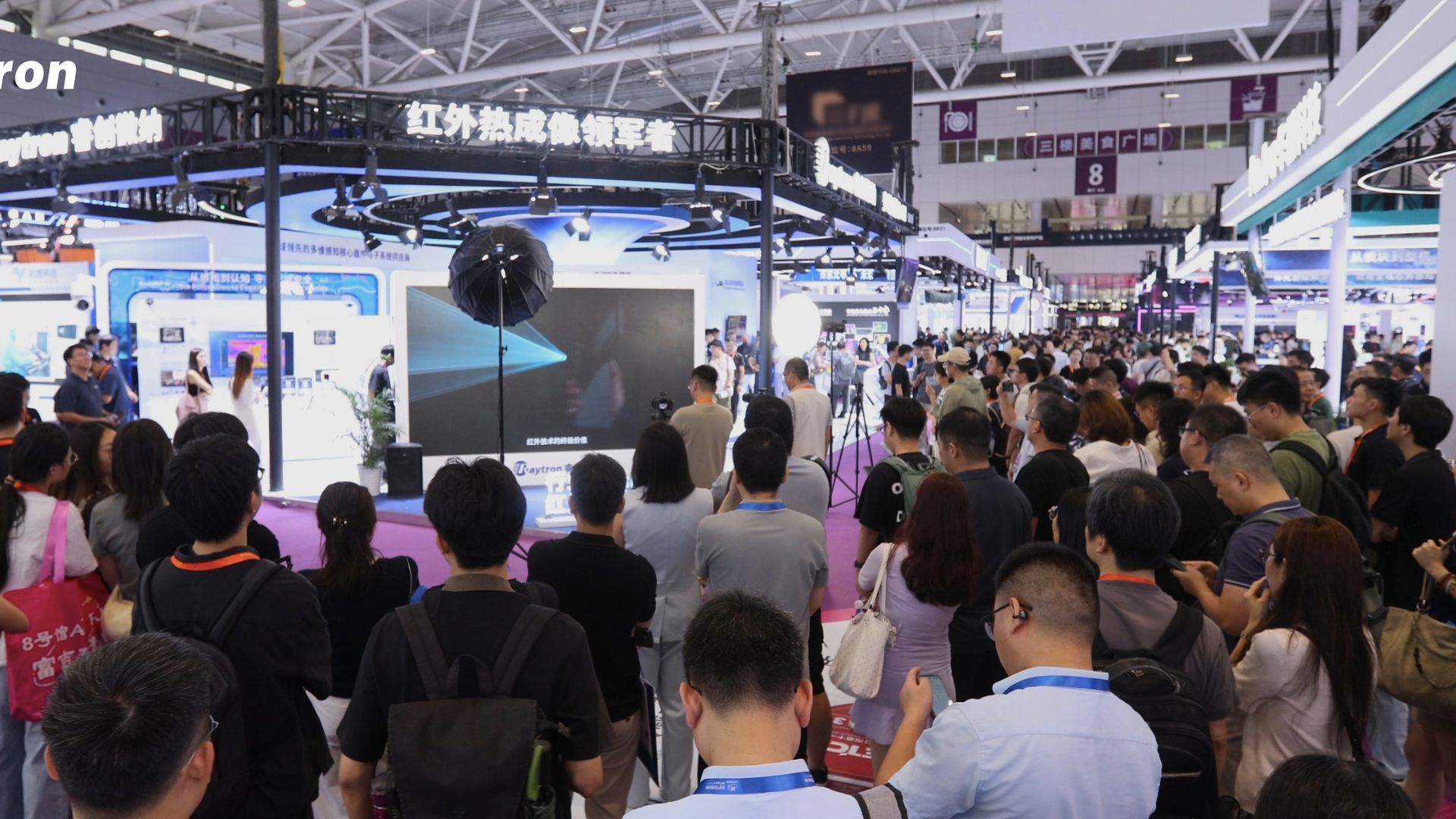
Thermal imaging is moving beyond simply capturing heat signatures. At CIOE 2026, Raytron unveiled an Infrared Vision-Language Model (VLM). The system is designed to enable thermal imaging systems to interpret and understand what they see. The development marks a significant step toward more intelligent infrared sensing. Interpreting information from the physical world The development comes as artificial intelligence increasingly moves from conventional image recognition toward systems capable of interpreting information from the physical world. Raytron’s new approach focuses specifically on infrared imagery, where temperature, heat distribution and thermal signatures provide information that conventional visible-light cameras cannot capture. Most modern vision-language models have been developed primarily using large datasets of visible-light images. Thermal cameras, however, produce fundamentally different visual information.Rather than relying mainly on reflected visible light, infrared cameras detect radiation emitted by objects. This allows them to reveal temperature differences, heat patterns and thermal anomalies that may not be visible to the human eye. Infrared Vision-Language Model According to Raytron, its dedicated Infrared Vision-Language Model is designed around these characteristics rather than treating thermal images simply as another form of conventional imagery. The company says the model is supported by more than five million proprietary multimodal infrared data samples covering applications such as industrial temperature measurement, night vision and gas detection. The model incorporates a dedicated infrared visual encoder intended to capture thermal distributions and other infrared-specific signal features. This could allow AI systems to move from identifying objects in thermal images toward interpreting what those objects and thermal patterns mean in a particular environment.One of the most significant aspects of the announcement is the emphasis on application-specific understanding.Raytron says its model has been trained for scenarios including gas detection, electrical inspection and perimeter monitoring. For gas detection in particular, the training data covers gases including methane, sulfur dioxide, ethanol, R-134a, R-152a and sulfur hexafluoride.The company says the model is designed to account not only for the appearance of gas in infrared imagery but also for factors such as gas-plume patterns, dispersion behavior and background interference. These characteristics are important because thermal imaging systems operating in industrial environments must distinguish meaningful thermal or infrared signatures from surrounding conditions. AI-enabled infrared system can identify anomaly automatically This represents a broader shift in the role of thermal cameras. Instead of producing an image that must subsequently be interpreted by an operator or separate software, an AI-enabled infrared system can potentially analyze the scene and provide a higher-level description or identify an anomaly automatically. Another important element of Raytron’s approach is edge AI deployment.Rather than sending thermal data continuously to a cloud-based AI service, the company says its technology can run locally using hardware acceleration on edge chips. Local processing can reduce latency and limit the amount of sensitive visual data that needs to leave the device.For industrial inspection, infrastructure monitoring and security applications, this capability could be particularly relevant. A thermal camera deployed in the field may need to detect an abnormal temperature, recognize a potentially dangerous situation or identify an unusual pattern without depending on a constant cloud connection.The approach also fits with a wider industry trend toward combining sensors, processors and AI capabilities closer to where data is generated.Raytron’s announcement at CIOE 2026 was not limited to the vision-language model. The company also introduced Falcon 500, its third-generation infrared AI image-processing chip.According to Raytron, Falcon 500 combines infrared image processing with intelligent sensing, multimodal integration and precision temperature measurement. The company describes the chip as a dedicated infrared AI image-processing solution designed to handle the specific requirements of thermal imaging systems. RRaytron Microelectronics+1Dedicated processing is important because infrared detector data can be affected by issues including temperature drift and non-uniformity. Infrared image-processing hardware can perform functions such as correction, noise reduction and image restoration before the data is used for AI analysis.By bringing these functions into a dedicated chip, Raytron is targeting systems that can combine image enhancement, AI inference and temperature measurement within the same hardware platform.Get the latest in engineering, tech, space & science - delivered daily to your inbox.Prabhat, an alumnus of the Indian Institute of Mass Communication, is a tech and defense journalist. While he enjoys writing on modern weapons and emerging tech, he has also reported on global politics and business. He has been previously associated with well-known media houses, including the International Business Times (Singapore Edition) and ANI.
Raytron brings AI understanding to thermal imaging with new infrared vision-language model
Full Article
Original Source
Read the full article at Interestingengineering →KhanList aggregates and links to publicly available news content. We do not host full articles from third-party sources. Always verify important information with original sources.