
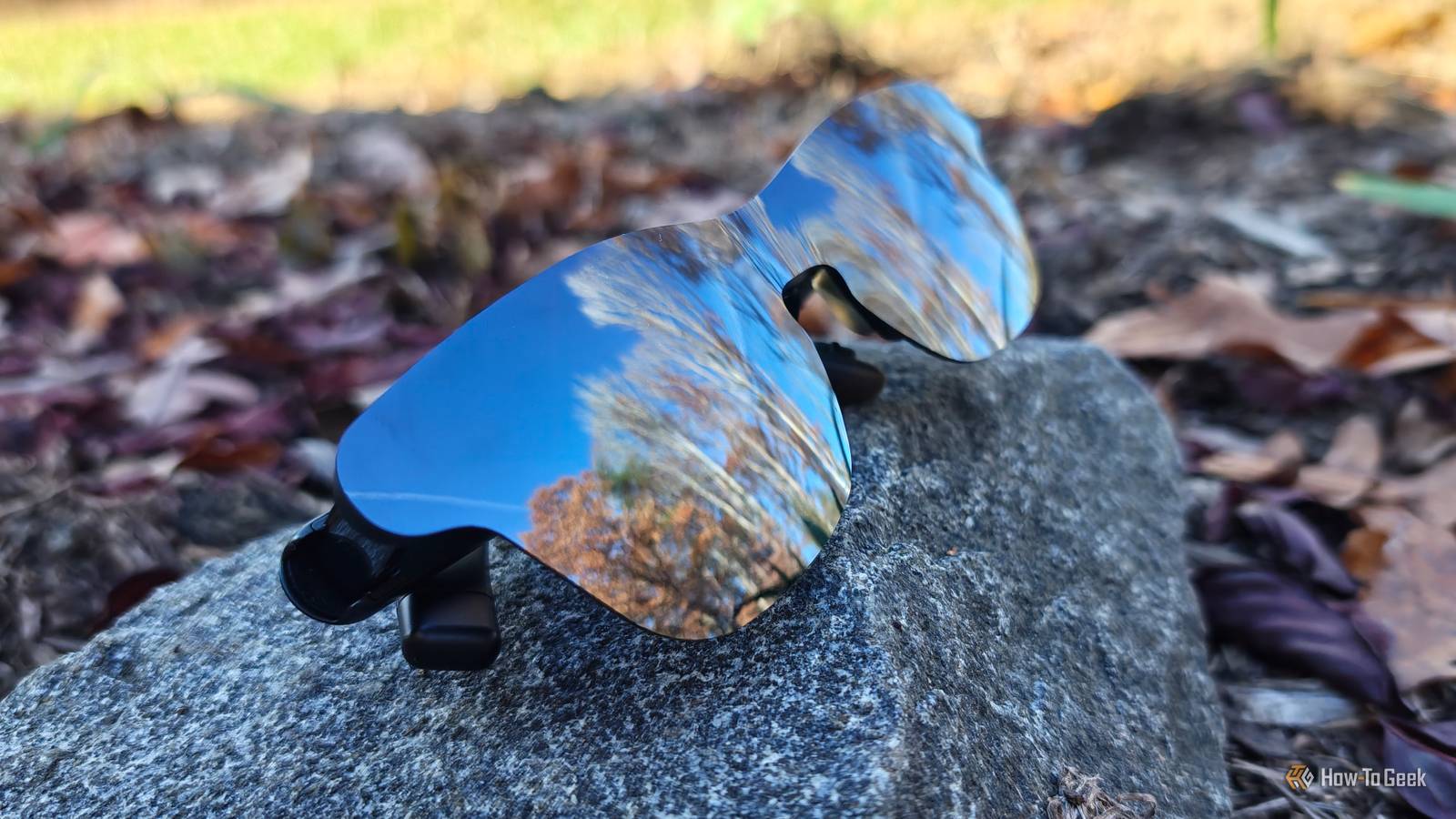
Published Nov 25, 2026, 2:00 PM EST Bertel is a lifelong tech enthusiast with over a decade of experience writing thousands of articles about Android devices, Linux, and more. Before joining the How-To Geek team, Bertel wrote for the likes of MakeUseOf, MakeTechEasier, and Android Police—at the latter he wrote over 3,500 articles. He delights in helping others decide which tech to bring into their lives... and which tech to do without. Bertel graduated from the College of William and Mary in 2012 with degrees in History and Government. He has spent his entire career as a tech journalist covering Android, Linux, wearables, smart home devices, and more. RayNeo has come a long way in a short time. When we reviewed the RayNeo Air 2S two years ago, they were a bulky affair despite "Air" being in the name. The RayNeo Air 3S Pro was still large, as all display glasses are, but it looked decidedly less budget. Now, I have my hands on the RayNeo GT Max AR glasses, and even when placed side-by-side with the more premium XREAL One Pro, there's a case to make that RayNeo's glasses are the better-looking of the two. I'm not saying that RayNeo has fully closed the gap with XREAL, but its latest AR glasses may just be the most well-rounded and easiest to recommend. RayNeo GT Max AR glasses 8/10 Brand RayNeo Speakers Yes With a 307-inch virtual display and a 59-degree field of view, the RayNeo GT Max AR glasses are designed for a cinematic experience and gaming. Pros & Cons Large, steady virtual display Very competitive price port Pocket TV is the ideal video companion No electrochromic dimming Awkward menu navigation Price and availability The RayNeo GT series includes two pairs of glasses, the GT and the GT Max. The GT costs $330, and the GT Max goes for $100 more. Both are available directly from RayNeo, Amazon, and Best Buy. Specifications Brand RayNeo Speakers Yes Weight 78g Refresh rate 120Hz (2D), 60Hz (3D) Resolution 1920 x 1080 Field of view 59 degrees Connectivity USB-C Max brightness 1,200 nits Good-looking glasses, despite being comically large RayNeo’s style is catching up with the competition To be clear, the RayNeo GT Max is not a successor to the RayNeo Air 3S — there's a newer Air 4 Pro that you can buy. This year instead marks the debut of RayNeo’s GT and GT Max. Ironically, the GT Max is quite a bit slimmer and sleeker than the Air 4 Pro, despite the impression that the names “Max” and “Air” would give. The GT Max looks quite striking with its very thin glass across the front, yet like other AR glasses, there's no mistaking these for regular frames. The glasses are a bit too large and sit too far from the eyes to pass in that way — and that's before you consider the mandatory wire hanging down from the right stem to whatever device you've connected. The GT Max comes with two SeeYa 0.6-inch micro-OLED panels, each with a resolution of 1920 x 1080. They offer a 59-degree field of view, two degrees larger than the pricier XREAL One Pro serving as my current pair of AR glasses. The refresh rate goes up to 120Hz when viewing 2D content and 60Hz for 3D. RayNeo's built-in interface is easy to navigate. A button on the left opens the menu. The volume rocker next to it switches between options. Pressing the menu button when the menu is open confirms a selection; double-pressing goes back; holding it down exits the menu. The menu contains all the options you hope to see, logically arranged, with little fluff. Display glasses remain a refreshing product category in that way. The glasses also have spatial sound developed in partnership with Bang & Olufsen utilizing four speakers. You can see the speakers symmetrically placed on each stem. I quite like the case these glasses come in, which is smaller than XREAL's while also doing a better job of storing the USB cable. I've kept the plastic caps the cable came with to keep it from scratching the glasses when not in use. This has made it easier to keep the glasses on hand. A maximum experience in some areas but not others These glasses punch above their weight, but they’re missing a few key features RayNeo sent me GT Max, which offers a virtual display of up to 307 inches and a 59-degree field of view. This is the key differentiator between it and the non-Max model, which maxes out at 231 inches and a 46-degree field of view. It’s an impressive feat, but it’s also a double-edged sword. When the display’s set to its max size, you can’t actually see it all at once. It’s akin to sitting in the front row of an IMAX movie. That said, while 307-inches feels a bit unnecessary, the 59-degree field of view is worth the extra money. You can shrink the display size on the GT Max, but you can’t increase the field of view on the cheaper model. There is built-in 3DoF tracking, which means the glasses can arrange and remember window tracking relative to your head position, but they can't remember a window's location in one room as you walk into another. That would be 6DoF, which I experienced in my Samsung Galaxy XR review, and you can also see in my colleague’s review of the XREAL AURA. This 3DoF manifests in three types of screen placement: Follow, Steady, and Pinned. Follow keeps the screen in a fixed position directly in front of your eyes at all times. Steady does the same, but the screen moves more gradually. This makes movement less jerky, as the glasses don't try to follow your micro-movements. Fixed keeps the screen in one location the way a real screen would be. These three options separate these glasses from less expensive options and make them more viable as computer monitor replacements, as I learned firsthand. The GT Max has proven so steady and stable that I've found them comfortable to watch video on for hours at a time, which was not my experience when I was limited only to the Follow option on my older XREAL Air 2 Pro. Unlike the XREAL One Pro, there is no electrochromic dimming, which would allow you to dim the background behind your virtual display to make it easier to view. As someone who has grown used to that feature, its absence is deeply felt. RayNeo's glasses are simply more difficult to use near windows and in particularly bright rooms as a result. Don’t bother trying to use them outdoors on a sunny day. These glasses are far from unusable, but you will have to give more thought to where and when you put them on. As for sound, I’m using the built-in audio to play music while I write these words in the desktop mode baked into my Motorola Razr Fold, and I’ve relied exclusively on the glasses to provide sound while watching TV and YouTube. I’ve only felt compelled to reach for earbuds when I need to block out background noise. The sound quality has been enjoyable all on its own. Paired with Pocket TV Pro, I’d choose this over more expensive VR headsets Display glasses are perfect for watching video and playing games, but there’s a giant asterisk. At the end of the day, they’re just monitors for your face, and they don’t come with their own input method. That means how well everything works depends on the software on your phone or PC. I like Samsung DeX, but it's a janky way to watch Jellyfin. Opting for a device with Android XR is better, but pinching and tapping in the air to pause can still get awkward. So my experience was greatly improved by the fact that RayNeo also sent me its Pocket TV Pro to go along with the GT Max. The RayNeo Pocket TV Pro is a follow-up to the prior Pocket TV, a device roughly the size of a fat TV remote. You can think of Pocket TV as Google TV in your pocket. There is no attempt here to adapt the experience to AR. You’re simply watching Google TV on a flat virtual display — and it's perfect. Pocket TV Pro simply boots up quickly to Google TV, and the controls are nearly identical to any Google TV remote that comes with your TCL or Hisense TV. With a few taps, I'm back to whatever I was watching on Netflix or YouTube, with little thought that I'm viewing a virtual display instead of a TV or projector. The “Pro” comes from the addition of Dolby Vision when used in conjunction with the GT or GT Max. There are also two USB ports, so you can charge while you watch. Of the two additions, the latter is the one I value more. Up to 5.5 hours of battery life isn’t much if you aren’t charging after each use. Because of the Pocket TV Pro, I do not reach for my phone when I want to watch video on the GT Max. It’s also because of the Pocket TV Pro that I fully intend to continue reaching for the GT Max when I want to watch Netflix or Jellyfin, even after my XREAL AURA arrives. You don’t have to buy the Pocket TV Pro alongside this product, but I highly recommend you do, because the GT Max really feels complete when these two devices pair together. As for gaming, the GT Max can plug into a Steam Deck or any other PC gaming handheld you may have lying around. Unfortunately, I don’t have any of those. I only have a Nintendo Switch 2, and to use this handheld with these glasses, I would need to part with $90 to buy RayNeo’s JoyDock. Instead, I downloaded Iron Marines to my Razr Fold and played that using a Bluetooth mouse, just as I would if I were sitting at a PC. Like many mobile games, it scales just fine to this massive display, and the colors look great. But if you do want to play PC games with the glasses, and you also lack a PC handheld, an Nvidia GeForce Now or Xbox Game Pass subscription will serve you well. I’ve completed quite a few games by pairing cloud gaming with AR glasses and a Bluetooth controller. It’s a good time. Should you buy the RayNeo GT Max? You should buy the RayNeo GT Max if: You want an even larger virtual display You primarily want AR glasses for multimedia You want to save money with few compromises You should not buy the RayNeo GT Max if: You can't do without electrochromic dimming You want an ultrawide display You want to experiment with mixed reality The RayNeo GT Max AR glasses are built to be immersive for video first and foremost. With a comfortable design, steady head tracking, and attractive optics, RayNeo has pulled it off — and it has done so at a price point low enough that you can add the worthwhile Pocket TV Pro add-on and still not spend as much as you would for similar glasses from XREAL. If electrochomic dimming isn't a must-have feature for you, then I handily recommend these glasses. They are among the best I’ve worn yet. RayNeo GT Max AR glasses 8/10 Brand RayNeo Speakers Yes With a 307-inch virtual display and a 59-degree field of view, the RayNeo GT Max AR glasses are designed for a cinematic experience and gaming.
RayNeo's latest AR glasses deliver an unmatched virtual cinematic experience
Full Article
Original Source
Read the full article at Howtogeek →KhanList aggregates and links to publicly available news content. We do not host full articles from third-party sources. Always verify important information with original sources.