
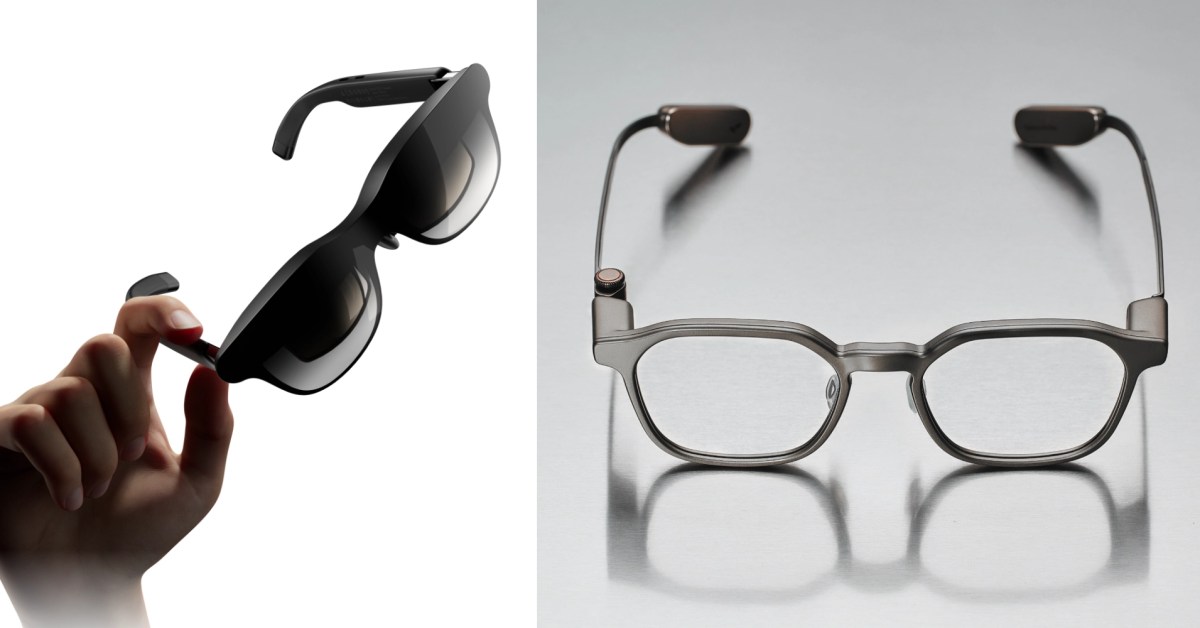
Still waiting for tech like the Vision Pro, but in normal everyday glasses and sunglasses? The industry leader in AR glasses shipments has something to say. The best Apple accessories share a distinct DNA: immaculate industrial design, lightweight ergonomics, tactile physical precision, and friction-free performance that feels native from minute one. Launched globally this fall, the RayNeo GT Max and RayNeo iO pair premium materials and bleeding-edge optics with the one thing Mac and iPhone owners actually want from a display accessory — plug it in, and it works. RayNeo isn’t a small player making a big claim here. The company took the No. 1 spot in global AR smart glasses shipments across the first half of 2026, with 24.8% market share according to IDC and 23.9% according to Counterpoint Research. Its Black Friday and Cyber Monday sale is live now through November 30, with the flagship GT Max at $335 (down from $429), the lighter GT at $249 (down from $329), and the camera-free iO smart glasses at $389 (down from $499). Everything is available on RayNeo.com and Amazon US. Turn your iPhone into a 307-inch screen with RayNeo GT Max — no headset required Watching a movie on your iPhone is convenient, but craning your neck for a comfortable view is hardly cinematic. Having a premium AR display in sunglasses form, without packing a bulky mixed-reality headset or computing puck, opens up entirely new possibilities. The RayNeo GT Max and RayNeo GT connect to your device over a single USB-C cable. Instead of clunky goggles, the GT Series puts a massive virtual display — 59 degrees of field of view on GT Max, to be exact — into a sleek, understated sunglasses design that blends into coffee shops and airport lounges at just 68 to 78 grams. That single USB-C connection carries uncompressed video and powers the glasses directly: no secondary battery packs to carry, no charging anxiety, and zero wireless lag. One thing to check before you buy: the glasses need a device that outputs video over USB-C (DisplayPort Alt Mode). That covers the iPhone 15, 16 and 17 series, Macs from 2015 onward with USB-C, iPad from the 10th generation on, and USB-C handhelds like the Steam Deck. The iPhone 16e, 17e and iPhone Air have USB-C ports but don’t output video over them, so they aren’t supported. Consoles and older Lightning devices need RayNeo’s HDMI adapter. Both GT Max and GT use dual 1080p Micro-OLED panels, delivering a Full HD image to each eye with ultra-smooth 120Hz refresh rates in 2D mode. GT Max adds 38 pixels per degree, 98% DCI-P3 cinematic color coverage, and TÜV Rheinland triple eye-comfort certification. Each model offers three selectable virtual screen sizes, depending on how immersed you want to be: ModelVirtual screen sizesField of viewWeightAudioBlack Friday priceRayNeo GT136, 201, or 231 inches46 degrees68 gramsBang & Olufsen Quad-Speaker Array$249 (was $329)RayNeo GT Max227, 267, or 307 inches59 degrees78 gramsBang & Olufsen Quad-Speaker Array$335 (was $429) GT Max’s wider field of view provides a more expansive picture, while GT offers a featherweight design. For travel, the appeal is simple: an immaculate 307-inch personal theater that slips right into your daily bag alongside your Apple gear. A private external display that travels with your Mac The GT Series also functions as an instant, private external display for a USB-C Mac. That makes the glasses invaluable far beyond streaming media, especially when you need an expansive, shoulder-surfer-proof dual-monitor workspace on a flight, train, or co-working desk. Both GT and GT Max include three native 3DoF hardware display modes, meaning you can position your virtual screen around your head: Follow keeps the display centered smoothly in front of you as you turn your head. Pinned locks your virtual display in place in 3D space, letting you glance naturally between your MacBook keyboard and your floating multi-window setup. Steady dampens micro-movements to keep the screen rock-solid on turbulent flights. Because the tracking runs on dedicated silicon inside the glasses, none of it taxes the Mac or iPhone you’re plugged into. The glasses draw minimal power directly from the connected device and include a four-speaker spatial acoustic array co-tuned by Bang & Olufsen, with a directional Whisper Mode that cuts sound leakage on a plane or in an office. GT Max also comes in three sizes based on inter-pupillary distance (IPD) — small for under 64mm, medium for 64–67mm, large for over 67mm — ensuring a tailored, comfortable fit. If an everyday display frame came out of Cupertino today, it would look like RayNeo iO. Rather than heavy visors, iO pairs with your iPhone through the RayNeo app to project glanceable, contextual intelligence into genuine everyday eyewear. iO uses a high-efficiency binocular MicroLED optical engine to float high-contrast green text into your sightline, presenting a virtual image equivalent to a 33-inch screen viewed from two meters away. With peak eye-level brightness rated at 1,300 nits, reading notes and prompts stays crystal clear even under direct midday sun without occluding your real-world surroundings. The waveguide is 97% transparent and the optical engine is hidden inside the frame, so from the outside these read as ordinary glasses — most people never clock them as smart eyewear at all. For presentations and pitches, the built-in teleprompter scrolls your notes in sync with your natural speaking cadence, so you keep your eyes locked on your audience instead of looking down at your phone. During face-to-face meetings or international travel, the glasses deliver live subtitles and two-way translation right on the lenses, with support for 55 languages and 109 accents at roughly one second of latency. Turn-by-turn navigation and an evolving suite of OTA features Beyond live translation and teleprompting, RayNeo iO acts as a constantly evolving heads-up companion. RayNeo pushes frequent over-the-air (OTA) software updates, continually expanding what the glasses can do throughout your day. Just now coming to iO is heads-up turn-by-turn navigation, which projects glanceable directional arrows, street names, and real-time transit alerts directly into your line of sight. Whether you’re walking through a new city or cycling down busy streets, you can navigate without holding your iPhone in front of you or looking down at your wrist. Alongside navigation, regular software updates continue to introduce new lifestyle tools, customizable notification filters, and contextual dashboard widgets that keep the hardware feeling fresh. There’s more coming in December, too: RayNeo is opening the iO SDK to the public, so third-party apps — and community-built ones from people with no development background — start landing on the platform shortly after the holidays. Capture meeting notes and follow-ups without cameras RayNeo iO’s productivity tools extend that concept further with a focus on personal privacy. This is where they really shine in the Apple ecosystem. Skipping camera modules entirely, the glasses eliminate the social friction of camera-equipped smart eyewear, making them far easier to wear into a boardroom or a client meeting. A four-microphone array with a bone-conduction sensor captures clear audio for automated meeting minutes and AI summaries that extract key action items. RayNeo V1 and Google Gemini 3.1 Flash Lite are built in and free out of the box — no subscription required for everyday voice response, contextual reasoning, and ambient assistance. On the temple, an intuitive Smart Crown lets you scroll notifications and highlight key moments with familiar, physical micro-precision. The titanium frames weigh just 33 grams and are rated IP54 for dust and water resistance, with a battery good for up to two days of typical use, 6.2 hours of continuous live translation, and a 25-minute charge to 80%. iO supports Bluetooth 5.4 and carries Apple’s MFi (Made for iPhone) certification. It also has no speakers by design — which sounds like an omission until you realize what it buys you. RayNeo’s ultra-slim titanium temple arms sit flush against your ears and leave them completely free, so your AirPods stay in with Spatial Audio, Transparency Mode, and Active Noise Cancellation untouched for music and calls, while iO handles your heads-up visual intelligence. Save on RayNeo smart glasses for Black Friday and Cyber Monday RayNeo’s Black Friday and Cyber Monday deals run November 19 through November 30 on RayNeo.com and Amazon US, in two phases: the main Black Friday sale through November 26, then Black Friday Weekend and Cyber Monday from November 27 to November 30. RayNeo GT Max is $335, down from $429 (22% off), delivering an expansive 307-inch view with the widest field of view in the lineup. RayNeo GT is $249, down from $329 (24% off), for a lighter take on the same idea. Every GT series purchase includes a complimentary RayNeo Lens Shade. RayNeo iO is $389, down from $499 (22% off), and the bundle with the portable eyewear charging case is $428, down from $549. Two extras make the iO deal considerably better than the sticker suggests: Six months of AI Pro VIP, free. Every iO bought at the promotional price between November 19 and 30 includes a complimentary six-month AI Pro VIP membership, unlocking hands-free access to frontier models including ChatGPT 5.5, Gemini 3.1 Pro, DeepSeek V4 Pro, Qwen 3.7 Max, and Kimi K2.7. It activates automatically on device setup through December 18. Free prescription lenses, November 27–30. Prescription-ready iO configurations include base custom lenses at no charge during Black Friday Weekend and Cyber Monday — a $159 value in the US, which keeps the prescription-equipped iO at $389 against a $658 list price. Upgraded lenses are free for the first 100 orders worldwide. Bundles carry the deepest percentage discounts of the event: GT with the Pocket TV Pro streaming hub is $369 (30% off, and the combination adds native Dolby Vision playback), and GT Max with Pocket TV Pro is $469 (25% off). RayNeo.com also stacks site-wide savings on top — $20 off orders over $299, $40 off over $400, and $90 off over $600. Elsewhere in the lineup, the Air 4 Pro is $233 (from $299), the Air 3s is $210 (from $269), Pocket TV Pro is $155 (from $199), and the JoyDock Switch adapter is $69 (from $89). The Air models hold their promotional pricing through December 7. Also new as of November 19, though at full launch price rather than a discount: the $449 RayNeo GT Max Call of Duty: Modern Warfare 4 Limited Edition, with a sandblasted digital camo finish and a custom in-lens tactical OSD. Ready to take your iPhone and Mac beyond the screen? Explore RayNeo GT Max and GT for a massive, private view of movies and work, or choose RayNeo iO for glanceable insight, live captioning, and camera-free AI intelligence right in sight. FTC: We use income earning auto affiliate links. More.
RayNeo Black Friday deals: AR smart glasses that turn your Mac and iPhone into a 307-inch screen
Full Article
Original Source
Read the full article at 9to5mac →KhanList aggregates and links to publicly available news content. We do not host full articles from third-party sources. Always verify important information with original sources.