
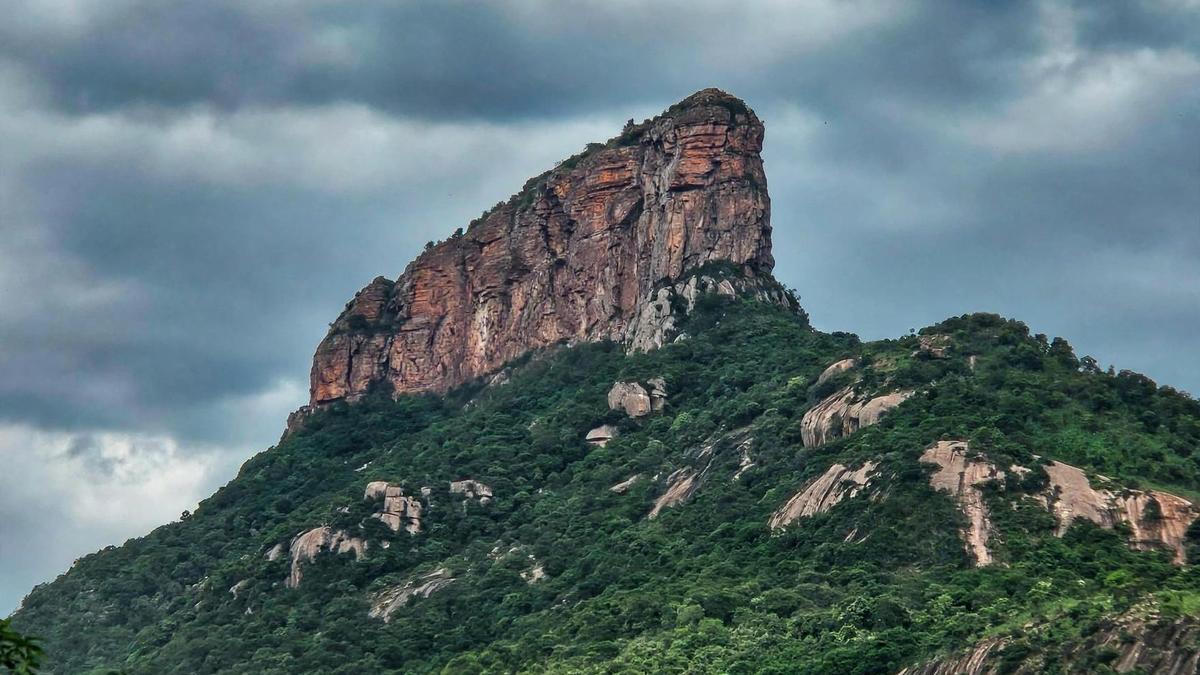
Across the Rayalaseema region of Andhra Pradesh, fragments of a historically-rich landscape stand amid rocky hills, river valleys, and expanding settlements. Forts that once guarded strategic routes, temples that drew generations of devotees, and monuments bearing the imprint of successive dynasties offer vivid glimpses into the region’s political, cultural, and religious history. Today, however, these sites face severe pressure from quarrying, road construction, and unregulated tourism.Geologists aptly describe this landscape as a library of deep time, preserving natural events spanning billions of years. Much of Rayalaseema lies within the Cuddapah Basin and the ancient Dharwar craton—one of India’s oldest crustal blocks. Its basement rocks formed more than 2.5 billion years ago during the Precambrian era. Over centuries, sediments accumulated, volcanoes erupted, and layers were buried, folded, and eventually exposed again.This ancient foundation stands in stark contrast to the young, restless Himalayas, which were born from the collision of tectonic plates and remain seismically active.Prof. U. Suresh from the Department of Geology at Sri Venkateswara University, Tirupati, explains this profound difference: “The southern heartland of Andhra Pradesh is the weathered, unyielding skeleton of an ancient Earth. Safely sitting on the Dharwar Craton and the Cuddapah Basin, this region was formed 2.5 billion years ago. While the Himalayas strive restlessly toward the sky, Rayalaseema rests in profound structural calm.”For those who know where to look, this ancient stillness is hidden in plain sight. Along the ghat road up to Tirumala, that mysterious calm is written in stone. Exposed on a steep, dusty road cut that thousands of pilgrims pass without a second glance lies the Eparchaean Unconformity—one of the world’s most significant geological boundaries. Here, light layers of 1.5-billion-year-old Nagari quartzite rest directly on dark, 2.5-billion-year-old Archaean granite. Between them, nearly 800 to 1,000 million years of Earth’s history have vanished. It is a billion-year gap where older rocks were uplifted, eroded to a plain, and buried again.Further south, the Nagari Hills dominate Chittoor and Tirupati. Their flat-topped profiles are classic mesas—ultra-hard quartzite on ancient granite bases. Formed 1.5 billion years ago, these peaks were strategic lookout posts during the British Raj and the two World Wars. Today they are spiritual sentinels. The sharpest is Nagari Nose, standing at 2,805 feet and visible within a radius of 70 kilometres.“Devout families from hundreds of villages surrounding the Nagari hills and neighbouring Tamil Nadu revere the peak and perform pujas atop it on every full moon day,” says Ramanuja Chalapathi, a former government schoolteacher and social activist in Nagari.Now, mining activity is slowly climbing toward the peak, threatening Nagari Nose and other geological wonders—Three-Rocks-Mound (Moodu Ralla Banda) and Bheemuni Palada rock, he says. “Once a ridge is cut, its original structure can never be restored.”Similar damage was reported at Nemaligundulu on the Tirupati–Madanapalle highway. Rare breccia and sheared quartzite recording dynamic fault movements from over 1.5 to 1.9 billion years ago were blasted for road material during widening. “When road widening was underway a few years ago, we submitted a memorandum to the officials and senior politicians to preserve Nemaligundlu rocks and divert the road, but no one really cared. An influential political leader even got angry at us, rejecting the geological wonders as mere stones and chips,” said a geology scholar, requesting anonymity.Another site of interest is Moghili Ghat in Chittoor, which is approximately three billion years old. Prehistoric layers and ancient outcrops were flattened for a highway, illustrating how rapidly modern machinery can obliterate eons of history. “After the destruction of Moghili Ghat, the human–elephant conflict escalated at the tri-state junction. The natural migratory path has been ruthlessly disturbed. Although an elevated express corridor was constructed, the damage is already done,” says a senior forest officer in Chittoor.In Nandyal, geology and devotion coexist at Yaganti. The historic Uma Maheswara Swamy temple sits among rugged hills with natural cavities. The rocks belong to the Kurnool Group, particularly the tough Banaganapalli quartzite. Quartzite forms when quartz-rich sandstone is deeply buried, compacted, and cemented into an exceptionally hard rock that resists weathering. Joints widen, creating steep escarpments and hollows that characterise Yaganti. Yet uncontrolled construction, drilling, litter, and visitor pressure threaten the fragile structure.Another site that reflects a different chapter is Belum Caves near Kolimigundla. Unlike exposed cliffs, Belum preserves a subterranean landscape carved by acidic groundwater upon limestone over millions of years. The system was developed in the Narji Limestone of the Kurnool Group. Belum is India’s longest natural cave system. In June 2025, the Geological Survey of India designated it a protected geo-heritage site.First explored by Robert Bruce Foote in the nineteenth century and later surveyed by a German team in the 1980s, its chambers, Thousand Hoods, Meditation Hall, and Patalaganga amaze visitors. “Unregulated groundwater extraction or artificial illumination altering the cave’s thermal balance can cause irreversible damage to delicate speleothems that took a billion years to form,” says a senior official of the Department of Archaeology.These ancient geological foundations also gave the region an acidic, iron-rich, and fast-draining soil that most flora cannot tolerate. Yet, nature adapted, transforming Rayalaseema into an evolutionary refuge. The Red Sanders tree, for instance, grows exclusively in the rugged, rocky hills of Kadapa, Tirupati, Chittoor, and Nellore, drawing on the soil’s high mineral content to develop its prized, deep-crimson heartwood.This harsh terrain also fosters rare, highly specialised fauna. The Golden Gecko, a species of lizard, is restricted to the rocky ravines and quartzite caves of the Seshachalam Hills. Deep within the Siddavaratam range of Kadapa district, the critically endangered, nocturnal Jerdon’s Courser depends entirely on the specific gravelly soil formed by 1.4-billion-year-old rocks. Meanwhile, the elusive Slender Loris finds shelter in the scrub forests draping the boulder-strewn quartzite hills of Sri Venkateswara National Park.The same Precambrian forces that folded this bedrock also gave birth to the region’s waterfalls. Plunging 270 feet inside SV National Park, Talakona Falls cascades over stepped benches of 1.4-billion-year-old quartzite. At the foot of the Tirumala hills, Kapilatheertham plunges over granitic gneiss and quartzite along an ancient fault line where the hills uplifted over a billion years ago. Kailasakona and Ubbalamadugu (Tada) Falls flow through narrow gorges carved into 1.9-billion-year-old Nagari quartzite—landscapes sculpted long before the arrival of plant life on Earth.The ultimate testament to this stands at Silathoranam in the Tirumala hills. This striking natural arch, measuring 25 feet wide and 10 feet high, was sculpted from 1.5-billion-year-old quartzite by centuries of wind and rain. Now enclosed within a protective garden by the Tirumala Tirupati Devasthanams, Silathoranam demonstrates how cultural reverence can safeguard irreplaceable natural heritage.Preserving these geological structures remains a key concern. Geologists believe that one way to strengthen the protection of these structures is by securing UNESCO Global Geopark status for several of these geological wonders. “Such recognition would establish strictly regulated tourist zones, protect the historical integrity of nearby forts, and introduce heritage education tours. It can transform these sites from simple tourist spots into protected world-class geological models,” says Prof. T. Madhu, Head, Geology, Sri Venkateswara University, Tirupati.“Rayalaseema’s rocks have preserved chapters of Earth’s history that no modern engineering project can recreate once destroyed. Protecting them is not a choice between development and conservation. It is an opportunity to make development more intelligent, tourism more meaningful, and scientific knowledge more accessible,” he adds.Dr. Peta Srinivasulu Reddy, retired professor of Telugu Studies at SV University and a popular writer of several books on Tirupati and Tirumala, says, “From the mysterious Eparchaean Unconformity to the natural formations of Sleeping Balaji, Standing Garuda, Shiva Linga, and Elephant Trunk in Tirumala hills, the wonders are undeniable. Deepest inheritance lies hidden beneath rugged hills, within caves, and along ancient valleys. Recognising it is the first step. Preserving naturally follows.”
Rayalaseema landscape: Preserving the past, securing the future
Full Article
Original Source
Read the full article at Thehindu →KhanList aggregates and links to publicly available news content. We do not host full articles from third-party sources. Always verify important information with original sources.