
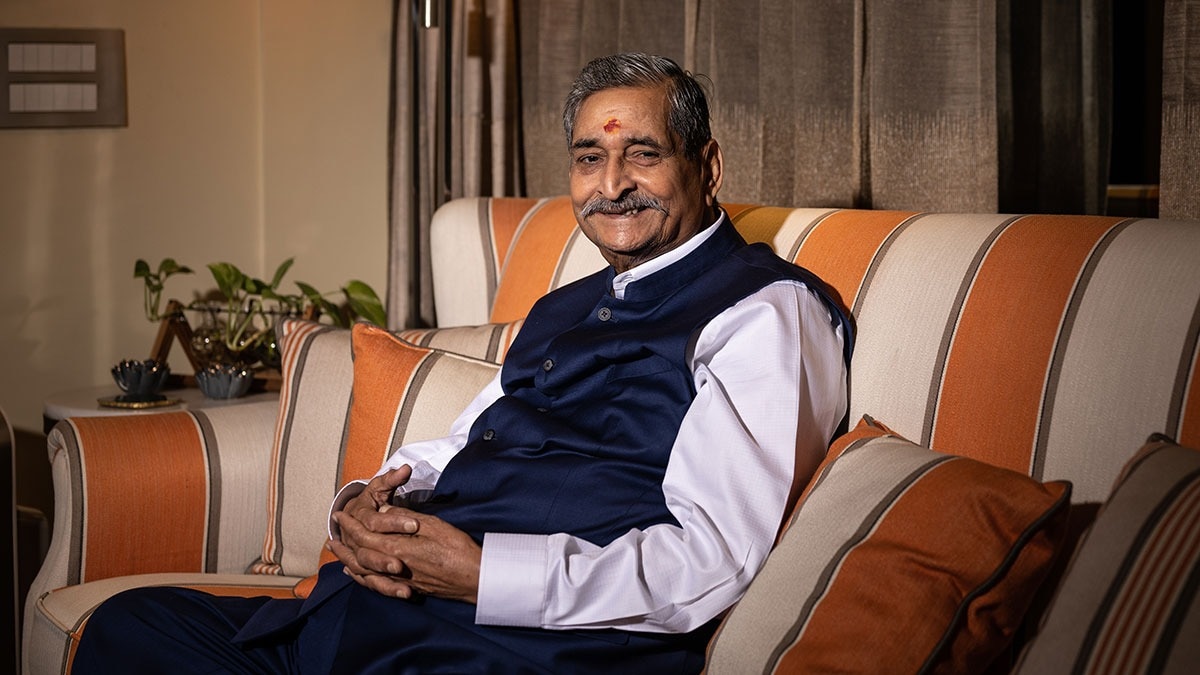
There are lives that seem to have been scripted with an unusual sense of adventure. Ravindra Kishore Sinha’s was one of them. It had the unpredictability of a reporter’s assignment, the audacity of an entrepreneur’s gamble and, above all, the persistence of a man who refused to allow circumstances to determine the boundaries of his ambition.Siinha rose far beyond the circumstances into which he was born, but never allowed success to take him away from the soil, the people and the values that had shaped him. He passed away on October 30, aged 75, leaving behind a formidable business legacy.But the story of Sinha’s life cannot be adequately told through balance-sheets, corporate acquisitions, political positions or the extraordinary wealth he accumulated. To understand the man, one must return to a rented garage in Patna, a few ex-servicemen looking for work and a young journalist who had suddenly found himself without a job.In 1971, when India and Pakistan were at war, Sinha was working for a Patna-based newspaper and earning a monthly salary of Rs 230. Then he did something few young reporters would have dared to attempt. He slipped into Bangladesh to report on the war. He had neither the financial security nor the insurance cover that such an assignment warranted. But journalism, for him, was a calling, pursued with an almost reckless devotion. Three years later, that calling came to an abrupt halt. His newspaper refused to renew his contract, reportedly because of his differences with the establishment over his writing. But what appeared to be a professional setback would eventually become the defining turning point of his life.There was, however, a larger idea taking shape in his mind. Sinha had come into contact with several ex-servicemen during his journalistic years. Many had returned from the 1971 war to find themselves without employment and struggling to rebuild their lives. A meeting with Jayaprakash Narayan, who encouraged him to work for ex-servicemen, helped give direction to an idea that had been germinating.In 1974, Sinha set up Security and Intelligence Services (SIS) in a rented garage in Patna. His first contract was modest: 11 security guards for a factory in Bihar’s Ramgarh, now in Jharkhand. He did not even have enough money to buy uniforms for the men he had recruited. He approached the factory for an advance, bought the uniforms, had the initials SIS stitched on them and sent his first batch of guards to work.It was a small beginning, but behind it lay an extraordinary quality: foresight. At a time when India’s idea of security largely revolved around the neighbourhood chowkidar, Sinha anticipated that a rapidly industrialising country, with its factories, mines, banks, airports, commercial establishments and expanding urban spaces, would need organised, trained and professionally managed security personnel.Sinha was not simply recruiting guards. He was creating a market, professionalising a neglected occupation and giving a second innings to men who had once worn the uniform of the armed forces.The business grew, almost imperceptibly at first, and then with remarkable momentum. SIS expanded beyond Bihar, established its corporate office in Delhi and gradually spread across the country. In 2008, it made a landmark acquisition of the Australian security company Chubb Security Personnel, a transaction that took an Indian enterprise into the international arena.There was another milestone that gave Sinha particular satisfaction. He had always dreamt of taking his company public. In 2017, SIS was listed on the Indian stock exchanges, becoming the first company in its sector in India to do so.Yet, to reduce Sinha’s life to a corporate success story would be to miss perhaps its most endearing dimension. He was a man deeply committed to social service and extraordinarily generous towards those who came to him for help.For many people in Bihar, Sinha’s name was associated not just with a successful businessman or a BJP leader but with someone they could approach in a moment of distress. A person in need, a family struggling to educate a child, someone facing a financial crisis or a person desperately seeking an opportunity could knock on his door. People who knew him recall that he never turned away someone who had approached him with a genuine need.There was a personal warmth to his philanthropy. He took satisfaction in knowing that his help had altered the circumstances of a family. The education of a poor and meritorious child or a job that restored financial stability to a struggling household could give him a happiness that another corporate milestone perhaps could not.Sinha’s philanthropy was also institutional. Through SIS Group and various charitable organisations, he helped skill more than 200,000 young people and create permanent employment for over 100,000 individuals from underprivileged backgrounds. His initiatives extended to dowry-free community marriages, public libraries, free ambulance services, temple construction and flood and disaster relief. The Indian Public School in Dehradun, which he established in 1999, offered free education to a quarter of its students.In many ways, Sinha’s social philosophy was simple: give a person an opportunity, and you may change the destiny of an entire family. It was a philosophy he had practised from the days of those first 11 guards.His political journey was no less remarkable. An ardent and deeply committed BJP loyalist, Sinha had been associated with the RSS since his student days and belonged to the generation that helped build the BJP from its formative years. It was an enduring ideological commitment that shaped much of his public life. His political associations eventually took him to the Rajya Sabha in 2014, when the BJP nominated him from Bihar.But there was another constitutional responsibility that, according to people familiar with the developments, could have come his way. Sources say the BJP had actively considered his name for the post of governor. But his health did not permit him to accept the possibility, and he chose to excuse himself.There was something unmistakably rooted about Sinha, despite the scale of the success he had achieved. He remained attached to the familiar comforts of his earlier life. He preferred his Innova to the more expensive cars in his garage, continued to wear traditional kurta-pyjama and had little appetite for the conspicuous consumption that wealth often brings. Litti-chokha remained an essential part of his hospitality. His idea of a holiday was Dehradun rather than the fashionable destinations abroad.Sinha also had a journalist’s instinct for preserving the past. His book Jan Andolan, documenting the student movement led by Jayaprakash Narayan between 1970 and 1975, reflected his continuing engagement with a period that had shaped his political and personal convictions. He went on to write several other books, including Me and My Guru, Mahamanav Mrityunjay, Belag-Lapet and Samay Ka Sach. Even after leaving journalism, he never quite abandoned the reporter in him.If Sinha was the visionary who imagined the enterprise, his son Rituraj Sinha became the strategist who helped take it into a different league. Rituraj was not merely handed a business empire to inherit; he immersed himself in its workings and helped transform it. An alumnus of Doon School and Leeds University Business School, he began his career in banking in the United Kingdom before joining SIS in 2002. He worked across business development, corporate finance and operations, eventually becoming group managing director in 2017.A formidable businessman in his own right, Rituraj brought to SIS financial understanding, strategic thinking and an appetite for expansion. He helped steer the group towards private equity partnerships, international acquisitions and diversification into facility management, cash logistics and technology-enabled security. He played a pivotal role in the company’s first private equity transaction in 2007 and subsequently led several acquisitions and joint ventures with international partners.Under his leadership, the group’s revenues grew from around Rs 25 crore when he joined in 2002 to nearly Rs 15,982 crore in FY2026. The expansion was not simply a matter of increasing the number of security guards; it involved building a sophisticated, professionally managed business with international operations and a much wider portfolio of services.Rituraj also helped take forward his father’s dream of listing SIS on the stock exchanges. The transition from a founder-driven enterprise to a publicly listed, professionally managed organisation required a different kind of leadership, and he emerged as a central figure in that transformation. Sinha had every reason to take pride in the son who had not merely carried his legacy forward but had added an entirely new dimension to it.But perhaps Sinha’s most enduring achievement was not the size of SIS, its turnover or the distinction of becoming one of the country’s wealthiest parliamentarians. It was the lives he touched along the way. The ex-serviceman who found a second career, the rural youth who discovered a livelihood, the child whose education was secured, the family that found relief in a moment of despair, and the ordinary person who knew that there was someone in Patna who might listen and help.His passing has left a vacuum in the lives of thousands that cannot be measured in corporate figures or political designations. For the people who depended on his generosity, the young men whose careers began through his initiatives, the families whose children received an education because of his intervention and those who found in him a source of support during their darkest hours, the loss is intensely personal. They have lost not merely a benefactor but someone they could turn to, someone who would listen and, more often than not, try to help.He leaves behind a company, a political legacy and a family that will carry forward his work. But his more intimate inheritance lies elsewhere: in the thousands of livelihoods created by his enterprise, in the children whose futures were altered by his generosity, and in the countless people who will remember him as someone who did not turn away when they needed help.Perhaps that is the most beautiful way to remember Ravindra Kishore Sinha: a man who could think on an enormous scale, dream beyond the limits of his circumstances and build an empire, yet remain accessible to the ordinary person who came knocking at his door. Some men leave behind fortunes. Some leave behind institutions. The rare ones leave behind people whose lives are better because they passed this way. Sinha belonged to that last category.Subscribe to India Today Magazine- Ends
Ravindra Kishore Sinha: He built a business empire but never forgot his roots
Full Article
Original Source
Read the full article at Indiatoday →KhanList aggregates and links to publicly available news content. We do not host full articles from third-party sources. Always verify important information with original sources.