
A Korean manufacturer paying an Indonesian supplier does not, in practice, buy rupiah with won. It buys dollars with won, then buys rupiah with dollars, because no bank offers a deep direct pair between the two. The invoice pays two foreign exchange spreads instead of one, moves through correspondent banks that are closed at different hours and settles somewhere between one and three days later. Across Asian corridors that arrangement costs between 1.5% and 3.0% of the payment, which on a million-dollar invoice is fifteen to thirty thousand dollars and up to three days of working capital doing nothing. Behind it sits more than a billion dollars parked in pre-funded Nostro accounts purely so that the plumbing has somewhere to draw from. Dollar stablecoins solved a real part of this. USDT and USDC proved that value can move between ledgers in seconds rather than days; they now carry enormous volume. What they do not do is provide native liquidity in the currencies Asian businesses actually invoice in, which means a payment routed through a dollar stablecoin still crosses the dollar twice. Ratio is built around that gap, it is an on-chain foreign exchange orchestration layer running on Kaia, the Layer 1 formed by the merger of Kakao's Klaytn and LINE's Finschia; it coordinates dollar stablecoins alongside regional ones including IDRX, IDRP and JPYC so that a local currency can settle against another local currency directly. I sat down with John Cho, Ratio's chief executive and co-founder and chief stablecoin officer at the Kaia DLT Foundation, who spent eighteen years in corporate strategy at SK, LG's HS Ad and Kakao's Ground X before arriving at the problem.Ishan Pandey: Hi John, it's a pleasure to welcome you to our "Behind the Startup" series. Please tell us about yourself and the journey that took you from corporate strategy at SK and LG through Ground X and the Klaytn and Finschia merger to founding Ratio.John Cho: Thanks for having me. My background is a bit unusual for this industry. I studied psychology, specialized in neuropsychology, and that pulled me toward consumer behavior and data. Before crypto I worked in strategic planning and growth roles at Korean conglomerates, then in advertising, on the data side rather than the creative side. I was early to performance marketing, building the pipelines and teams that turned Facebook and Google ad data into strategy.I joined Ground X, Kakao's Web3 subsidiary, in 2019 on the strategic planning team. Our focus was to use blockchain as invisible infrastructure for services people already used. KakaoTalk reaches essentially the entire Korean market, while LINE is deeply embedded across Japan, Thailand, Taiwan, and Indonesia. In Asia, these messaging platforms function as super apps, bringing together communication, shopping, payments, and other parts of daily life.The Klaytn and Finschia merger created Kaia and brought those ecosystems together on one Layer 1. Ratio originally began as back-end infrastructure for LINE, providing stablecoin-native FX functionality inside its consumer-facing services. As we built it, however, we identified a much larger product-market fit and decided to spin Ratio out as a B2B solution. FX is the backbone of virtually every cross-border payment, remittance, or settlement flow. As adoption of stablecoin rails increases, so will the need for reliable, efficient stablecoin FX infrastructure connecting currencies, issuers, and local settlement networks.Ishan Pandey: Take us inside a single payment. A Korean company owes an Indonesian supplier a million dollars. Walk us through where the money actually goes on the conventional route, which of those steps a direct local-to-local stablecoin settlement removes and which ones it cannot remove. John Cho: On the conventional route, that payment almost never travels as won to rupiah. The Korean bank converts won to dollars and sends instructions through SWIFT to its correspondent bank. The dollars move between correspondents, often with an intermediary in between, and land at the Indonesian bank's correspondent, where they convert again from dollars to rupiah before reaching the supplier's account. So you have two FX conversions, each carrying a spread, plus fees at every hop, and the whole thing only moves during banking hours across two time zones. Two to three business days is normal. And for that chain to work at all, banks maintain pre-funded Nostro accounts sitting idle as insurance.Local-to-local settlement removes the middle of that chain. A won stablecoin swaps directly into an IDR stablecoin at mid-market rates through our FX Engine, and the off-ramp happens one-to-one with the issuer into rupiah through domestic rails. That takes out the double conversion through dollars, the correspondent chain and the waiting on time zones, since the swap executes whenever it's initiated. What it cannot remove are the regulated entry and exit points. On-ramping requires licensing, KYC, and AML screening, and it should. The final domestic leg into the supplier's account still runs on local rails. And the FX itself doesn't disappear, since won-rupiah is still a currency pair with a real rate. You just execute it once, at mid-market, instead of twice with spreads.Ishan Pandey: You have put the capital locked in pre-funded Nostro accounts supporting Asian trade at more than a billion dollars. For a corporate treasurer, releasing that is the headline benefit and also the scariest change, because pre-funding is what guarantees the payment lands. What has to be true operationally before a treasury team is willing to stop pre-funding, and what did you have to build to get there? John Cho: You're right that it's the scariest change, and I'd push it further: no treasurer stops pre-funding because a deck told them to. Pre-funding is the guarantee that payroll lands and suppliers get paid. You earn the right to replace it.Operationally, four things have to be true. The treasurer needs to see settlement finality in real time, not a status message that says processing. Liquidity has to be available at the moment of execution, including weekends and off-hours, which is precisely when pre-funded models exist to cover. The exit has to be guaranteed, meaning a one-to-one off-ramp relationship with the issuer rather than a market order into whatever depth the pool has that day. And compliance screening has to be native to the flow, because no bank partner will touch a rail that treats compliance as an add-on.What we built maps to that list. Ratio runs proprietary liquidity, sourced from market makers, FX desks, and funds, but executed entirely within our own stack. We built a rebalancing network that coordinates internal reserves with issuer minting pathways, so inventory replenishes in real time the way a traditional FX desk rebalances after a swap. Pricing is anchored to oracles at mid-market. Just as important is what we don't ask for. Ratio plugs into existing treasury and ERP workflows, so teams shift volume gradually, corridor by corridor, running parallel with their legacy process until the numbers make the case. Nobody moves a billion dollars of pre-funding on faith, and we don't ask anyone to.Ishan Pandey: Here is the strongest argument against you, and I want to give you room to answer it properly. Dollar stablecoin liquidity is vastly deeper than anything denominated in won, rupiah or yen and depth is what determines execution quality. Why is a thin local-currency stablecoin genuinely better than two conversions through a very liquid dollar one, and at what size does that argument break?John Cho: I'll concede the premise up front: dollar stablecoin liquidity is deeper, by orders of magnitude, and it will remain that way for years.The case for local corridors starts with what the dollar route actually costs end to end. Routing through USDT or USDC means two currency conversions, each carrying a spread. On top of that, on- and off-ramping through regional PSPs can cost 100 to 500 basis points per leg, and local-fiat-to-dollar-stablecoin conversion often carries a persistent premium. Deep liquidity in the middle does not solve the tolls at both ends.A local-to-local swap at mid-market can run at roughly 30 basis points, with the fiat exit at one-to-one through the issuer. The real comparison is therefore one conversion at mid-market against two conversions plus ramp premiums. In the corridors we operate, the local route can win on total cost even before local liquidity reaches dollar-stablecoin scale.We also expect regulation to change the liquidity equation. As countries across the region turn stablecoin frameworks into law, mandates and incentives - whether regulatory, tax-related, or both - are likely to favor compliant on-chain transactions using local stablecoins. That should deepen domestic pools and shift institutional preference over time. More fundamentally, consumers and merchants ultimately want to transact and settle in their own currencies, not in dollars. Where does the argument break today? At a ticket size that overwhelms available local inventory. Our model raises that threshold by arranging proprietary depth and using issuer minting and rebalancing pathways rather than relying solely on public order books. The threshold is real, but it should keep moving upward as regulated local issuance, bank access, and transaction volume grow.Ishan Pandey: Kaia has published a regulated architecture for won-denominated stablecoin issuance and settlement and completed a pilot with KB Kookmin, South Korea's largest bank, covering offline payments. What did that pilot teach you that the design documents did not, and how do you read the regulatory path for a won stablecoin from here?John Cho: The biggest learning was that even the best-designed architecture is only part of the solution. For a payment system to work in practice, merchants need robust and dependable settlement infrastructure. Some merchants are willing to hold or settle in stablecoins, while others need to receive local fiat directly into a bank account. A pilot makes that distinction much more concrete than a design document does.That means the technology cannot operate in isolation. You need reliable, compliant, licensed on- and off-ramp partners that can connect on-chain settlement to the banking system. Until we reach a point where every form of money is on-chain - and I believe that day will eventually come - the first and last mile will still need to plug into legacy rails. The architecture has to treat those connections as core infrastructure, not as an afterthought.On regulation, Korea is still expected to pass its Digital Asset Basic Act (DABA) legislation in the fourth quarter, and as of now that timetable remains on track. There is broad alignment on the direction of travel across lawmakers, traditional financial institutions, on-chain companies, and the Bank of Korea. Important details still need to be resolved, particularly around issuance eligibility, reserve safeguards, compliance, and supervisory responsibilities. But the debate is now about how the framework should work, not whether Korea will establish one.Ishan Pandey: Kaia's distribution story is 280 million users reachable through wallets embedded in LINE and Kakao, which is a consumer asset. Ratio is an institutional foreign exchange business. Are those genuinely the same company, or are they two businesses that happen to share a chain, and what does consumer distribution actually do for an enterprise settlement product?John Cho: The honest answer is that Kaia and Ratio are distinct businesses that share infrastructure on purpose. Kaia provides the settlement layer and access to an Asian messaging ecosystem reaching hundreds of millions of users. Ratio is the B2B FX infrastructure that makes regional currency flows across that ecosystem executable.The connection is straightforward: settlement infrastructure is only valuable when real flows move across it. When a LINE-based service offers remittances, merchant payments, or FX, Ratio can execute the currency conversion and coordinate liquidity in the back end. Consumers never need to interact with Ratio directly; they use an application they already know, while Ratio provides the institutional plumbing underneath it.Consumer distribution reinforces that institutional model. It generates transaction volume, gives local stablecoin issuers a reason to participate, and provides banks and regulators with evidence of real demand rather than projections. I spent years at Kakao learning how difficult consumer distribution is to build. Ratio remains firmly B2B, but ignoring one of Asia's largest distribution networks when it sits one integration away would make little sense. Ishan Pandey: An orchestration layer sits between issuers, chains and local payment rails, which is a lot of moving parts. When a leg fails partway through a multi-currency route, who carries the foreign exchange exposure and the settlement risk in that window? And how do you answer a bank that says you have removed one intermediary by becoming another?John Cho: Two questions, and the second one deserves a straight answer, so let me take them in order:On failure: Ratio carries it. We execute within our own stack on proprietary inventory, so if a leg fails mid-route, the FX exposure in that window sits on our book, the same way it sits on an FX desk's book in traditional markets. Our first layer of risk management is prevention. Ratio monitors real-time FX volatility and automatically cancels a swap when market conditions move outside predefined upper or lower thresholds. This prevents transactions from executing against distorted pricing or when settlement risk is no longer acceptable.Because Ratio uses real-world FX rates rather than prices formed solely within an on-chain pool, corporate treasury teams can evaluate each transaction against the same market references and internal limits they already use. They can hedge, size, or otherwise manage FX exposure on their side as needed, without having to model AMM slippage, fragmented liquidity, or the other inefficiencies common in existing on-chain swap infrastructure.The objective is to provide a controlled, institutionally familiar execution environment in which unacceptable risk is blocked automatically and approved transactions are priced transparently.On becoming another intermediary: Ratio is part of the transaction flow, but our role is not simply to add another layer. Stablecoin FX has a specific institutional requirement: banks need access to global stablecoin liquidity through infrastructure that is both controllable and easily composable, similar to how RFQ infrastructure functions in traditional FX markets.Ratio provides that composability backbone. Through a single integration, banks can access liquidity across multiple regional stablecoins, issuers, and settlement partners without having to build, operate, and manage each connection independently. Instead of stacking additional intermediaries and bilateral relationships, we consolidate a fragmented network into one coordinated execution and settlement layer.The relevant questions are therefore not whether an intermediary exists, but how much complexity it removes, what it costs, and how transparent and controllable the resulting flow is. On those measures, Ratio is significantly more efficient and less friction-heavy than both conventional correspondent banking and today's fragmented on-chain infrastructure.Ishan Pandey: Finally, for treasury and payments teams across Asia who are watching this and have no mandate to touch crypto, what is the most practical thing they can do this quarter to reduce what they are currently paying to move money across borders?John Cho: Measure first. Most treasury teams know their bank fees and almost none know their all-in cost per corridor, because the largest cost is the spread, and spreads hide. Take your top three corridors, benchmark what you actually received against the mid-market rate at execution time, add the fees, and express it in basis points. That number is your negotiating position, and no mandate is required to calculate it.Then use it. Ask your current providers to quote all-in against mid-market. The conversation changes immediately, because they know what you're comparing them to. Third, and this one costs nothing: assign someone to track stablecoin legislation in your operating markets. Korea, Japan, Hong Kong, and Indonesia are all moving, and I expect the region's major economies to have frameworks in place within 12 to 24 months. When your regulator and your bank both support regulated stablecoin settlement, it stops being crypto and becomes a payment method, the same way nobody holds a mandate discussion about SWIFT. And the day that happens, the team that spent a quarter benchmarking its corridors knows exactly what the new rails are worth. Everyone else is guessing.Don’t forget to like and share the story!Vested Interest Disclosure: HackerNoon has reviewed the report for quality, but the claims herein belong to the author. #DYOR.
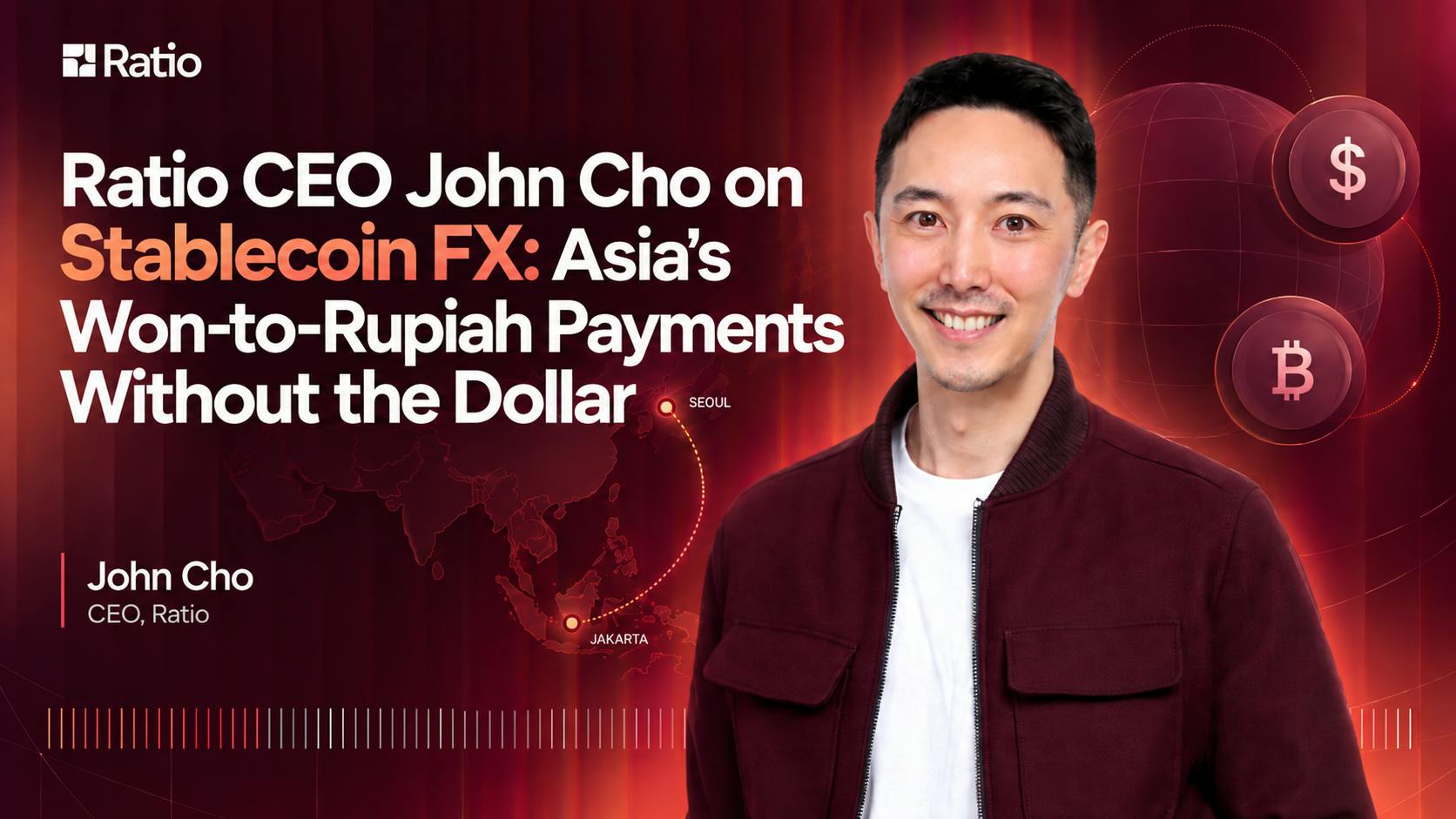
Ratio CEO John Cho on Stablecoin FX: Asia's Won-to-Rupiah Payments Without the Dollar
Full Article
Original Source
Read the full article at Hackernoon →KhanList aggregates and links to publicly available news content. We do not host full articles from third-party sources. Always verify important information with original sources.