
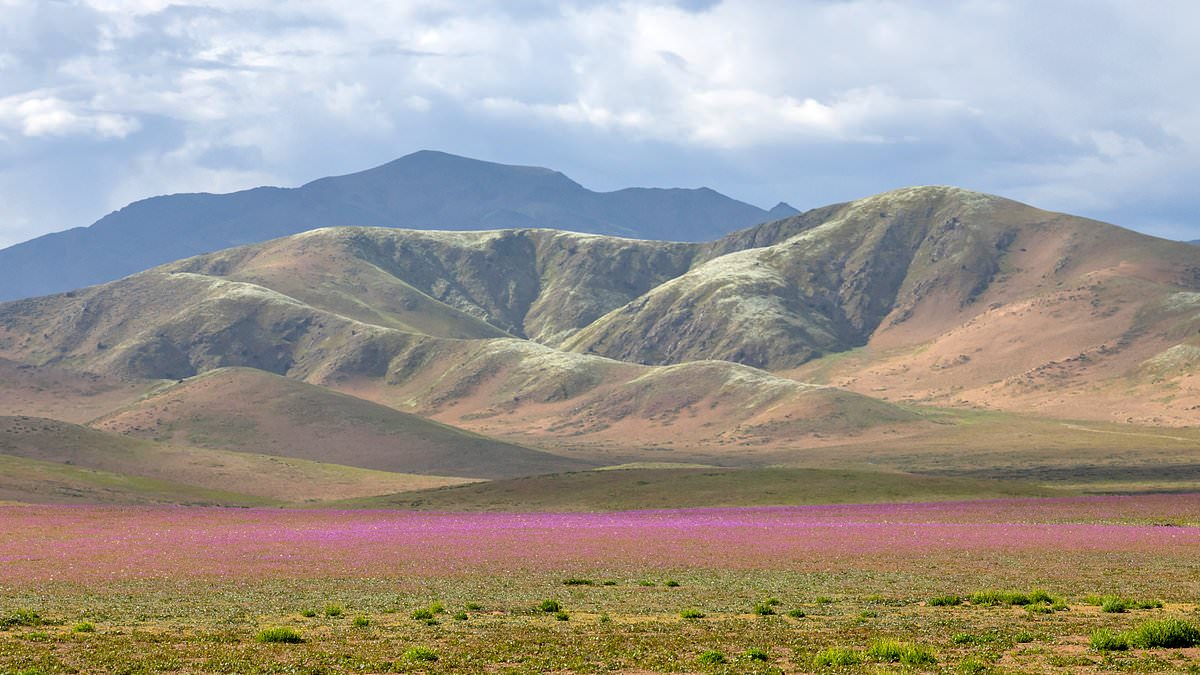
The world's driest desert has been transformed into a sea of flowers in a spectacular explosion of life driven by the rare Super El Niño.Chile's usually drab Atacama Desert has been painted in shades of pink, yellow and white by a living carpet of more than 200 species of plants and flowers.The Atacama normally receives just 15mm of rainfall over an entire year, making it one of Earth's harshest environments.But this year, record levels of rainfall have created a historic 'Desierto Florido', or flowering desert.The spectacular bloom now covers an estimated area of 6,560 square miles (17,000 sq km), making it the biggest and most intense desert bloom since 1997.Jorge Carabantes, head of the Protected Areas Department at the National Forest Corporation (CONAF), said: 'This is a flowering event that is obviously extraordinary and unusual, very different from other blooms that occur elsewhere on the globe.'The Atacama, the world's driest desert, has been transformed into a sea of flowers in a spectacular explosion of life driven by the rare Super El Niño The Atacama normally receives just 15mm of rainfall over an entire year, making it one of Earth's harshest environments While the Atacama normally looks lifeless, flower blooms known as 'Desierto Florido' often occur during the transition from winter to spring The Atacama lies between the Pacific Ocean and the Andes mountains, stretching some 1,600km (1,000 miles) all the way down the northern coast of Chile.Some flowering in the Atacama is not uncommon during the brief rain showers in the transition from winter to spring, but this year's display is truly exceptional.The Super El Niño weather phenomenon isn't expected to hit its peak until November but the intense buildup of heat in the equatorial Pacific is already having profound effects on global weather.Between July and August, Chile recorded record rainfall in several regions, with some levels never seen since measurements began in the 1950s.César Pizarro, head of the Biodiversity Conservation Section at CONAF Atacama, says: 'Since rainfall records began, these are the most significant figures in terms of volume: 160, 180, 190 millimetres (6 to 7 inches) in some locations.'These storms have triggered destructive flooding in many parts of Chile, killing at least ten people and leaving more than 100,000 stranded in the country's worst weather disaster in decades.However, in the north, the unusually high rainfall has led to a record-breaking Desierto Florido, which is drawing thousands from across the country and around the world.While the dull brown rocks of the Atacama may look lifeless, the desert actually hides a layer of dormant life, just waiting for the first drops of rain to fall.Record-breaking rainfall has triggered a 'Desierto Florido', or flowering desert, spanning 6,560 square miles (17,000 sq km) Experts believe this is the largest and most intense desert bloom in the Atacama since 1997, and El Niño is the main cause Between July and August, Chile recorded record rainfall in several regions, with some levels never seen since measurements began in the 1950s, triggering flowers to bloom in the desert Scientists call this layer the germplasm, and it contains plant seeds, bulbs, and tubers, as well as the eggs of various invertebrates and reptiles.When rain starts to fall, this sends a signal for all these different species to spring to life and start reproducing to produce the next generation of seeds.'There are hills and mountain ranges where no greenery or flowers had been seen for more than 30 or 40 years,' Mr Pizarro adds.'This desert germplasm can remain (dormant) for many years, even decades. The hills this year are the best example of that.'Whether arriving from within Chile or overseas, tourists are venturing into the remote, inhospitable areas of the Atacama to admire the millions of flowers adorning vast areas of the desert, stretching from the coast to the horizon.According to data provided to the AP by the National Tourism Secretariat, the Atacama region is expected to see nearly 300,000 overnight trips by the time the natural phenomenon ends in November, positioning Desierto Florido as one of the region´s main tourist attractions this season.Chef Franco Moya, 37, and his girlfriend travelled nearly 1,000km (621 miles) from Santa Cruz, a town in central Chile´s Colchagua Valley, to several parts of the desert to celebrate his birthday.'It was striking to see how the flowers grow in such a dry place,' he said. 'It´s my first time here... and it was a truly surprising moment.'However, this beautiful display is a symptom of a massive event that has climate scientists worried.El Niño is part of a naturally occurring weather cycle called the El Niño Southern Oscillation that changes between a hot and cool phase once every two to seven years. The rainfall has activated dormant seeds, bulbs, and tubers that may have been lying in the soil for decadesThere are now flowers and grasses growing on parts of the Atacama that have been bare for up to 40 years Experts say that the intense rainfall in Chile has been caused by the Super El Niño developing in the equatorial Pacific Ocean (illustrated) During the hot, El Niño part of the cycle, the trade winds that normally blow warm water from the Pacific towards Australia slow or even reverse.This allows warm water to collect near the surface of the equatorial Pacific Ocean off the west coast of South America, driving up global average temperatures.Scientists have warned that this year's 'Super El Niño' has already smashed historical temperature records, months before reaching its peak.The latest data shows the sea surface temperature at the heart of the phenomenon is now 3.05C above the average for 1991-2020, overtaking the 3.02C record set in November 2015.Scientists say it's now looking on track to be the largest in at least 1,000 years – with a possible peak of 4.1C in November and December.Besides making the planet hotter, this also causes profound changes to patterns of rainfall around the world.According to the World Meteorological Organization, El Niño is associated with increased rainfall and flooding in parts of South America, East Africa and the southern United States.Meanwhile, the weather cycle typically brings drought conditions in eastern and northern Australia, Indonesia, southern Africa and parts of South Asia.WHAT IS THE EL NINO PHENOMENON IN THE PACIFIC OCEAN?El Niño and La Niña are the warm and cool phases (respectively) of a recurring climate phenomenon across the tropical Pacific - the El Niño-Southern Oscillation, or ENSO for short.The pattern can shift back and forth irregularly every two to seven years, and each phase triggers predictable disruptions of temperature, winds and precipitation. These changes disrupt air movement and affect global climate. ENSO has three phases: El Niño: A warming of the ocean surface, or above-average sea surface temperatures (SST), in the central and eastern tropical Pacific Ocean. Over Indonesia, rainfall becomes reduced, while rainfall increases over the tropical Pacific Ocean. The low-level surface winds, which normally blow from east to west along the Equator, instead weaken or, in some cases, start blowing the other direction from west to east. La Niña: A cooling of the ocean surface, or below-average SST, in the central and eastern tropical Pacific Ocean. Over Indonesia, rainfall tends to increase, while rainfall decreases over the central tropical Pacific Ocean. The normal easterly winds along the Equator become even stronger.Neutral: Neither El Niño or La Niña. Often tropical Pacific SSTs are generally close to average.Source: Climate.gov
Rare 'Super El Niño' turns the Atacama Desert into a sea of flowers in spectacular explosion of life
Full Article
Original Source
Read the full article at Dailymail →KhanList aggregates and links to publicly available news content. We do not host full articles from third-party sources. Always verify important information with original sources.