
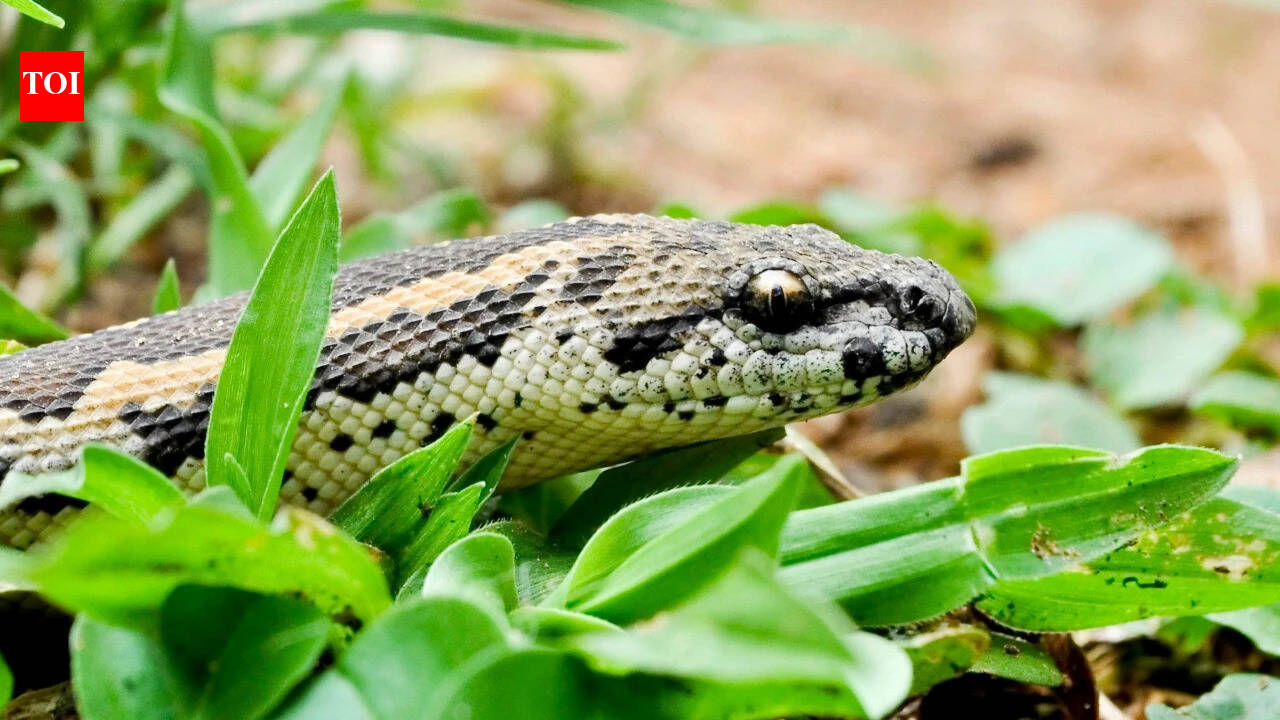
(Image credit: Wikimedia Commons)A snake species that is known to have inhabited parts of Iran and Pakistan has now been officially recorded in India’s diverse list of reptiles. Three live Sistan sand boas have reportedly been recorded in Rajasthan. Found in the northern parts of the Thar Desert, the three snakes were documented in the Sikar district of Rajasthan. Their discovery has now offered researchers an opportunity to understand the distribution of a species whose presence may have gone unnoticed in the past few years.According to a research paper published in the Journal of Threatened Taxa on May 26, 2026, researchers Vivek Sharma and Dharmendra Khandal have documented the presence of the Sistan sand boa (Eryx sistanensis) in India, making this the first confirmed record of the species in the country.The first snake was documented on August 19, 2025, at around 9:30 pm, inside a cowshed near Goshala. The second was found on September 12 in Sunda ki Dhani, after a local boy caught the snake in his courtyard and had been playing with it before it was taken to safety. The third individual was documented on September 21, in the Rukansar area, where it was found in a pile of bricks at a house under construction.The snakes have not been discovered in typical sand dune areas, but in and around residences and farmlands. The researchers have described the areas surrounding the region as a combination of natural scrub patches, crop fields and grasslands.A species that can be mistaken for another sand boaOne of the reasons this discovery is riveting is due to the close resemblance between the Sistan sand boa and the Indian red sand boa (Eryx johnii). Both belong to the same genus, and their similarities in body shape, head structure and certain scale characteristics have historically made distinguishing between them difficult.The Sistan sand boa was formally described as a separate species in 2020, following research in Iran. Before this, it had been overlooked or interpreted as a regional variation of the Indian red sand boa for more than a century.The Indian study examined the physical characteristics of the three snakes to distinguish them from their close lookalike. Researchers recorded differences in their body colouration, patterns, scales and tail structure.The Sistan sand boa generally has a tan or buff-coloured body, with dark, sooty bands running along its back. These markings can vary depending on the animal's age. The researchers observed that the juvenile had 14 distinct dark bands, while the adult had 15. Another distinguishing feature was the shape of its tail. In the Sistan sand boa, the tail gradually tapers towards its tip, whereas the Indian red sand boa tends to maintain a more consistent thickness along much of its length before narrowing towards the end. However, the researchers note that this feature may not always be sufficient to distinguish younger individuals of the two species.Its presence may extend beyond RajasthanAlthough the three snakes provide the first confirmed record from India, the researchers suggest that the species may have a wider distribution across the northwestern parts of the country. They refer to earlier photographic records and sightings from Haryana and Punjab, including rescued individuals reported from the outskirts of Fatehabad and Bathinda. The authors also discuss earlier observations from Churu district in Rajasthan, dating back to 2003 and 2006.Some additional sightings have been reported from Bikaner, Hanumangarh and Jaisalmer. However, the researchers clarify that they have not been able to personally examine and formally identify all these individuals, meaning that further documentation is needed before their presence can be confirmed. The newly documented population in Sikar is approximately 290 km from the nearest previously published locality in Pakistan's Cholistan Desert. So, with its existence now officially recorded in India, its distribution across the region remains to be studied.Why is it important to have now discovered this species?There are myriad threats that the Sistan sand boa may face, and therefore, the study raises some concerns regarding its conservation. The researchers point out that the species can be mistaken for the Indian red sand boa, which is frequently targeted in illegal wildlife trade and certain superstitious practices. Its resemblance to the latter may make it vulnerable to being captured and exploited in similar ways.The paper mentions instances in which Sistan sand boas were reportedly used by snake charmers as two-headed snakes, locally referred to as Do-muh-wala saanp. The researchers have also highlighted that live individuals of both species have been used in religious activities during the annual Goga Mela in Churu, Rajasthan, which can put pressure on an already vulnerable population.As of now, the Sistan sand boa remains to be evaluated by the IUCN. However, in India, the species falls under Schedule II of the Wildlife (Protection) Amendment Act, 2022.
Rare Sistan sand boa, known from Iran and Pakistan, documented in India
Full Article
Original Source
Read the full article at Timesofindia →KhanList aggregates and links to publicly available news content. We do not host full articles from third-party sources. Always verify important information with original sources.