
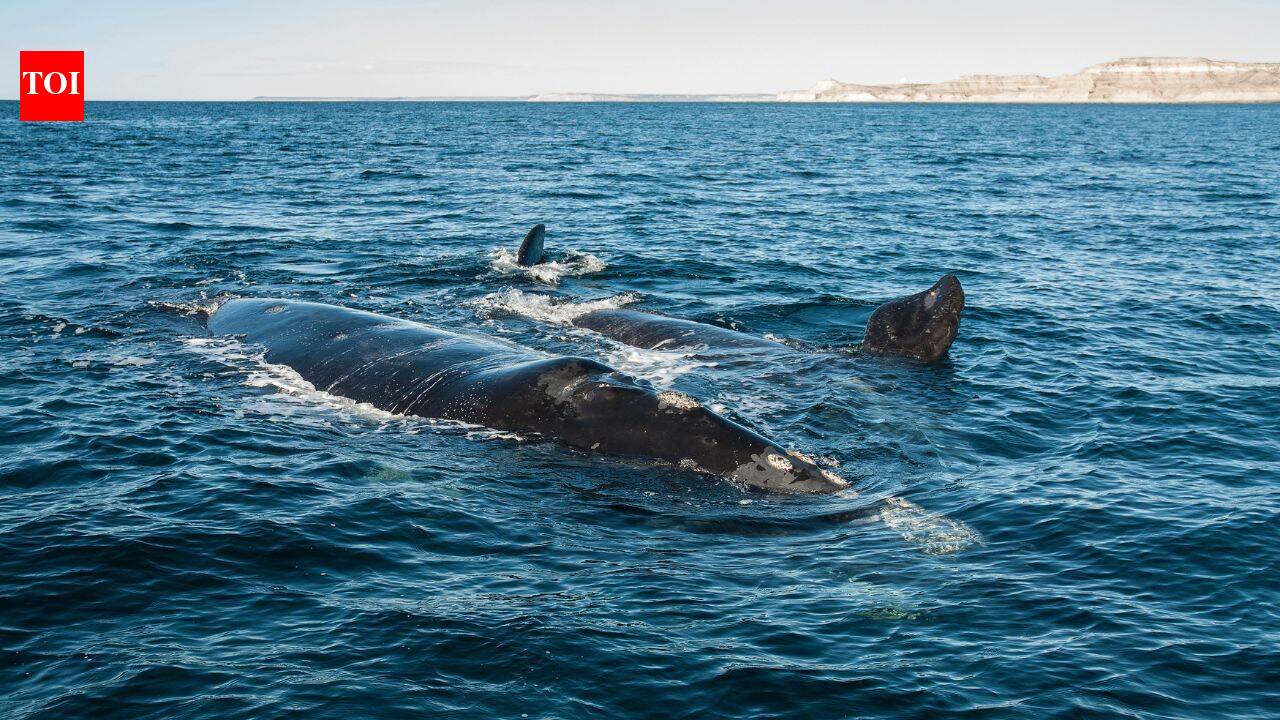
Representative image of North Atlantic right whale from CanvaScientists have confirmed that a North Atlantic right whale calf spotted off Quebec in September was a previously uncounted baby from the most recent calving season, raising the season’s total to 24. The discovery, reported by the Associated Press (AP) and confirmed through analysis by the New England Aquarium, is a rare bright spot for one of the world’s most endangered large whales, whose global population is estimated at only about 380 animals.The calf was photographed beside its 38-year-old mother, a whale researchers know as Silt, near Anticosti Island in Quebec. Researchers with the Mingan Island Cetacean Study first recorded the pair, and scientists later matched photographs and data to determine that the young whale had escaped detection during the winter surveys normally used to document right whale births.A welcome surpriseNorth Atlantic right whales are so rare and so closely watched that researchers usually identify calves soon after they are born. The whales give birth in the warmer waters off the southeastern United States during winter, then migrate north to feeding grounds off New England and Canada as the seasons change.That makes the late discovery especially unusual. Despite extensive boat-based and aerial surveys along the U.S. East Coast throughout spring and summer, scientists did not see the calf until researchers in Quebec photographed it months later. Amy Warren, a scientist at the New England Aquarium’s Anderson Cabot Center, said the find was an exciting surprise so late in the year.Silt had been briefly observed in the southeastern U.S. calving grounds in February 2026, but researchers believe she may have given birth there and moved away before she and her calf could be documented together. The possibility that a mother and newborn could avoid detection for months is a reminder of how vast the ocean remains, even for animals tracked by dedicated research teams.Richard Sears, founder and director of Mingan Island Cetacean Study, said the discovery shows how easily whales can become lost in the open ocean. For conservationists, however, the calf’s appearance is more than a curiosity. It adds one more young animal to a population that cannot afford to lose many.A stronger calving seasonNorth Atlantic right whale (Photo credit: Canva)The new calf brings the total for the most recent birthing season to 24, according to the New England Aquarium. That is the most productive season for North Atlantic right whales since 2009 and the fourth-highest count on record, a result that offers cautious hope after years of alarmingly low reproduction.Successful calving years matter because the species has so few breeding females. Scientists estimate that only about 70 reproductive-age females remain, which means every healthy calf represents a meaningful contribution to the population’s future.The species has reached 20 calves in a single season only a few times since 2010. In 2018, researchers recorded no births at all, a devastating outcome for an already fragile population. Against that history, 24 calves is a significant improvement, even if it does not erase the longer-term decline.Right whale numbers have fallen since 2010, with the population losing about 25 percent between 2010 and 2020. The species has gained some ground since 2020, but scientists say recovery remains uncertain because the whales continue to face serious human-caused threats across their range.Why the species remains at riskNorth Atlantic right whales face two of the most persistent dangers in the ocean: collisions with large ships and entanglement in commercial fishing gear. Both threats can injure or kill whales, and both become more dangerous when animals move outside areas designed to protect them.Warming ocean conditions have made the problem worse. As prey shifts and whales alter their movements in search of food, they can stray from protected zones and enter areas where vessel traffic and fishing activity create greater risks. Conservationists say those changing patterns have heightened the dangers facing the species.The calf’s discovery does not change those threats, but it does underscore why researchers continue to track individual whales so closely. Because the population is small, scientists can identify many animals by distinctive markings and use photographs to follow mothers, calves and survivors of injuries over time.That close monitoring is also what made this discovery possible. The unidentified calf was eventually matched to Silt through photos and data, allowing researchers to confirm that it belonged to the current calving season rather than representing an entirely separate population of young whales.A reason for cautious hopeThe discovery is cause for celebration among scientists, but it is not a declaration that the species has turned a corner. A productive calving season can help a population recover only if calves survive long enough to reproduce, and right whales must still navigate shipping lanes, fishing grounds and warming waters.Conservation groups have criticized recent U.S. government decisions to delay new protections for the whales for a decade, arguing that commercial fishing interests have been prioritized over measures that could reduce entanglement risk. The AP reported that those moves have drawn concern from advocates who believe stronger safeguards are needed now.For now, the image of Silt swimming beside her previously uncounted calf offers a rare moment of good news. It is a reminder that even in a population of roughly 380 animals, the ocean can still hold surprises, and that careful research can turn an overlooked life into an important addition to the species’ future.
Rare right whale calf spotted with 38-year-old mother; season total rises to 24
Full Article
Original Source
Read the full article at Timesofindia →KhanList aggregates and links to publicly available news content. We do not host full articles from third-party sources. Always verify important information with original sources.