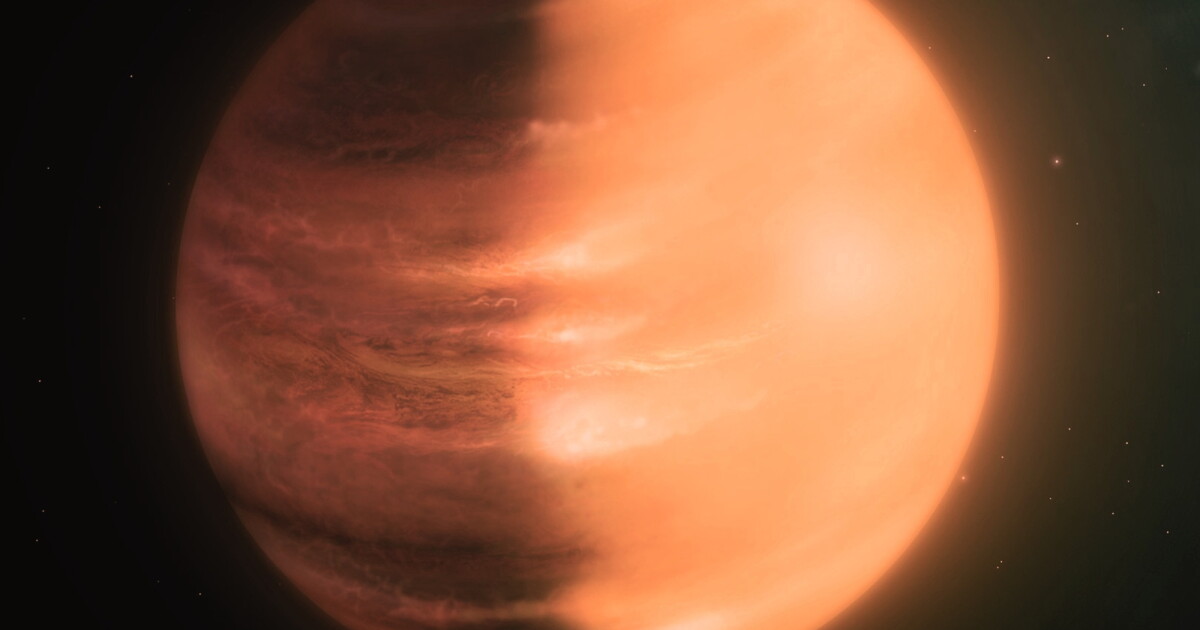
An international team led by researchers from the University of Oxford has discovered two of the lowest-density giant planets on record.In a paper published in Monthly Notices of the Royal Astronomical Society, the researchers explain how the rare ‘super-puff’ planets have a density lower even than candy floss.The two planets, named TOI-791 b and TOI-791 c, orbit an F7-type dwarf star roughly 1,110 light years away in the southern constellation of Volans. They are ‘siblings’ believed to have formed in the same protoplanetary disc that once surrounded their host star.The discovery could shed light on the origins of these rare types of planets, which may have formed in the deep, cold space far from the heat of their host stars.Less dense than cotton candyThe new study, a collaboration between the University of Oxford, Université Côte d’Azur/Observatoire de la Côte d’Azur and the University of Birmingham, quantified the density of TOI-791 b and TOI-791 c and compared them with objects in our own Solar System.Both TOI-791 b and TOI-791 c are roughly the size of Jupiter. And yet, they are incredibly diffuse.TOI-791 b has a density of only 0.038 grams per cubic centimetre, while TOI-791 c has a density of 0.047 grams per cubic centimetre.Put simply, that means the planets are incredibly puffy – even less dense than candy floss, which is roughly 0.05 grams per cubic centimetre.Jupiter’s average density, meanwhile, is 1.33 grams per cubic centimetre, which is between 28 and 35 times greater than the density of TOI-791 b and c, respectively. Earth’s density is 5.5 grams per cubic centimetre. Comparison of the exoplanets in the TOI-791 system with planets in our Solar System.NASA/Daniel Rutter Only four other systems are known to contain more than one super-puff planet. That means TOI-791 could provide valuable clues as to the formation and evolution of this rare, mysterious planet type.“Only a handful of these super-puffy planets are known, and it is even rarer to find two in the same system,” study lead author Dr George Dransfield, a physics professor at the University of Oxford, explained in a statement. “Their extremely low densities make them fascinating targets for understanding how planetary systems form and evolve.”Interestingly, the TOI-791 planets are also locked in a rare gravitational dance known as a 5:3 mean-motion resonance. This means that for every five orbits completed by the inner planet, the outer planet completes almost exactly three orbits.This causes both planets to tug on one another, producing a measurable shift in transit timings as the planets pass in front of their host stars.Investigating the origin of super-puffy planetsTOI-791 b and TOI-791 c were discovered in 2019 and 2023, respectively, by volunteers for the Planet Hunters TESS citizen-science project. Researchers subsequently measured the planets’ densities by comparing different observations captured by various global telescopes.Scientists estimated the planets’ sizes and masses by calculating the gravitational force they exerted on each other. This allowed them to measure the planets’ densities, determining that they were super-puffy exoplanets.Follow-up observations might help scientists better understand the origins of these rare planets. One leading theory suggests that a large fraction of their total mass consists of gaseous envelopes composed of hydrogen and helium.“This system offers a unique laboratory for understanding how super-puff planets form and evolve,” said Professor Amaury Triaud from the University of Birmingham, a co-author on the study. “We propose to carry out space-based observations using the James Webb Space Telescope to assess if the puffy atmosphere contains carbon-, nitrogen-, and oxygen-bearing species, revealing new insight into how these unusual planets formed.”These atmospheres may have formed due to the planets developing far from their host star in cold regions of the protoplanetary disc. This would have allowed gas to cool rapidly, making it gather around a solid core.Beyond shedding light on the origin of super-puffy planets, the TOI-791 discovery also serves as a reminder that countless surprises are likely hiding in old and new astronomical datasets.Lead author Dr George Dransfield stated that the discovery shows how it will always be important to seek out and discover new exoplanets. “Despite almost 6,300 planets discovered as of today, nature continues to surprise us,” he explained.“It’s a reminder that ongoing planet discovery and exploration is still essential: every unusual system adds a new piece to the puzzle of planet formation and evolution.”This research was published in Monthly Notices of the Royal Astronomical Society.Source: University of OxfordFact-checked by Mike McRae.
Rare 'cotton candy' planet discovery may be the super puffiest ever seen
Full Article
Original Source
Read the full article at Newatlas →KhanList aggregates and links to publicly available news content. We do not host full articles from third-party sources. Always verify important information with original sources.