
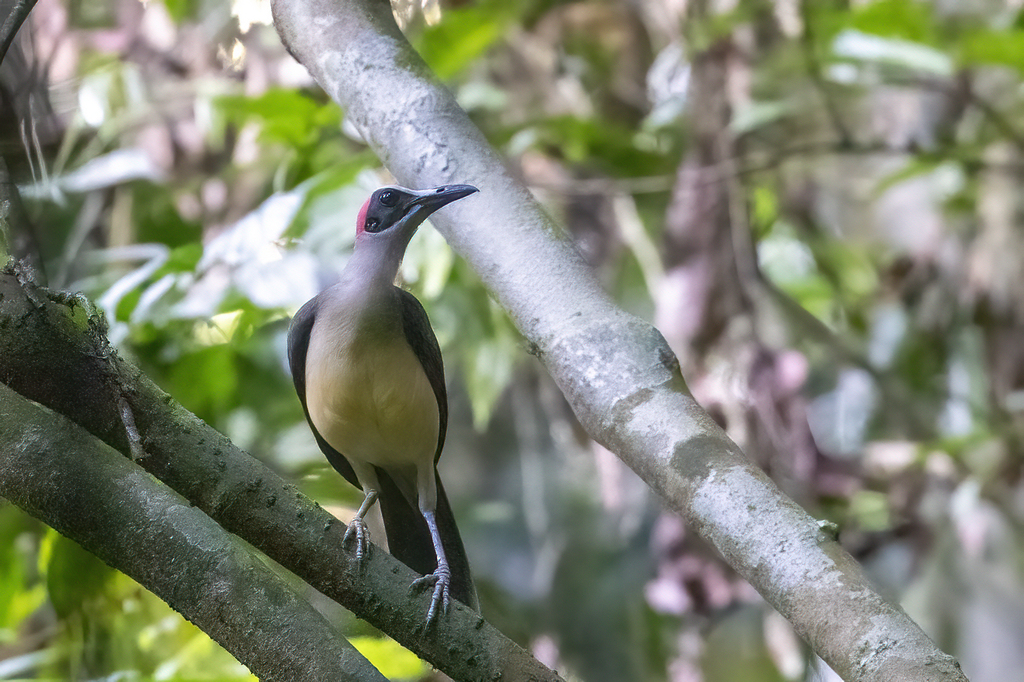
Scientists have made the first record of a rare bird in the west of the Democratic Republic of Congo — inside a biosphere reserve that is severely threatened by deforestation.The grey-necked picathartes — a bird of the Lower Guinean rainforest — was not previously thought to live as far south as the DRC.But records of it there, as well as recent new records of the same species in the southwestern corner of the Republic of Congo and in Angola’s northern Cabinda province, lend impetus for the proposed Mayombe Forest Transfrontier Protected Area (TFPA) — home to other charismatic species like gorillas, chimpanzees and forest elephants. When ecologist Jean Semeki installed camera traps along a forest trail in the Luki Biosphere Reserve in the west of the Democratic Republic of Congo to survey its mammals, he and his colleagues weren’t prepared for what they’d find when they downloaded the images. Alongside video footage of inquisitive apes — members of the reserve’s remnant population of endangered central chimpanzees (Pan troglodytes troglodytes) — were videos of a strange, long-legged bird, hopping across the leaf litter. It was a grey-necked picathartes (Picathartes oreas). “When I first saw the video, I couldn’t believe my eyes,” said Semeki’s co-author, Hugues Dethier, when he analyzed the camera trap data. “I asked my colleague Guillaume Baltus to take a look, and he confirmed the identification.” Picathartes are large slender grey and white birds with vivid blue and red patches on their bald heads. They’re known to lead secretive lives in the understory of rainforests in Cameroon, Equatorial Guinea, Gabon and the Republic of Congo — the DRC’s northern neighbor, building their cup-shaped nests from mud on the walls of caves and rocky overhangs. But until now, they weren’t known to live this far south. Camera trap image of a grey-necked picathartes in the Luki Biosphere Reserve, Democratic Republic of Congo. Image courtesy of Hugues Dethier et al. The discovery, reported recently in the journal Ostrich, extends their previous range by nearly 400 kilometers (249 miles). For a species already considered by the IUCN to be near threatened with extinction due to its small population size and habitat degradation throughout its range, finding it inside Luki provides small comfort. Luki — which is also home to black-bellied pangolins (Phataginus tetradactyla), bay duikers (Cephalophus dorsalis), moustached monkeys (Cercopithecus cephus) and other small mammals — faces serious threats from people trying to earn a living from shifting cultivation, charcoal production, artisanal logging and hunting. “These activities are practised and present even within the core zone, which has a status of full protection,” said Semeki, a forest and wildlife management specialist who is based at the University of Kinshasa, DRC. “The current situation in the Luki Reserve is very alarming.” Satellite-based forest monitoring data provided to Mongabay by Global Nature Watch indicates that Luki has lost more than 3,500 hectares (8,649 acres) of primary forest — equivalent to more than 18% of what was mapped in 2001. More than 1,125 hectares (2,780 acres) was lost between 2023-25 alone. Two years after making their picathartes discovery in Luki in 2021, the same team of researchers used camera traps to detect picathartes for the first time in the Republic of Congo’s Conkouati-Douli National Park, along the border with Gabon. A view of the Mayombe Massif in Kouilou, Republic of Congo. Image by jbdodane via Flickr (CC BY-NC 2.0). Both Luki and Conkouati-Douli are key components of the proposed Mayombe Forest Transfrontier Protected Area (TFPA). This is a conservation plan, approved by four countries in 2013 for the ridge of mountains that extends from south-western Gabon, through the Republic of Congo and the Angolan enclave of Cabinda, to the DRC and Luki — the Mayombe rainforest’s southernmost remnant. The massif was historically estimated to hold some 10,000 square kilometers (3,861 square miles) of dense rainforest surrounded by another 26,000 km2 (more than 10,000 mi2) of drier lowland rainforest, woodlands and savanna. But the TFPA initiative — which remains alive in principle — has stalled due to a lack of funding and coordination between the various responsible government ministries and their ever-changing personnel, said Tamar Ron, a biodiversity conservation consultant who helped to initiate plans for the TFPA 26 years ago. “At the moment what you have is that in each of the [four participating] countries there is a different level of activity — projects for conservation that are not transboundary,” Ron told Mongabay. But she added, “There is no way we can protect the Mayombe without transboundary collaboration — simply no way.” Chimpanzee in the DRC’s Luki Biosphere Reserve. Image courtesy of Cedric Vermeulen and Jean Semeki. The grey-necked picathartes, along with the chimpanzees, and western lowland gorillas (Gorilla gorilla gorilla) present in some of Mayombe’s remnant forests, could serve as flagship species highlighting the importance of transboundary conservation, said Pedro Vaz Pinto, a conservation biologist who discovered a small nesting colony of the birds in Cabinda’s Mayombe National Park — another key component of the proposed TFPA. Cabinda is a small boot-shaped province wedged between the DRC and the Republic of Congo to the north and separated from the rest of Angola by the DRC’s narrow strip of Atlantic coastline. Like the researchers in Luki, Pinto discovered the picathartes colony in Cabinda accidentally, via camera traps set to monitor apes and other mammals in 2023. Months later he spotted a likely nesting place: caves on top of a rocky hill. “I climbed that hill and sure enough there was a colony,” he told Mongabay. He stayed until some of the adult birds showed up. Four of their swallow-like nests held both chicks and eggs. “I’ve already been approached by people who would like to go there and see the picathartes,” Pinto said. This could become feasible if discussions to establish a biological research station in the rainforest come to pass. “That would be the way to go — to bring researchers, primarily, but also tourists,” he said. Grey-necked picathartes in Angola’s Mayombe National Park. Image courtesy of Pedro Vaz Pinto. At around 200,000 hectares (more than 494,000 acres), Cabinda still has “good rainforest pockets” left standing, Pinto said. These areas provide suitable habitat for healthy numbers of gorillas, chimpanzees and forest elephants (Loxodonta cyclotis). But the park also faces big threats from logging, which is legal in some areas, and widespread gold mining, including some industrial operations, he said. “Because of the gold price increasing so much in recent years, the pressure is increasing in the park.” The Mayombe landscape sits on the southern-western margin of the Congo Basin tropical forest, and the latest records of picathartes at new sites in three different countries that share it is yet more proof of its ecological importance, said Ron, the biodiversity consultant. “I wouldn’t be surprised if there will be more discoveries of [unrecorded] species.” But without funding and active support for the four-country transboundary conservation initiative, she said, some areas of the Mayombe massif remain vulnerable to irreversible degradation. “On the one hand, the potential [for transboundary conservation] is enormous, and on the other hand, the destruction and the threat is very imminent.” Banner image: A grey-necked rockfowl (Picathartes oreas) in Cameroon. Image © Niall Perrins via iNaturalist (CC BY-NC 4.0) Citation: Dethier, H., Van Hoef, Y., Baltus, G., Vermeulen, C., Patton, P., Ngabinzeke, J. S., & Lhoest, S. (2026). Range extension of the grey-necked Rockfowl Picathartes oreas Reichenow, 1899 in both congos, evidenced by camera traps. Ostrich, 97(2), 155-160. doi:10.2989/00306525.2026.2647920 In search of the ‘rare and beautiful’ in an Ivorian rainforest Feedback: Use this form to send a message to the author of this post. If you want to post a public comment, you can do that at the bottom of the page. Credits Topics
Rare bird finding strengthens case to protect Congo rainforest across borders
Full Article
Original Source
Read the full article at News →KhanList aggregates and links to publicly available news content. We do not host full articles from third-party sources. Always verify important information with original sources.