
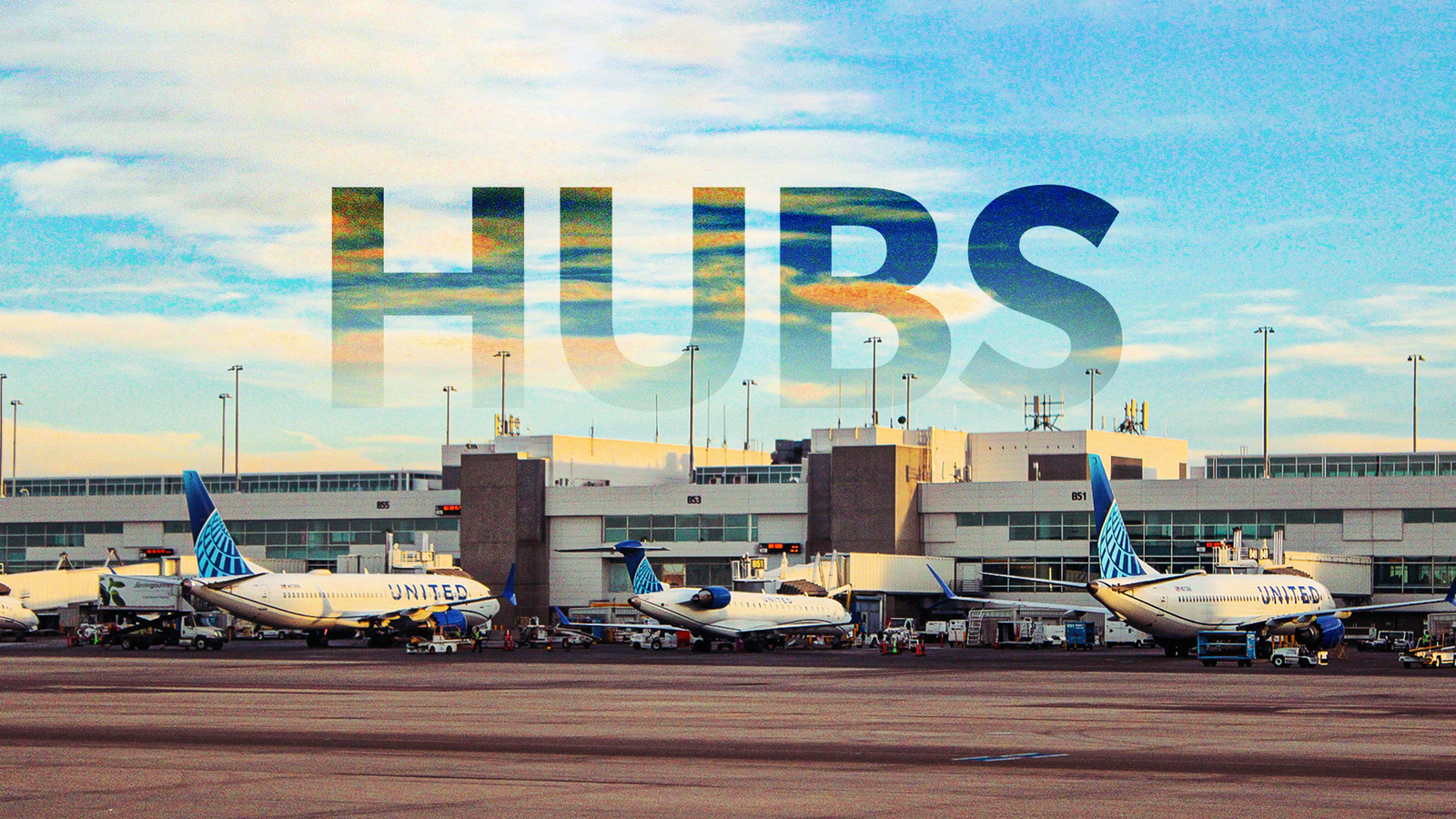
United Airlines operates the largest fleet of jetliners in the world, serving one of the world’s most expansive and complex networks of air routes. To keep domestic commuters and international flyers moving, UA contends with harsh weather, air traffic control failures, and other unexpected disruptions across roughly 4,500 daily departures at its top hubs. This countdown examines the hard data to reveal how airfields from the West Coast to the Windy City, Big Apple, Lone Star State, and even the nation's capital stack up. 7 Chicago O'Hare International Airport (ORD) Down from 73% in 2025 to 71% on-time in 2026, so far Credit: George Wirt | Shutterstock According to Delay Atlas, Chicago O'Hare is at the very bottom for on-time performance (OTP). It is the network's worst-performing hub, with only 73% of United flights arriving as expected in 2025. Tight flight schedules and congested skies quickly collapse during summer thunderstorms in the Midwest. Meanwhile, winter snow and ice pose another seasonal weather obstacle. The airport as a whole ranks approximately 24th this year among major US airports. Traveling in the morning normally goes smoothly, but as the day goes on, delays mount quickly. Last year, nearly 90% of flights departing between 5:00 AM and 8:00 AM did so on time. By the busy evening rush between 5:00 PM and 8:00 PM, on-time departures (OTD) dropped below 70%. Traffic jams on the tarmac often force arriving planes to sit on the ramp waiting for an open gate. All that waiting on the ground creates big headaches for both the airline and passengers. A Boeing 737 sitting with its engines idling burns roughly 1,000 to 1,200 pounds (454 to 544 kg) of fuel every hour just waiting to move. Those delays can even cause pilots to time out of legal working hours and force a crew swap. In the worst-case scenario, travelers could be left stranded without their checked bags, making ORD the biggest drag on United's schedule. 6 Newark Liberty International Airport (EWR) Up from 76% in 2025 to 79% on-time so far this year Credit: John McAdorey | Shutterstock Last year, United canceled 2.3% of its Newark schedule, the highest cancellation percentage of any United hub, and just 76.3% of its flights landed on time. Despite the sound of slot restrictions, the airport's overall rise to fifth place in the country for punctuality was aided by federal regulations. The cap set a ceiling of 72 takeoffs and landings each hour, and yet UA still has trouble here, despite OTD rising to 79.0% in 2026. Situated in one of the busiest air corridors in the nation, the airport only has a small footprint to operate out of. The confined airfield leaves almost no room for error. When bad weather hits the East Coast, air traffic slows to a crawl. That's when UA often has to cancel flights outright rather than let planes circle in the air. Major runway construction made things even tighter, temporarily cutting flights down to 28 per hour and forcing UA to trim its peak schedules to prevent gridlock on the apron. To carry as many travelers as possible without breaking the strict FAA hourly flight cap, UA employs its biggest jets for domestic trips as well as overseas itineraries. The airline flies Boeing 777 widebodies, which weigh over 304,500 pounds (138,119 kg), between Newark and San Francisco. Using one giant twin-aisle instead of two smaller narrowbodies lets United move hundreds more people at once while saving precious takeoff spots and gate space. 5 Denver International Airport (DEN) Down from 79% in 2025 to 76% on-time so far this year Credit: Denver International Airport With almost 108,000 flights passing through its ramp in 2025, Denver claims the title as United's busiest hub. The airline reported a network-best cancellation rate of only 0.41% and a strong 78.9% on-time arrival (OTA) rate despite the heavy demand. Air traffic control can also land and launch a higher volume of jets than at airports like Newark without creating ground gridlock, thanks to Denver's generous real estate. The airport is situated on expansive plains with six runways that never overlap, maximizing ground operations efficiency. Although the airport layout is ideal for dense schedules, Denver's high altitude presents a weather hurdle in summer. Sitting 5,434 feet (1,656 meters) above sea level, the air is already thinner than at coastal airports. On hot summer afternoons, that thin, warm air behaves as if it were over 9,000 feet (2,743 meters) high in a turbofan engine. The low density and high temperature make it much harder for jet engines to pull in enough air to produce takeoff thrust. On a heavy Boeing 737 MAX, the engines have to spin at over 100% N1 and can push internal exhaust temperatures close to 1,832°F (1,000°C) just to get off the ground. That burns more gas on every sortie and compounds wear and tear on the planes. 4 San Francisco International Airport (SFO) Down from 79% in 2025 to 73% on-time this year Credit: Wirestock Creators | Shutterstock San Francisco delivered a low cancellation rate of 0.46% and a strong 79.8% OTA rate in 2025. However, with an average OTD of only 73.42%, SFO came in 19th place in the country overall. The airport's design is to blame for recent drops in hourly flight volumes. The FAA revoked the parallel landing exemption that allowed simultaneous operations of its two main arrival runways, which lie only 750 feet (229 meters) apart. The two strips are 3,550 feet (1,082 meters) below the standard FAA separation limit. That forced the agency to prohibit two aircraft from landing side by side in low clouds. The long-standing exemption ended this March following a broader federal safety review sparked by the January 2025 midair collision of American Airlines Flight 5342. Thus, when the famous Bay Area fog rolls in, arrival capacity immediately drops from 60 planes per hour down to about 30. That sudden slowdown forces air traffic controllers to hold flights back at their departure cities across the country, creating ripple-effect delays throughout the day. Once planes finally clear the fog, the cool conditions actually help United's biggest jets take off. Long international flights across the Pacific rely heavily on the Boeing 777-300ER, which can weigh up to 775,000 pounds (351,534 kg) at takeoff when fueled for a transpacific voyage. 3 George Bush Intercontinental Airport (IAH) Down from 80% in 2025 to 79% on-time this year, so far Credit: quiggyt4 | Shutterstock United's primary hub for the Southern US and Latin America is Houston Intercontinental. The field handled over 74,200 flights last year, with an 80.6% on-time rate and a low cancellation rate of 0.55%. In terms of punctuality, the airport as a whole rose to sixth position in the country, highlighting how a large hub can still run efficiently when the layout is optimized for high traffic on the ramp. ATC can coordinate large waves of aircraft without causing taxiway congestion thanks to the five runways and extensive taxiway grid. When summer storms shut down Chicago or crowded skies slow down Newark, UA can use Houston as a backup to relieve pressure. Rerouting connecting travelers through Texas helps keep the rest of the network moving. Wide taxiways keep planes rolling steadily to their gates, preventing backups during the busy afternoon rush. Houston is also a primary home base for UA's newest single-aisle aircraft, the Airbus A321neo. Built with lightweight metal alloys and powered by next-generation engines, these planes cut costs and emissions with lower fuel burn on busy daily routes while giving travelers a quieter, more modern cabin experience. 2 Washington Dulles International Airport (IAD) Holding at 82% on-time from 2025 through 2026, so far Credit: George Wirt | Shutterstock Dulles avoids many weather-related ground delays, in contrast to other East Coast hubs that come to a complete stop during summer storms. With an 82.1% on-time arrival percentage and a low 0.85% cancellation rate across approximately 37,000 flights, Washington Dulles established itself as United's top-performing fortress hub in 2025. In terms of departure timeliness, the airport as a whole rose to second place in the country and is looking to improve, with 82.2% OTD in 2026 so far. The airport has a significant edge over congested competitors like Newark due to its runway and taxiway configuration. Four wide strips that don't intersect make it possible for controllers to run high-volume operations, even when clouds and rain roll through the area. Arriving flights from Europe can land without circling the field, while domestic flights push back from the gates and take off without obstructing arriving jets. United is increasingly using its Boeing 787-9 Dreamliner to maximize comfort on busy cross-country flights from Dulles to the West Coast. The plane's lightweight carbon-fiber materials allow the cabin to be pressurized closer to ground level, enabling a cabin altitude of 6,000 feet (1,829 meters), rather than 8,000 feet (2,438 meters) on older planes. Combining that atmosphere with higher humidity, smart lights, and quieter walls greatly reduces jet lag. 1 Los Angeles International Airport (LAX) On-time performance dropped from 83% in 2025 to 79% this year Credit: John McAdorey | Shutterstock Los Angeles International is the most consistent and dependable operating base for United. The airline completed around 30,000 flights in the last year with an 82.5% OTA rate and a 0.50% cancellation rate, but LAX has slipped to 79% OTA in 2026, per JohnnyJet. UA's Los Angeles business focuses mostly on direct, point-to-point flights, as opposed to mega-hubs like Chicago or Denver, which rely on massive waves of connecting passengers. LAX functions primarily as a massive Origin-and-Destination market, meaning most passengers begin or end their trips in Los Angeles rather than connecting through. Because UA runs a smaller, leaner schedule here than at mega-hubs like Denver or Chicago, operations rely less on tightly packed connecting waves where a single late inbound plane triggers a domino effect of missed connections. Four parallel runways split into north and south complexes allow ATC to manage steady arrival and departure flows without the strict spacing bottlenecks seen in foggy San Francisco. Additionally, United's $573 million renovation of Terminal 7 streamlined gate layouts, boarding areas, and baggage handling, giving the airline modern infrastructure to turn aircraft around quickly.
Ranked: Which Of United Airlines' US Hubs Run The Best Operation In 2026?
Full Article
Original Source
Read the full article at Simpleflying →KhanList aggregates and links to publicly available news content. We do not host full articles from third-party sources. Always verify important information with original sources.