
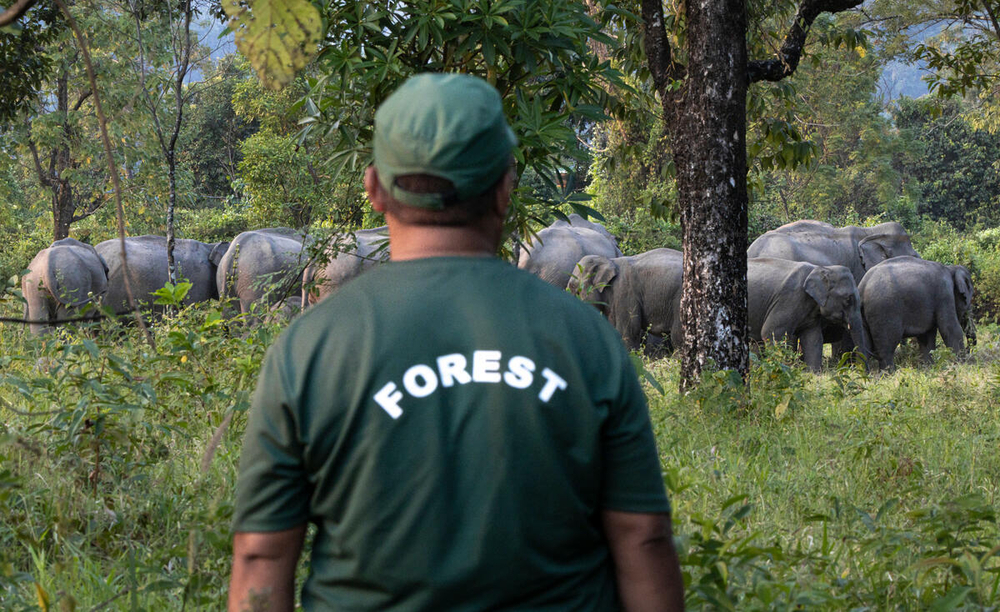
Delegates to the COP17 biodiversity summit conducted the first global review of progress toward the ambitious goals adopted in 2022 under the Kunming-Montreal Global Biodiversity Framework.Among these goals is the commitment to conserve 30% of the planet’s land and waters by 2030, but achieving this will depend on better policy to support a constituency that has been often overlooked and underfunded: rangers.“If rangers are not recognized in policy, they cannot be properly planned for or funded, and without them, even the most ambitious conservation targets will fall short,” the authors of a new op-ed argue.This article is a commentary. The views expressed are those of the authors, not necessarily of Mongabay. At the COP17 biodiversity summit in Yerevan, Armenia, conservation leaders from around the world gathered to conduct the first global review of progress toward the ambitious goals adopted in 2022 under the Kunming-Montreal Global Biodiversity Framework (KMGBF). Among them is Target 3, a commitment to effectively and equitably conserving 30% of the planet’s land and waters by 2030 (30×30). But achieving a shift in land and sea management on this scale will depend on something in conservation policy that has too often been overlooked: a large portion of the people responsible for actually making it happen — rangers. For years, the world has debated how much land to protect and how much money to invest in nature, while paying far less attention to the workforce needed to turn those commitments into results. Rangers play a central role in managing protected and conserved areas and delivering commitments on biodiversity, climate, and land degradation. Yet our latest research shows they remain largely absent from the policies and frameworks meant to guide this work. Why rangers matter Effective conservation requires people on the ground who can monitor ecosystems, manage protected and conserved areas, and ensure that rules governing their use are upheld. The International Ranger Federation defines a ranger as any person, regardless of title — wildlife warden, forest guard, game scout, marine ranger, park guard, and others — working in situ to safeguard nature and preserve cultural and historical heritage. Rangers work under many different governance systems and are not limited to government employees. They may serve national or local authorities, be members of Indigenous or local communities (IPLCs), or work for organizations responsible for conservation. Members of Akashinga, Zimbabwe’s all-women ranger force. Photo image courtesy of Akashinga. One global survey found that 36% of rangers are local people, employed within a 20-kilometer (12-mile) radius of where they live and drawn from local communities. From monitoring wildlife and restoring habitats to managing human-wildlife conflict and responding to climate-related threats, rangers perform a wide range of essential conservation duties that make them a critical workforce for the health of the planet. In many places, that work is carried out in partnership with IPLCs, including through locally determined rules and conservation practices. Yet rangers face major challenges in carrying out their duties. Nearly half of rangers across Asia, Africa, and Latin America lack adequate equipment, training, and staffing. An average of two rangers die in the line of duty each week. Rangers face risks from confrontations with organized wildlife criminal networks, human-wildlife conflict, and natural disasters. Climate change adds to these pressures. Yet many still lack basic protection: only 47% have life or health insurance. This creates alarming instability at the foundation of global conservation. Governments and donors are investing heavily in expanding protected and conserved areas while underinvesting in a portion of the people required to manage them. That imbalance puts conservation outcomes at risk. Risk of paper parks The key word in Target 3 is “effectively.” Conservation history offers an important lesson: designating protected and conserved areas does not automatically translate into conservation outcomes. Around the world, many sites are protected on paper but lack the staffing, resources, and management capacity needed to deliver effective conservation. The success of 30×30 will depend not only on how many hectares we designate as protected and how many dollars we invest in them, but on how effectively those places are managed. And management depends on people. The three fundamental pillars of any enterprise are capital, space, and labor. By decoupling capital and space from labor, environmental governance risks proliferating poorly managed paper parks. Without sufficient staffing that is well trained, equipped, responsible, and accountable, even the best-designed conservation strategy will struggle to achieve its objectives. The conservation community often describes biodiversity loss as a financing challenge. While funding undoubtedly matters, it is also a workforce challenge. Without the necessary people to manage these areas, those investments are at risk. On the frontlines of conservation, rangers race to safeguard Batutegi forest in Sumatra, Indonesia, August 2026. Image by Basten Gokkon for Mongabay. Missing piece Despite being central to the success of biodiversity conservation, rangers have not been a major focus of policies and funding plans for biodiversity. One global estimate put annual global spending at around $24 billion, which is less than 40% of the roughly $68 billion needed each year to adequately manage the existing system. Rangers are not adequately recognized for their contributions to these policies and plans, or valued as a profession and an investment. Our research — supported by the Universal Ranger Support Alliance (URSA), the International Ranger Federation (IRF), and others — highlights this critical gap. We reviewed 45 global and national conservation policy documents, including 21 National Biodiversity Strategies and Action Plans (NBSAPs). The disparity was stark: references to area appeared roughly 70 times more often than references to rangers, while finance appeared more than 80 times as often. Even in national biodiversity plans, where rangers received somewhat more attention, they remained far less visible than either finance or area. The contrast is even clearer when conservation is compared with public health. In the World Health Organization and UNICEF’s “Operational Framework for Primary Health Care,” health workers — including nurses, midwives, doctors, and paramedics — are mentioned about 48 times as often as rangers are in the conservation documents we reviewed. The conservation sector can learn from public health frameworks that routinely emphasize the importance of doctors, nurses, midwives, community health workers, and health care systems. Policymakers understand that hospitals alone do not save lives. Health outcomes depend on the people delivering services, but conservation frameworks do not currently apply the same logic. We celebrate protected and conserved areas, ambitious targets and innovative finance mechanisms, but we often overlook the workforce required to implement them. Indigenous women of the Ticuna community of San Francisco de Yahuma in Loreto, Peru, launch a drone to monitor the integrity of their territory. Image courtesy of Joseph Zegarra/Rainforest Foundation US. Bringing the workforce back into policy Addressing this “ranger blind spot” is essential to achieving global conservation goals, particularly the 30×30 target. Future policies governing protected and conserved areas (PCAs) must formally recognize the people responsible for managing them and ensure they have the staffing, resources, and institutional support to succeed. The workforce must also be part of core negotiations for future conventions and targets, including innovative finance mechanisms such as carbon and biodiversity credits, which also fail to address it adequately. The same emphasis is needed at the national level, including in countries’ legal and constitutional frameworks and policies. Equally important is the adoption of established standards for ranger training, professional conduct, pay, and working conditions. These should promote respect for human rights, equip rangers with the skills and support to do their jobs safely and effectively, and hold them accountable for their actions. They must also address gender inequality and extend appropriate recognition and protections to rangers employed by IPLCs and other nongovernmental organizations. In the weeks following Yerevan and in preparation for the next meetings of the Convention on Biological Diversity, delegates should picture a gleaming new hospital with no doctors or nurses. Without the people needed to make it work, even the best-equipped hospital cannot deliver care. The same is true of conservation. If rangers are not recognized in policy, they cannot be properly planned for or funded, and without them, even the most ambitious conservation targets will fall short. Madhu Rao chairs the IUCN World Commission on Protected Areas (WCPA). Nik Sekhran formerly served as director for sustainable development at the UNDP and has more than 25 years of conservation and sustainable development experience across Africa, Asia, Oceania, and Latin America. Banner image: Monitoring an Asian elephant herd, Sarpang, Bhutan. Image courtesy of Universal Ranger Support Alliance. See related coverage: On the frontlines of conservation in Sumatra: Rangers safeguard Batutegi forest The uplifting story of one of Zimbabwe’s pioneering women rangers Citation: Timmins, H. L., Churcher, J., Singh, R., Stolton, S., Acharya, K. P., Yadav, S. P., … Slade, J. (2026). The “ranger blindspot”: Global policy and implementation gaps. Ambio. doi:10.1007/s13280-026-02496-7 Credits Topics
Rangers’ role must be built into biodiversity conservation commitments (commentary)
Full Article
Original Source
Read the full article at News →KhanList aggregates and links to publicly available news content. We do not host full articles from third-party sources. Always verify important information with original sources.