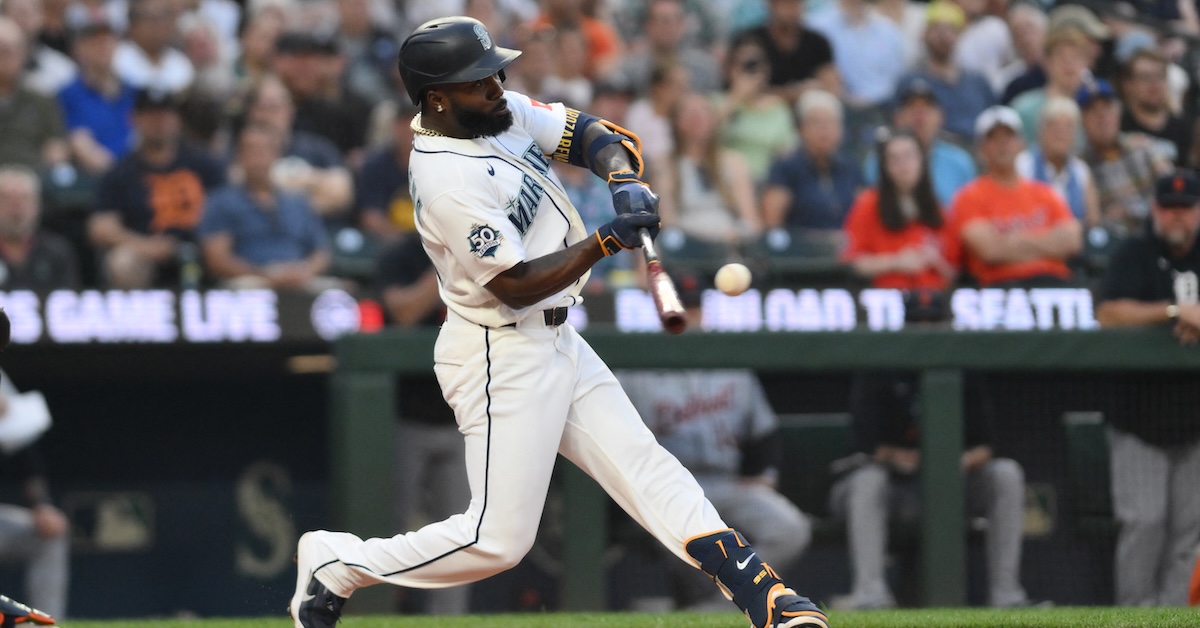
Steven Bisig-Imagn Images Randy Arozarena is leading the Seattle Mariners with 3.2 WAR. He’s on pace for a career-high 4.5 WAR. He’s running a 138 wRC+, his best mark since the summer of 2020, when a steady diet of chicken, rice, and pushups turned him into the kid who only hit homers. He was an All-Star. But some of Arozarena’s underlying numbers are confusing. He’s on pace for 20 home runs, his standard year-end total. If you’ll forgive a digression, Arozarena has ended up with 20 homers in three of his five full seasons, which ties him for third on the all-time 20-homer-season leaderboard, behind only Bobby Abreu (five) and Harold Baines (four). But Arozarena’s bat speed is down by a huge margin, as is his launch angle. How is he going yard just as often while swinging softer and running a career-high groundball rate? Let’s try to figure out what’s going on here. I always like to start with plate discipline, and that’s certainly a logical jumping off point, because the biggest change in Arozarena’s profile is in the strikeout column. He’s running a 20.7% strikeout rate this season. That’s an enormous six-point drop from last year, and it’s more than three points below his previous low. In fact, if you look at things from a certain angle, that drop is the entire reason that Arozarena is putting up his best season ever. If you ignore walks and strikeouts and just look at balls in play, Arozarena’s wOBAcon and xwOBAcon are nearly identical both to the numbers he put up last year and to his career averages: Arozarena is getting the same results as ever when he puts the ball in play. Now, I know that he’s getting to those results in a different way, and we’re going to dive into those differences soon, but in that sense, the entirety of his wRC+ boost has come from the fact that he’s striking so much less. So let’s talk about why he’s striking out less. Generally speaking, there are three ways to strike out less. You can improve your plate discipline by laying off more pitches outside the strike zone. You can improve your contact rate – that is, you can just stop whiffing as much – but that’s pretty hard to do and even harder to keep doing, because contact skills are very sticky. It usually comes along with step one; laying off bad pitches means your swings come on better pitches, which naturally boosts your contact rate. Lastly, you can amp up your swing rate. It’ll likely lower your walk rate too, but the more often you swing, the higher your chance of putting the ball in play. Arozarena has chosen the third path, with just a smidgen of the second thrown in. He’s increased his swing rate across the board, running his highest zone swing rate since 2022 and his highest chase rate ever. He’s also running a 70% contact rate on pitches outside the zone, nearly eight percentage points higher than in any previous full season. O-contact is notoriously finicky, so that part is almost certainly a fluke, but the relationship I’m talking about is easy enough to see. He’s swinging more and putting the ball in play more: You Aren't a FanGraphs Member It looks like you aren't yet a FanGraphs Member (or aren't logged in). We aren't mad, just disappointed. We get it. You want to read this article. But before we let you get back to it, we'd like to point out a few of the good reasons why you should become a Member. 1. Ad Free viewing! We won't bug you with this ad, or any other. 2. Unlimited articles! Non-Members only get to read 10 free articles a month. Members never get cut off. 3. Dark mode and Classic mode! 4. Custom player page dashboards! Choose the player cards you want, in the order you want them. 5. One-click data exports! Export our projections and leaderboards for your personal projects. 6. Remove the photos on the home page! (Honestly, this doesn't sound so great to us, but some people wanted it, and we like to give our Members what they want.) 7. Even more Steamer projections! We have handedness, percentile, and context neutral projections available for Members only. 8. Get FanGraphs Walk-Off, a customized year end review! Find out exactly how you used FanGraphs this year, and how that compares to other Members. Don't be a victim of FOMO. 9. A weekly mailbag column, exclusively for Members. 10. Help support FanGraphs and our entire staff! Our Members provide us with critical resources to improve the site and deliver new features! We hope you'll consider a Membership today, for yourself or as a gift! And we realize this has been an awfully long sales pitch, so we've also removed all the other ads in this article. We didn't want to overdo it. Somehow, Arozarena has gone from a chase rate that’s much better than the league average to one that’s a bit worse, but his walk rate has actually increased slightly while his strikeout rate has dropped in a huge way. That’s a pretty good trick if you can make it work, and it brings us back to bat speed, because it sure sounds like Arozarena has just decided to be more of a contact hitter, dusting his game with a sprinkling of Luis Arraez. As you likely know, contact hitters like Arraez tend to have really high swing rates because they can hit just about any pitch. Last year, Arozarena’s bat speed was at 72.3 mph, and this year he’s at 70.9 mph. A total of 202 players have taken enough swings in each of the past two years to qualify for Statcast’s bat tracking leaderboard. The 1.4-mph gap between Arozarena’s 2025 and 2026 bat speed is tied for the eighth-highest drop-off. We’re talking about the 94th percentile here. It’s a very large drop. Knowing that he’s making more contact than ever, the puzzle pieces start falling into place. Arozarena is trading power for contact, right? That would make sense, but it doesn’t seem quite that simple. It’s true that Arozarena’s swing is both slower and shorter, and he’s making more contact and hitting the ball softer, but somehow he’s not hitting the ball that much softer. The other players with a bat speed loss of at least 1.4 mph this season have lost an average of 1.25 mph from their exit velocities, but Arozarena has lost just 0.3 mph. So he’s swinging softer, and hitting the ball softer, but the latter drop is smaller than you’d expect, and as we’ve established, the ball is finding its way over the wall just as often. The numbers I’ve just told you about aren’t quite telling the whole story, though. The 0.3 mph of average exit velocity Arozarena has lost isn’t quite as bad as it sounds, because the league average has dropped by 0.6 mph. It’s a weird year, so despite the drop-off, he’s actually gone from the 79th percentile to the 82nd! On the other hand, Arozarena’s 90th-percentile exit velocity has dropped more than two ticks, from 106.7 mph to 104.5 mph. That really is a big drop, and it takes him from above average to below average. This is another narrative that we’re familiar with. With his slower, shorter swing, Arozarena is giving up some top-end power in exchange for fewer mishits, and the numbers check out. Sports Info Solutions credits Arozarena with a 10% soft-hit rate, his lowest mark ever. So there we are. Arozarena is indeed trading top-end power for contact ability and squared-up rate. But it’s still a little weird. How he hitting for just as much power if he’s traded in his top-end exit velocities? The answer consists of a few different factors. The first is that Arozarena is powerful enough already. This is a concept I think about a lot but haven’t written about yet. Plenty of hitters look for home runs by selling out for the pulled fly ball. It allows Isaac Paredes to be a power hitter despite shockingly low exit velocities, but it makes less sense for players with more raw power. Pulling the ball requires meeting the ball farther out in front of you, which requires starting your swing earlier, which means you have less time to make good decisions and react to the pitch. It’s harder to do. The margin for error is smaller. If you have enough power to hit homers to center and right field, you should absolutely do that. It’s why so many hitters will tell you that their goal is to hit a line drive to right-center (left-center for lefties), or to focus on hitting the inside part of the baseball. It’s a balanced approach that leaves them on time for the fastball, driving it the other way, and just a bit out in front of a pitcher’s secondaries, driving them to the pull side for power. Last year, Arozarena’s average intercept point was 30.8 inches in front of his center of mass. This year, it’s down to 27.5 inches. That’s a 3.3-inch drop, and it’s tied for the third-highest drop in baseball (among batters with at least 250 plate appearances in each of the past two seasons). His pulled air ball rate has dropped to just over 14%, the lowest mark of his career. (As you probably know, Statcast tracks bat speed at the moment the bat is closest to the ball, and bat speed increases throughout the swing, so meeting the ball so much deeper is part of the reason Arozarena’s bat speed numbers and swing length are down some, but it’s far from the whole reason. Even if we compare apples to apples by looking only at fastballs over the heart of the plate that Arozarena pulled over 95 mph, his bat speed is still 2.1 mph slower this year than it was last year.) But even with this slower swing, he’s hitting the ball hard enough to go yard anyway. He’s already hit eight home runs to center or right field, more than he hit in either of the last two seasons. It’s easy to see in the spray chart. Arozarena is less of a dead-pull hitter and more of an all-fields threat: Now, seeing and hitting the ball deeper has other knock-on effects. As we know, your bat travels downward at the beginning of your swing and upward toward the end, resulting in high launch angles when you’re farther out in front. That provides some of the explanation for Arozarena’s declining launch angle. But seeing the ball deeper is also simply allowing him to make better contact. He’s running a career-high line drive rate and a career-low popup rate, both by wide margins: Strikeouts and popups both have a wOBA right around zero. They’re completely wasted plate appearances. If you combine the drops in Arozarena’s strikeout and popup rates, you’re at 9.2% of his plate appearances. He’s reclaimed nearly 10% of his plate appearances and turned them into non-popup balls in play. Even if he only ran a .200 BABIP on those reclaimed batted balls, it would still add 20 points to his on-base percentage. Instead, he’s running his highest BABIP in years because of that career-high line drive rate. No wonder the step back in top-end exit velocity has been worth it! And putting so many more balls in play is also part of the reason he’s kept his home run totals as high as ever. He may not have the same top-end exit velocity, but he gets more bites at the apple. I should also mention that this isn’t the only reason Arozarena’s launch angle has dropped so extremely. It seems that pitchers are approaching him differently. He’s seeing fewer four-seamers and sliders and more sinkers and offspeed pitches. In other words, he’s seeing pitches that come into the plate at a lower height and that break downward more often. That’s one recipe for lowering your launch angle and running a career high groundball rate. Now, I’m not certain how long all of this will last. For example, Arozarena is pulling the ball less, but he’s specifically hitting it to right field more often, rather than center field. That allows him to get the most out of his contact in the air, as center is where fly balls go to die, but it could be something of a fluke. Hitters only have so much control over their spray angle. Likewise, I’ve talked about Arozarena’s career-high line drive rate a lot, and while the drivers behind it are fairly intuitive, it’s still an extremely finicky stat that could regress to the mean. The same goes for Arozarena’s .330 BABIP, his highest mark in years. That’s to be expected when you’re trading popups for line drives, which is why advanced metrics like xwOBAcon and DRC+ are both on board with his big year, but that doesn’t mean it can’t regress. Lastly, there’s no way of knowing how long Arozarena will stick with this approach. He’s a power hitter who’s had great success pulling the ball in the air throughout his career. It wouldn’t be shocking to see him go back to what he knows next season, or in response to a bad slump. Still, this is a truly impressive run. Arozarena has a career wRC+ of 125, and he’s never finished a season below 114. Necessity was not the mother of this particular reinvention. It’s really bold for a player with such a good track record to make such a significant change in his approach, and so far at least, it’s really working.
Randy Arozarena, Contact Hitter?
Full Article
Original Source
Read the full article at Blogs →KhanList aggregates and links to publicly available news content. We do not host full articles from third-party sources. Always verify important information with original sources.