
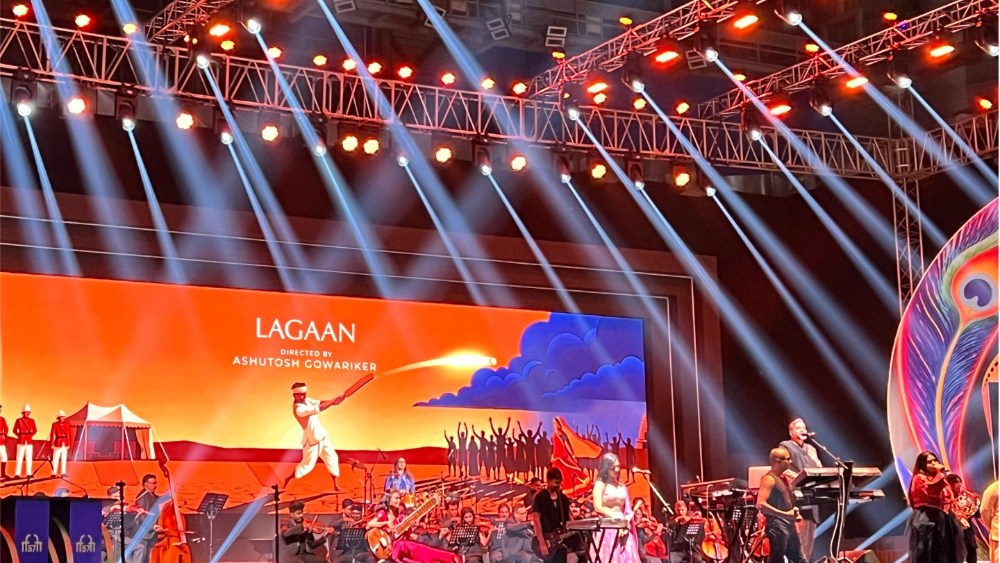
The 57th International Film Festival of India opened in Goa on Friday, with “Lagaan” director Ashutosh Gowariker setting out a “Stories Without Borders” program in his first year as festival director and Goa Chief Minister Pramod Sawant renewing his push for a film city in the state. Paweł Pawlikowski’s “Fatherland,” which shared the best director prize at Cannes this year, opened the festival. The ceremony at the Dr. Shyama Prasad Mukherjee Indoor Stadium began with the national anthem “Jana Gana Mana” and national song “Vande Mataram,” followed by a ceremonial lamp lighting with Sawant, National Film Development Corporation (NFDC) chair G. Krishna Kumar, Gowariker and several other dignitaries. Bollywood star Kartik Aaryan was in attendance, along with Sai Pallavi, who plays Sita in Nitesh Tiwari’s blockbuster “Ramayana.” Jury chairs Aanand L. Rai (“Tanu Weds Manu”), who heads the international jury, and filmmakers Madhur Bhandarkar and Himanshu Sekhar Khatua, who led the Indian Panorama feature and non-feature juries respectively, were also in the audience. The festival runs through Nov. 28. Three-time Grammy winner Ricky Kej set the tone with “A World of Cinema Through Music,” an orchestral performance built around a medley of film themes played with Indian instruments. It moved from “The Godfather,” “Parasite” and “Rashomon” to “The Lord of the Rings,” Satyajit Ray’s “Pather Panchali,” “Doctor Zhivago,” “The Good, the Bad and the Ugly,” “La Bamba,” Gowariker’s own “Lagaan” and “Mission: Impossible 2.” Kej returned later with a set mixing musical traditions from Italy, Mongolia, the U.S., India and the U.A.E. A peacock dance, symbolizing the festival’s Golden Peacock award, also featured on the program. Goa has been IFFI’s permanent home since 2004, and its streets and landmarks have turned up in films such as “Dil Chahta Hai” and “Dear Zindagi.” “But our ambition goes further,” Sawant said. “We want Goa to become the place where the films are produced and completed.” The state’s plans include a proposed film city with facilities for pre-production, post-production, VFX and film education, which Sawant said would encourage local filmmaking, draw filmmakers from across India and open new avenues for young Goan creative professionals. He has raised the idea at earlier editions of the festival, seeking central government support for a Goa film city at the 2021 opening ceremony. Sawant also pointed to the Goa Regulation of Film Shooting Act 2021 and an online single-window permit system run by the Entertainment Society of Goa, and said the state’s film financing scheme for Goan producers is being revised to cover newer formats and digital productions. With virtual production, AI, animation and VFX changing how films are made, he said Goa wants a stake in that next phase. Gowariker, the Oscar-nominated director of “Lagaan,” “Swades” and “Jodhaa Akbar,” took the job in May. He told the audience that until now he had only experienced festivals as a filmmaker who flies in with a film, does a Q&A and leaves, and that his team shaped this edition by asking what stories actually do for people. “We live in a time when we are more connected than ever, and yet it has also become very easy to stay inside our own circle,” Gowariker said. “Borders today are not only lines on a map. They’re also habits. A story is one of the few things that can cross such a line without a passport.” The international program comprises 159 films from 86 countries, picked from more than 1,400 submissions, according to Gowariker, alongside 76 Indian films in 18 languages. Romanian director Alina Șerban’s “I Matter,” a Romania-Germany-Belgium production, is the mid-festival film, and Singaporean director Anthony Chen’s “We Are All Strangers” closes the event. Spain is this year’s Country of Honor and Russia the Partner Country. A showcase of 21 films from BRICS nations, a first for the festival, opens with “Ramayana” on Nov. 22. Fifteen films compete for five awards in the International Competition. Prize money across the festival’s jury awards totals INR1.36 crore ($147,000), including INR51 lakh ($55,000) and the Golden Peacock for best film. Rai’s jury also includes Romanian director Bogdan Mureșanu, Venezuelan sound designer María Alejandra Rojas, Thai director Ratchapoom Boonbunchachoke and Argentine director Sol Berruezo Pichon-Rivière. Eighteen titles in the lineup are their countries’ Oscar submissions. The program also counts nine world premieres, two international premieres, 24 Asian premieres and 116 India premieres. The Indian Panorama section brings 25 features and 20 non-features from across the country, chosen by Bhandarkar’s and Khatua’s juries. It opens with Aditya Dhar’s Hindi-language “Dhurandhar” and Leena Yadav’s “Becoming,” a film in Ladakhi. A curated package of 15 Goan films and six award winners from the 19th Mumbai International Film Festival complete the Indian slate. Gowariker also spoke about the WAVES Film Bazaar, the festival’s market, where buyers, programmers and producers from Paris, Busan and London mix with filmmakers such as a young director from Guwahati in northeastern India who had ridden a train for two days to get there. “Sometimes a great deal of cinema begins with someone saying, ‘Come, let’s have a coffee,’ and the other person saying, ‘Sure, I have ten minutes,'” he said. “Three hours later, there’s a co-production.” On the heritage front, the festival marks the centenary of Polish director Andrzej Wajda and revisits the work of Prem Nazir, Suryakant Mandhare, Raj Kumar, Uttam Kumar, Shakti Samanta, composers O.P. Nayyar and Ravi across Hindi, Bengali, Marathi and Malayalam cinema. “Lagaan” celebrates its 25th anniversary at the festival. Two new sections, Animation and Films About Films, feature Brad Bird’s “Ray Gunn” and Barnaby Thompson’s documentary “Maverick: The Epic Adventures of David Lean.” Women directed 52 films in the international lineup and first-time filmmakers 62. Of the 21 titles across the festival’s three competitions, 10 are by women and 12 are debuts. Chanchal Kumar, secretary of India’s Ministry of Information and Broadcasting, said, “A border may define where a story begins, it need not define how far that story can travel.” Chief guest Ravi Kishan, a Bhojpuri star and second-term Member of Parliament from Gorakhpur, looked back on a 34-year career spanning almost 700 films in Hindi, Bhojpuri, Telugu, Kannada, Tamil, Gujarati and Marathi, including Kiran Rao’s “Laapataa Ladies,” India’s Oscar entry. “Many years ago, I had the chance to lend my voice to Spider-Man as Tobey Maguire, and what, in Bhojpuri!” Kishan said. “Imagine there was no border and it was a blockbuster in Bihar.” Gowariker urged the audience to spend part of the nine days on a film they would not normally pick. “Watch at least one film in a language you do not understand, a film from a country you have not visited, and by a filmmaker whose name you have not heard,” he said. “Let the subtitles do their work. I think you will find that the border was never as wide as you thought.”
‘Ramayana’ Star Sai Pallavi, Ravi Kishan’s ‘Spider-Man’ Anecdote, Grammy Winner Ricky Kej Light Up International Film Festival of India Opening in Goa
Full Article
Original Source
Read the full article at Variety →KhanList aggregates and links to publicly available news content. We do not host full articles from third-party sources. Always verify important information with original sources.