
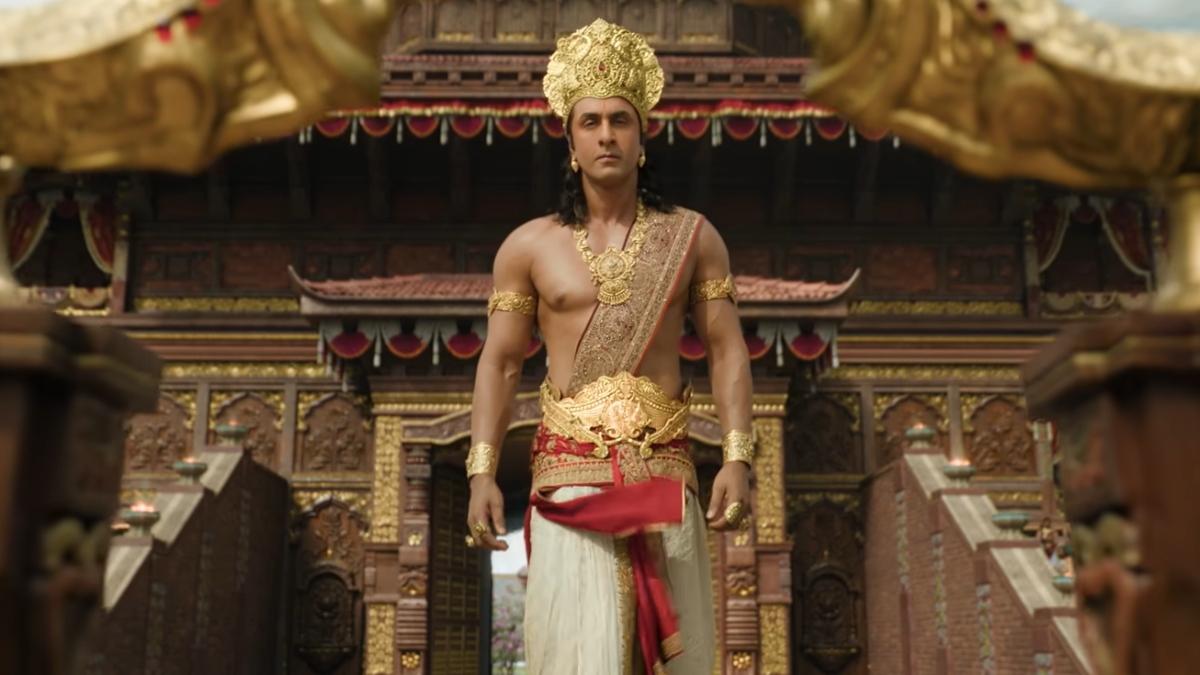
Long before the code of machines, there breathed a timeless rhythm, a song of righteousness written by a sage in the heart of India. Nitesh Tiwari’s ambitious two-part adaptation, Ramayana, is a cinematic leap of faith, seeking to bridge the infinite horizon of modern technology with the quiet, unyielding weight of human devotion. It feels ironic that aclassic story meant to teach us the destruction of ego (ahamkara) is being delivered via a medium that demands we bow down to the vanity of technological scale.The Ramayana is fundamentally a story of subtraction. It is about a prince who willingly gives up a throne, walks barefoot into the wilderness, strips himself of material comfort, and defeats a scholar king whose fatal flaw was his insatiable obsession with his own grandeur, which hollowed out his intellect. By filtering this narrative through a modern global cinematic lens, the DNEG-backed version fundamentally reverses those values, replacing spiritual subtraction with digital multiplication.In a cosmic battle of good versus evil engineered by the VFX wizards, Tiwari makes a bold narrative pivot: he chooses to give the devil his due. He sets the tone with Ravana’s cosmic domination, with the takedown of Indra’s Airavat in a colossal battle that sucks us into his imagination of the Valmiki’s epic.Coming after Adipurush, the film humanises Ravana (Yash) by tracing his deep devotion to Shiva, his birth from mother Kaikesi’s (Shobana) vengeful ambition, and his traumatic rise from slave status, giving him a deeply textured character arc. Tiwari, along with co-screenwriter Sridhar Raghavan, almost situates him as a socialist who eats what his subjects digest. Serving as the show-stealer, Yash makes a menacing Hindi debut. Beautifully dubbed by Sharad Kelkar, he plays Ravan with electrifying intensity that dominates the first part.Ramayana: Part 1 (Hindi)Director: Nitesh TiwariCast: Ranbir Kapoor, Yash, Sai Pallavi, Shobana, Ravi Dubey, Arun Govil, Lara Dutta, Vivek Oberoi, Rakul Preet SinghSynopsis: It chronicles the rise of a dominant Ravan alongside Lord Ram’s quiet, deeply restrained exile.Runtime: 195 minutesThe idea is to establish Ravana’s staggering power and the catalyst forShurpanakha’s (Rakul Preet Singh) actions, so that when the narrative shifts, the audience understands exactly how impossible Rama’s upcoming battle truly is, but it also means that Rama’s defining moments such as his youth under sage Vishwamitra, lifting Shiva’s bow, and silently accepting a 14-year exile to uphold his father’s honour, feel a bit hurried and show a character who is already morally complete.By exhaustively mapping out Lanka,Tiwari creates dense, operatic momentum. So, when the film shifts to the domestic drama of Ayodhya in King Dashrath’s (Arun Govil) household, it suffers from tonal whiplash, making the film’s emotional core feel rushed, safe and light. Yash in ‘Ramayana: Part 1’ | Photo Credit: Special Arrangement Even the Kevat episode that creates a spiritual connection beyond class and caste is bypassed, perhaps to accommodate one more action-oriented detail from Ravana’s life or because of its changing socio-political context in current times. In giving the devil his due, the divine gets diluted.The writers do delve into the question of Rama’s misery. Lyricist Dr Kumar Vishwas and screenwriters Shreyas Jain, and Tiwari try to translate the Sanskrit text into contemporary Hindi without diluting it into Hindustani. When a prince is suddenly stripped of his birthright and banished to the wilderness, there should be an internal storm. But because the narrative structure gives Rama little space to express grief, betrayal, or confusion, his acceptance of exile feels mechanical, and the constant urge to know what the future holds for him becomes another box ticked. Perhaps wafer-thin sensitivities have limited the writers from seeing the second layer in a God who has chosen to be human. It is where the music comes in to express the inner turmoil. Having grown up on Ravindra Jain’s music that brought Tulsidas into living rooms, the audio landscape created by A.R. Rahman and Vishwas feels oddly detached, functioning as a polished technical exercise rather than an emotional anchor. Hans Zimmer’s presence is felt beneath the seat during the colossal battle sequences, but Ramayana is not about shaking the soul; it is about stirring it.There is no harm in taking the epic to the world, but the moment a creator aims for a global audience, the creative process shifts from internal devotion to external comparison. This introduces a subtle, destructive ego into the art.DNEG built its legendary reputation by rendering into deep space, complex physics, and Western speculative worlds. Here, the opening battle between Gods and Asuras is absolutely awe-inspiring, and the mortal combat between Jatayu (powerfully voiced by Anupam Kher) and Ravana is a great example of blending action with emotion. Ranbir Kapoor in ‘Ramayana: Part 1’ | Photo Credit: Special Arrangement However, the demons from Ravana’s camp required a little more character. They were more like Orcs from Tolkein’s universe with ash splashed on their foreheads. The historically and culturally nuanced landscape of Ayodhya and Lanka demanded more layering. Instead of transporting the audience into a distinct, mythic era of raw materials and textures, the costume design feels like a Ramayana-inspired wedding collection. In a film where torsos are exposed, Arun Govil looks unusually frail while Ranbir looks artificially puffed up in a couple of sequences.The engineering behind the facial rigs isn’t inherently designed for Western acting styles, but the software algorithms that interpret the data seem calibrated for them. This creates friction when applied to Indian cinema, which draws from a completely different theatrical tradition, particularly in a mythological genre.Shobana shows how a performer can add a layer of natya in a digitised landscape. Vivek Oberoi takes it to the melodrama of yore. Ravi Dubey plays Lakshman with a self-conscious awareness that he is a second fiddle. Yash carries the intensity, but the shades that we associate with the great scholar are reduced to one scene. Ranbir gets it almost right. A master at digging deep into the mental crevices of his characters, he portrays Ram as someone whose evolution is defined by what he gives up, not what he conquers, with immense grace, quiet authority, and emotional restraint. Call it the burden of modern realism, he doesn’t have the virgin yet know-all smile of Arun Govil in Ramanand Sagar’s version, but Ranbir’s physical vocabulary, particularly his sense of purpose in handling the bow and arrow, is absolutely amazing.Sai Pallavi infuses Sita with divinity and a refreshing sense of agency. Far from being a coy princess, this Sita is a fierce, barefoot, two-sword-wielding, earthy warrior princess who stands her ground even when dynastic choices are made for her. Sai can do a lot with her eyes, but by taking desire out of the equation, the makers have stripped the Rama-Sita love story of raw human impulses and filtered it through a clinical lens of absolute duty. Even in the crucial sequence where Ravana kidnaps Sita, Tiwari avoids scenes of physical jostling.But you can sense the push and pull between him and the producer, trying to fit the spiritual, philosophical, and deeply internal text into a Hollywood-type blockbuster template. It is strange that a story that makes you tear up every year at the modest Ramlila in the neighborhood doesn’t hold you enough in front of the IMAX screen. It holds your gaze but doesn’t go any further.Interestingly, Vishwas was present at the press screening and, out of honesty or modesty or both, said his contribution may be a tedha medha laddoo (uneven sweet), but an offering to God. His self-awareness about his work fits the film, too. Ramayana: Part 1 is currently running in theatres.
‘Ramayana: Part 1’ movie review: Ranbir Kapoor and Yash excel as Ravana outshines Rama on screen
Full Article
Original Source
Read the full article at Thehindu →KhanList aggregates and links to publicly available news content. We do not host full articles from third-party sources. Always verify important information with original sources.