
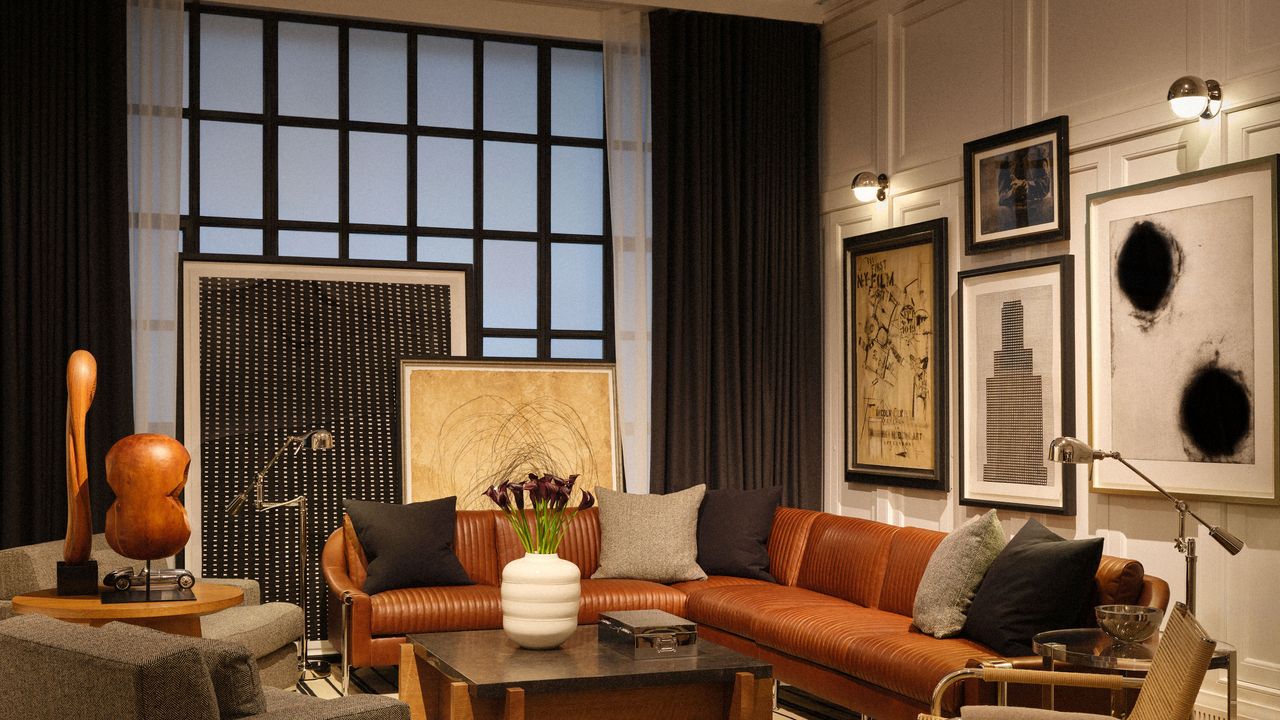
DebutPretty, Pattern-Happy, Yet Utterly Unpredictable—Mieke Ten Have’s New Collection for Rejuvenation Embraces the Fine Art of the MixIf you ask Mieke ten Have, impeccability is overrated. “I don’t like rooms that feel predictable,” says the interior designer and stylist. “I’d rather something be weird than perfect.” That old-soul sensibility is precisely what attracted Rejuvenation, the Oregon-based brand known for vintage style lighting and hardware. Looking for a fresh perspective on pattern and color, the company tapped her, a kindred creative spirit, to bring an eclectic approach to their product offerings.Ten Have in her Hudson valley bedroom; bed dressed in peony Floral duvet and shams, clover-striped floral reversible quilt, and bandana pillow. Photo: Frank FrancesFor her debut collection, ten Have combed through textile books and her own archives, gathering references that included Indian block prints, English documents, and even a Manhattan living room by Billy Baldwin. Inspiration also came from the grounds of her converted 18th-century barn in New York’s Hudson Valley. (Japanese spider chrysanthemums and peonies informed both palette and subject.) The dusty yet saturated hues of ancient Roman wall paintings at The Met likewise shaped her color story.The results of those inquiries are heirloom-worthy pieces ten Have has long wished existed for her own projects. Think hand-knotted medallion rugs based on a 19th-century Iranian carpet; drinks tables modeled after those she carts to photo shoots; petite brass lamps; and pillows and quilts adorned with exuberant florals and a Tree of Life motif.“I like for interiors to be in dialogue with different time periods and parts of the world,” says ten Have, whose collection debuted September 9 alongside handpicked antiques. “In decorating there’s nothing new under the sun. It’s the way that you rework or combine things that makes it feel novel.” —David FoxleyDebutRalph Lauren Home Unveils a Collection of Urbane Furniture and Lighting That Mines the Timeless Possibilities of LoftsRaw and ripe for reinvention, lofts have long captured our imaginations, whether the cast-iron buildings of Lower Manhattan or the factories turned artist ateliers of Montmartre. In her seminal 1986 compendium The International Book of Lofts, design writer Suzanne Slesin goes so far as to call them “the interior design laboratories of our time.” Proof that the sentiment still rings true, Ralph Lauren Home just debuted a collection of furniture and lighting tailored to those cosmopolitan spaces—an idiom Mr. Lauren has mined in his own New York City apartment, where a downtown, open-plan ethos is inserted into an uptown prewar envelope.Lucien Chair Courtesy of Ralph Lauren Home. ART: © 2026 Estate of Larry Rivers / Artists Rights Society (ARS), NYHarbor flush-mount light Courtesy of Ralph Lauren Home. ART: © 2026 Estate of Larry Rivers / Artists Rights Society (ARS), NYBeacon side table Courtesy of Ralph Lauren Home. ART: © 2026 Estate of Larry Rivers / Artists Rights Society (ARS), NYMelding industrial touches with hallmarks of automotive and nautical design, the fall 2026 Loft collection transmits an air of casual cool in a palette of chrome, leather, and stone. But those tough materials are tempered with warmth, like the woven-rope seat of the tubular Lucien chair or the rustic, if slightly Brutalist, wood base of the Anderson cocktail table (topped with a slab of Belgian Blue limestone or sandstone).Together, the pieces conjure the ultimate loft fantasy. Imagine coming home to the Tournament sectional’s channel-tufted leather upholstery, set on a gleaming chrome frame—the perfect landing pad after a long day’s work. Around you, Harbor wall lights deliver a moody glow. And, thanks to the glass-top Octane drinks table, there’s an ice-cold martini within reach. —Hannah MartinOne to WatchInspired by Queer Club Culture, Wunderkind Ceramist Joël Brodovsky-Adams Is Painting the Town OrangeDance music is always blaring from the 1970s speakers at Joël Brodovsky-Adams’s Brooklyn studio. “Robyn is my favorite pop star of all time,” says the Canadian-born ceramic artist during a recent visit to his Bay Ridge space. So much so that the sunset palette of the Swedish singer’s Honey album cover helped crystallize a new body of work, now the subject of a solo show at Manhattan’s Superhouse gallery.Joël Brodovsky-Adams at his brooklyn studio. His current show is now on view at Superhouse. Photo: Matthew Gordon/Courtesy of SuperhouseOn view through October 17, the exhibition draws upon queer theories of club culture. Its title, “Like a Rumor,” references José Esteban Muñoz’s seminal 2009 book Cruising Utopia. McKenzie Wark’s 2023 text Raving, meanwhile, inspired the sculptures’ amorphous style. “She describes the dance floor as blending and edgeless,” Brodovsky-Adams says. “I really latched onto that.” At Superhouse, works bearing fluid forms riff on everyday objects. One basketlike piece features handles that call to mind creatures kissing or exchanging gossip. Alien hooks suggest an extraterrestrial coat check.Orange offers a uniform palette, whether in the case of glaze dots covering a cantaloupe vessel or painterly pumpkin stripes (based on a favorite tank top) enlivening a legged vase. “I wanted a feast of textures and colors,” says Brodovsky-Adams. “Parameters are such a generative exercise. Giving yourself a smaller infinity to work with is really helpful.”A close-up of a sculpture reveals luminous dots of glaze Photo: Matthew Gordon/Courtesy of SuperhouseNew works share an orange palette Photo: Matthew Gordon/Courtesy of SuperhouseHis own creative and sybaritic roots can be traced to Montreal, a city known for nightlife, where he first picked up pottery as a hobby while studying biology at McGill University. He went on to pursue ceramics at Nova Scotia College of Art and Design and then in the prestigious master’s program at Alfred University. He credits the latter for his work’s language of levity and playfulness. “Every component of every piece starts as a wheel-thrown thing that I refine and manipulate, and then stick together into composite forms,” says Brodovsky-Adams. “I keep thinking of ways to remix them.” —Maya IbbitsonOne Great RoomWrapped in Marquetry, an Amsterdam Chamber Designed for Music Goes Against the GrainInside Future Days Shop’s Amsterdam music room, designer Rio Kobayashi wraps the space in dizzying marquetry of cherry, walnut, and oak, creating an immersive, instrument-like setting for DJ sets and live sessions. Photo: Kasia GatkowskaThe DJ table, adorned with flying-fish, sailboat, and bubble motifs, looks out over the shop below. Photo: Kasia GatkowskaThe Art Nouveau façade of Future Days Shop, a onetime fruit and fish purveyor Photo: Kasia GatkowskaIt looks like a train car,” says designer Rio Kobayashi of this private Amsterdam music room, sheathed in a dizzying marquetry made of cut and spliced cherry, walnut, and oak, among other materials. The space is an extension of Future Days Shop, the concept store and workshop that musician Tomo Katsurada and textile designer Eloïse Ptito opened downstairs in a former Art Nouveau fish-and-produce market. “I wanted to be inside an instrument,” explains Katsurada, who was inspired to work with Kobayashi after seeing his veneer-clad speakers at the London Design Festival in 2023. The Japanese-Austrian talent, who apprenticed as a furniture maker in Tyrol and cut his teeth under London woodworking maestro Martino Gamper, among others, began the puzzle-like scheme over two years ago, then collaborated with designer Onni Aho and a team in Helsinki to realize it all with utmost precision. The final touch was a hanging textile piece made by Ikumi Kawashima. During installation, Kobayashi’s improvisational spirit took over as he added graphic spray-painted accents. If visitors look closely at the timber surfaces, they’ll discover inlaid motifs of flying fish, cherries, apples, and pears—all nods to the building’s history. But they might prefer just to sit back on the foldout benches, Jasper Morrison lights twinkling overhead, and jam. “A room’s design shapes the way music feels,” says Katsurada, who conceived the space to host DJ sets as well as live sessions for broadcast. “Playing here feels really cosmic.” –H.M.The radiator cover is decorated with Ventilation holes shaped like kushi-dango, the Japanese rice-flour snack. The hanging textile was made by Ikumi Kawashima. Photo: Kasia GatkowskaKobayashi worked closely with designer and maker Onni Aho and fabricator Liitos to execute the components of his design so that they could perfectly wrap the space’s turn-of-the-century architecture. Photo: Kasia GatkowskaFinal TouchDior's Rechargeable Corolle Lamps Translate the Sculptural Elegance of the House's Iconic 1947 New Look Into Rippled Murano GlassPhotography by Jong Hyup. Styling by Alexandra Massillon.In 1947, Christian Dior revolutionized the way women dress when he debuted his New Look, a sinuous suiting silhouette with softened shoulders and a voluminous skirt. The latter serves as inspiration for the house’s new Corolle lighting collection. Breaking free from the constraints of cord and outlet, the rechargeable portable lamps, designed by recurring brand collaborator Noé Duchaufour-Lawrance, feature a calfskin strap, an aluminum crown, and a mouth-blown bell of rippled Murano glass. (The fixture is available in six-and-a-half- and nine-inch-tall sizes, both shown.) As Duchaufour-Lawrance notes, emphasizing each piece’s expressive savoir faire: “From one craftsman to another, from one atelier to another, the gesture differs.” —Madeline O’MalleyJewelryLizzie Fortunato Transforms Its SoHo Office Into a Refined Showcase for the One-of-a-KindLizzie and Kathryn Fortunato may share genetic code but the twin sisters, co-founders of the beloved jewelry line Lizzie Fortunato, also profess a deep love of the one-of-kind. “That’s the spirit that has always guided our brand, our outfits, our homes, everything,” says Kathryn, speaking from their newly re-designed showroom and atelier in Lower Manhattan. Here, true to that ethos, the unique takes center stage, whether in the case of the individually crafted glass, stone, and porcelain beads used to create their exuberant designs or the many vintage treasures that dot the rooms.A Murano-glass ceiling pendant crowns the new showroom at Lizzie Fortunato's Manhattan headquarters, designed with Alexander Laing. Photo: Seth CaplanLizzie (left) and Kathryn Fortunato with interior designer Alexander Laing Photo: Seth CaplanWhen the duo signed the lease seven years ago, their team having outgrown their prior space, they undertook only ad-hoc tweaks to the interiors, previously a law-firm office. Then the pandemic revolutionized their business, as at-home shoppers expanded what had-been a wholesale-only approach into a consumer-facing model. In due course, devoted clients were asking to try jewelry on in-person, requiring a more deliberate separation of public and private pursuits. Says Lizzie: “We realized a curtain rod wouldn’t cut it.”A built-in banquette wraps the conference room’s bespoke table, which is grouped with chairs vintage Robert Mallet-Stevens chairs. Photo: Seth CaplanWorking with emerging designer Alexander Laing, an alum of the AD100 firm Studio Valle de Valle, they have since reimagined the space as a sequence of shiplap-clad rooms, a new entry vestibule giving way to an elegant (if seemingly effortlessly so) showroom and office. Walls in muted cream and pistachio tones—both Little Green Paint colors—form a calming backdrop to custom millwork and eclectic art, ceramics, and home accessories. “Lizzie is a layering queen,” says Kathryn, pointing to the vintage Murano-glass ceiling light, Ikea table lamps, and Robert Mallet Stevens chairs. Behind the scenes, meanwhile, are their bustling atelier, stock room, kitchenette, conference room and more. “This is where the mania is,” Kathryn says with a wink.Painted in Green Stone Light by Little Green Paint, the entry vestibule is outfitted with a Giancarlo Valle chair and Art Deco dressing table; sconce by Léa Zeroil and painting by Blair Saxon Hill. Photo: Seth CaplanCustom millwork wraps the showroom, which displays the latest Lizzie Fortunato jewelry alongside assorted ceramics and vintage pieces. Photo: Seth CaplanNowadays, customers come from all over the world for appointments or else pop by on a whim. “We have had people come straight from the airport, fresh off a plane from Denmark,” says Lizzie, energized by the spontaneous pace of hybrid showroom/office working. “It’s the next step—everthing we have done has been incremental,” adds Kathryn. “Short of having a store it’s nice to have a space that reflects our personal style.” At 217 Centre Street, New York City. –Sam CochranRugsFor Her First Foray Into Interiors, Fashion Designer Hillary Taymour Collaborated With Layered to Create a Collection Suited for Grandparents and Gen Z Alike“I’ve always thought that somebody needed to do floral couches again,” says Hillary Taymour, the fashion designer behind the high-octane feminine womenswear line Collina Strada. “But properly, in a cool way.”With her Layered decor collaboration launching on September 16, Taymour is delivering on that vision. Her brand’s first furniture venture—a series of two sofas and four hand-tufted rugs—is drenched in her signature grounded-yet-girly prints. Taymour borrowed a melted floral motif on one couch straight from the curtains at Collina Strada’s Chinatown flagship. For the other couch, she wove pink, brown, and green tones into a fashionable plaid—a print also set to appear on Collina’s AW26 runway.The Garden Haze area rug Photo: Ryan Petrus“I feel like people need some liveliness in their homes, especially as Gen Z is getting older,” says 39-year-old Taymour, who purchased a weekend home north of New York City earlier this year that she jokes “looks like a 70-year-old man's cabin.”There are some quieter designs in the mix too, which she says she created for “my people in the city who can't commit to that much color.” But her beige Garden Haze rug is more interesting than your standard bouclé, constructed of varied pile densities to create the impression of an undulating, camel- and bone-toned flower bed.The Rosso Garden couch and the Petal Rug, both in the Olive Plum colorway, from the new Collina Strada x Layered collaboration. Photo: Ryan PetrusIn Taymour’s Upstate New York living room, Powwie, the designer’s pomeranian, perches on the Rosso Plaid couch from her new collaboration with Layered Rugs. The couch and area rug are both in the Garden Pop colorway.Photo: Ryan PetrusThis sense of organic, lived-in comfort inspired Taymour’s entire design process—so much so that she used her country home as the campaign’s shoot location. The resulting images, like the collection itself, are edgy, botanical, and fit for flower children and Zillennials alike. —M.I.FurnitureNicholas Obeid Channels Frank Lloyd Wright the Interior Designer's New Casegoods Invoke His Hero's Geometries and RestraintThe new Frank side table and cabinet by Nicholas Obeid Photo: Nicholas ObeidNicholas Obeid remembers his first introduction to the work of Frank Lloyd Wright. Growing up outside Detroit, the interior designer received a monograph on the pioneering American architect as a birthday present from an insightful neighbor. “So much of Wright’s work is intricate in its geometries but also shows considerable restraint,” says Obeid, reflecting on the legacy of the world’s first starchitect. Two years ago, he was reminded of that tome during a visit to the Detroit Institute of Arts, where a series of Wright’s early-20th-century stained-glass windows stopped Obeid in his tracks. “He was able to make something so visually impactful with one material in different shapes and colors.” Now, Obeid has applied that strategy to his new Frank collection of casegoods, launching with a side table and an cabinet. Hand crafted in Los Angeles, each piece is constructed entirely of white oak in three different finishes: high-glass lacquer plus two tones of ceruse, one light and one dark. True to Wright’s ethos, strong shapes predominate, from the contrasting pulls to the asymmetrical doors. Says Obeid: “It looks sharp and angular but it’s all soft to the touch.” –S.C.These stories appear in the October issue. Never miss a story when you subscribe to AD.
Ralph Lauren Home Unveils an Urbane Collection Inspired by the Enduring Appeal of Loft Living
Full Article
Original Source
Read the full article at Architecturaldigest →KhanList aggregates and links to publicly available news content. We do not host full articles from third-party sources. Always verify important information with original sources.