
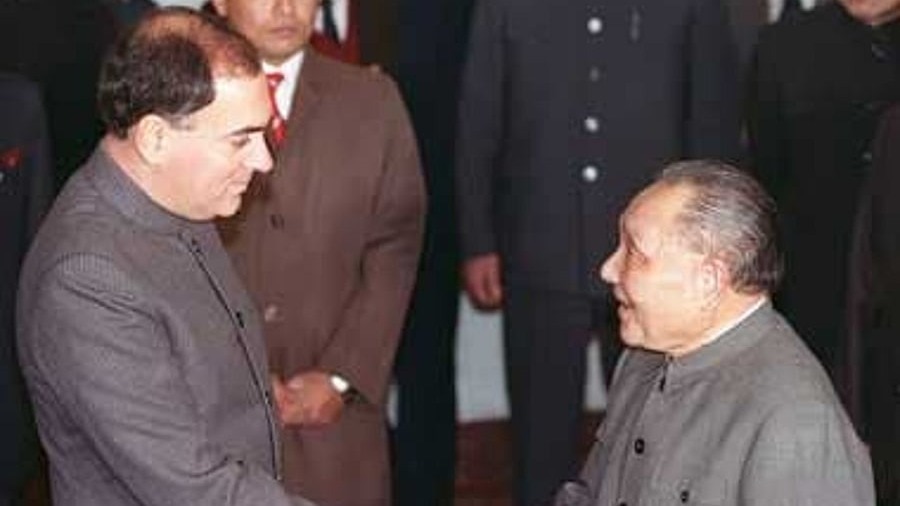
As India’s sixth Prime Minister between 1984 and 1989, Rajiv Gandhi championed global nuclear disarmament. In July 1988, at the Third Special Session on Disarmament of the UN General Assembly in New York, Gandhi unveiled India’s grand action plan for a phased elimination of nuclear weapons by 2010.Yet, what is not well known is that less than a year later, Rajiv Gandhi also restarted India’s nuclear weapons program. What drove the Prime Minister to execute this stunning geopolitical U-turn?I bought a copy of Sonia Gandhi’s autobiography ‘Belonging’, to look for answers. The book is silent on this aspect. Nuclear weapons figure only once, in Chapter 19 — “Rajiv’s commitment to both causes — non-alignment and disarmament — was an important plank of his foreign policy. He presented at the UN in 1988 a meticulous, step-by-step time-bound action plan for a non-violent and nuclear weapons-free world — by the nuclear powers were not ready for an idea ahead of his time.”This is perhaps an image that Sonia Gandhi would like to cultivate — Rajiv Gandhi, a man of peace in a dangerously unstable world. At the peak of the Cold War in 1986, NATO and the Warsaw Pact fielded over 60,000 nuclear weapons, enough to destroy the world several times over. Gandhi was echoing the sentiments of his grandfather, India’s first Prime Minister Jawaharlal Nehru, who called nuclear weapons “thoroughly bad”, a “symbol of evil” and a crime against humanity that threatened civilisation itself. In several public speeches, Nehru railed against nuclear weapons, including the arrival of intercontinental ballistic missiles in the 1950s -- “All this terrible annihilation and destruction takes place really by the pressing of a button on the order being given.” Yet, for all his public posturing, Nehru and his chief bomb scientist Dr Homi Bhabha were also stealthily building up dual-use nuclear infrastructure — the Atomic Energy Commission under the Prime Minister’s direct control, the Trombay complex and the CIRUS reactor supplied by Canada with US heavy water. Nehru pursued what nuclear scholars called a policy of deliberate strategic ambiguity — moral opposition and calls for a nuclear-free world from a position of eventual strength, while retaining the technical option for nuclear weapons in case circumstances changed.India’s circumstances changed dramatically in 1964 when China tested its first nuclear fission weapon followed by a full-scale hydrogen bomb test in 1966. China had inflicted humiliating losses on the Indian Army in a short border war in October 1962. A nuclear-armed China posed an existential challenge to India. The time for restraint was over. India raced towards nuclear weapons capability under Prime Minister Indira Gandhi, with a ‘peaceful nuclear explosion’ on May 18, 1974. China was clearly identified as India’s principal nuclear adversary and Mrs Gandhi’s advisers, including PN Haksar advocated building nuclear-tipped missiles and nuclear-powered submarines to deter Beijing from launching devastating nuclear attacks on India. The PNE in 1974 had created a device, but one that was the size of a small room, and hence, not deliverable by aircraft or guided missiles. Further testing and development would be needed to weaponise the device.But this development did not follow because of sustained global pressure. The US and Canada cut off nuclear cooperation. The West strengthened the Nuclear Non Proliferation Treaty (NPT) and the landmark US 1978 Nuclear NPT Act, to prevent countries like India from developing the bomb. New Delhi paused its nuclear weapons programme.Sonia Gandhi’s book waxes eloquent about Rajiv Gandhi’s visit to Beijing on 22 December 1988, the first by an Indian Prime Minister in 34 years. Three pages of Chapter 22 are devoted to the meeting ‘in which Deng held Rajiv’s hand for three minutes—a historic handshake, taken note of by the world.’ ‘The visit to China was short, but one of satisfaction for Rajiv and his delegation, opening a new and constructive chapter in India-China relations,’ she writes.But this photograph and its sugar-coated interpretation obscured some tectonic behind-the-scenes developments.India had paused its nuclear weapons programme, but Pakistan’s nuclear weapons programme was running at full steam. Islamabad was smarting from the loss of its eastern wing, hived off as Bangladesh through direct Indian military intervention in 1971. At a meeting in Multan in January 1972, President ZA Bhutto directed significant resources of the state towards his country’s nuclear weapons program. The Arab world pumped millions of dollars into Islamabad. Technology stolen by a Netherlands-based scientist-spy, Dr AQ Khan, in the late 1970s enabled Islamabad to rapidly enrich uranium to weapons - grade levels.But the turning point came four years later — a landmark meeting between President Bhutto and Chairman Mao Zedong. Bhutto visited Beijing with a high-level military-scientific delegation. That meeting between May 26-30, 1976, saw two agreements being signed for scientific and military cooperation. It was an extraordinary meeting because Mao was ailing and hardly entertained visitors. He died four months after the meeting. The significance of that summit was summed by Bhutto, two years later, in 1978. Deposed and jailed by a military dictator, General Zia ul-Haq, and on death row, Bhutto called the 1976 agreement with China “perhaps my greatest achievement and contribution to the survival of our people and our nation.”What Bhutto alluded to rhetorically was spelled out explicitly by a gush of intelligence that India’s strategic community had begun collating through the 1970s and 80s-- China was secretly arming Pakistan with nuclear weapons. In a 1987 book ‘Pakistan’s Islamic Bomb’, IDSA researcher T Sreedhara Rao minutely detailed the Beijing-Islamabad nuclear axis :‘N-weapon design information. Enriched uranium. Assistance in setting up an enrichment plant with the help of Chinese scientists. Nuclear test data. Conducting n-test on Pakistan’s behalf or making test sites available. Supply of heavy water. Transfer of plutonium reprocessing technology.’In short, China supplied Pakistan with everything but the actual weapon itself. This would make it the first instance of a nuclear-armed country blatantly proliferating nuclear weapons' know-how to another country.Under Mao’s successor Deng Xiaoping, the Pakistan-China nuclear axis accelerated. PAF C-130s flew back from Urumqi, Xinjiang, with supplies of highly enriched uranium for Pakistan to make a small arsenal of between two to four bombs. The US tracked this axis but turned a blind eye to the proliferation because Pakistan was aiding the fight against the Soviet Union in Afghanistan.At the Great Hall of the People in Beijing, on the morning of 22 December 1988, as China’s Paramount Leader Deng Xiaoping pumped the young Prime Minister’s hands, Gandhi already knew of Beijing’s perfidious role in arming Pakistan. Just three months later, Rajiv Gandhi had restarted India’s nuclear weapons program. Rajiv Gandhi with Chinese leader Deng Xiaoping during his 1988 visit to Beijing. Raj Chengappa’s 2000 book ‘Weapons of Peace’ mentions the date as sometime in March 1989. The decision was preceded by a meeting of Gandhi, his principal secretary BG Deshmukh and DRDO chief Dr VSR Arunachalam. The crux of their assessments was that Pakistan had the bomb, and that the US may tilt towards China to ensure Asian peace, making India vulnerable to pressure from Beijing.“I am most reluctant to exercise the option, but I can’t sacrifice national security,” Gandhi told his advisers. India accelerated its Integrated Guided Missile Development Program (IGMDP), the Agni IRBM, India’s nuclear weapons carrier, was tested on May 1, 1989.The following year, in 1990, China is believed to have tested a nuclear weapon for Pakistan at its site in Lop Nur — a 12-kiloton design called the CHIC-4, first tested by China in 1966. By 1992, China had armed Pakistan with nuclear-capable M-11 missiles, completing a dyad of air and ground-launched nuclear vectors for Pakistan. From worrying about the nuclear threat from its giant northern neighbour, India was now equally threatened by a nuclear-armed rival to its west. All through these developments, Indian diplomats continued to hail the Rajiv Gandhi-Deng Xiaoping meeting as laying the basis for ‘peace and tranquillity’ along the boundary with China.The reality was a nuclear-armed northern adversary that had woken a series of Indian Prime Ministers to nuclear weapons realpolitik — from Nehru, who set up the infrastructure; Indira Gandhi, who operationalised it; Rajiv Gandhi, who restarted it; Vajpayee, who tested the bombs; and Narendra Modi, who expanded the arsenal and activated the triad of sea-based nuclear weaponsWHY DID CHINA ARM PAKISTAN WITH NUKES?Through that one act of transferring nuclear weapons and later, M-11 ballistic missiles to Pakistan, Mao and his successors like Deng ensured India would be locked in a nuclear race with Islamabad. By helping Pakistan acquire a nuclear deterrent, China created a counterweight that for decades tied Indian military resources to its western border, limited India’s ability to project power and kept India focused regionally rather than as a peer competitor to China. As China expert Robert Ross noted in 2001, China views a credible Pakistani deterrent as the most effective way to guarantee the security of its sole ally in South Asia against Indian power. Another China expert John Garver believes China did it to keep ‘Pakistan independent, powerful and confident in order to present India with a standing two-front threat.’Pakistan used its China-supplied nuclear weapons to protect its infrastructure of terrorism which it set up after the first Afghan war, to bleed India through ‘a thousand cuts’. Thousands of Indian civilians were massacred through Pakistan’s proxy terror attacks in Jammu and Kashmir, Punjab, and through India’s heartland, including its major cities of Mumbai and New Delhi. Pakistan continued these attacks unhindered by fear of Indian military retaliation even as Prime Ministers from AB Vajpayee to Manmohan Singh debated on ways to respond to a nuclear-armed adversary. Mrs Gandhi’s book is silent on this wave of terror attacks launched by Pakistan, the most sensational of which was the November 26, 2008 attack on Mumbai.The tide began turning from 2016 onwards when the Modi government authorised military retaliation for incidents of high-casualty Pakistani terror attacks, shallow cross-border surgical strikes in 2016, a single airstrike on a terror camp in 2019 and crippling strikes on Pakistan’s terrorist training camps and military infrastructure during Operation Sindoor in 2025. Pakistan’s nuclear bluff has been called, at least for now.It is possible that Rajiv Gandhi never brought his work home, which is why Sonia never got to know what was playing on his mind in 1988 and 1989. Or, this is a story for some other insider to tell.- Ends
Rajiv Gandhi and the Bomb
Full Article
Original Source
Read the full article at Indiatoday →KhanList aggregates and links to publicly available news content. We do not host full articles from third-party sources. Always verify important information with original sources.