
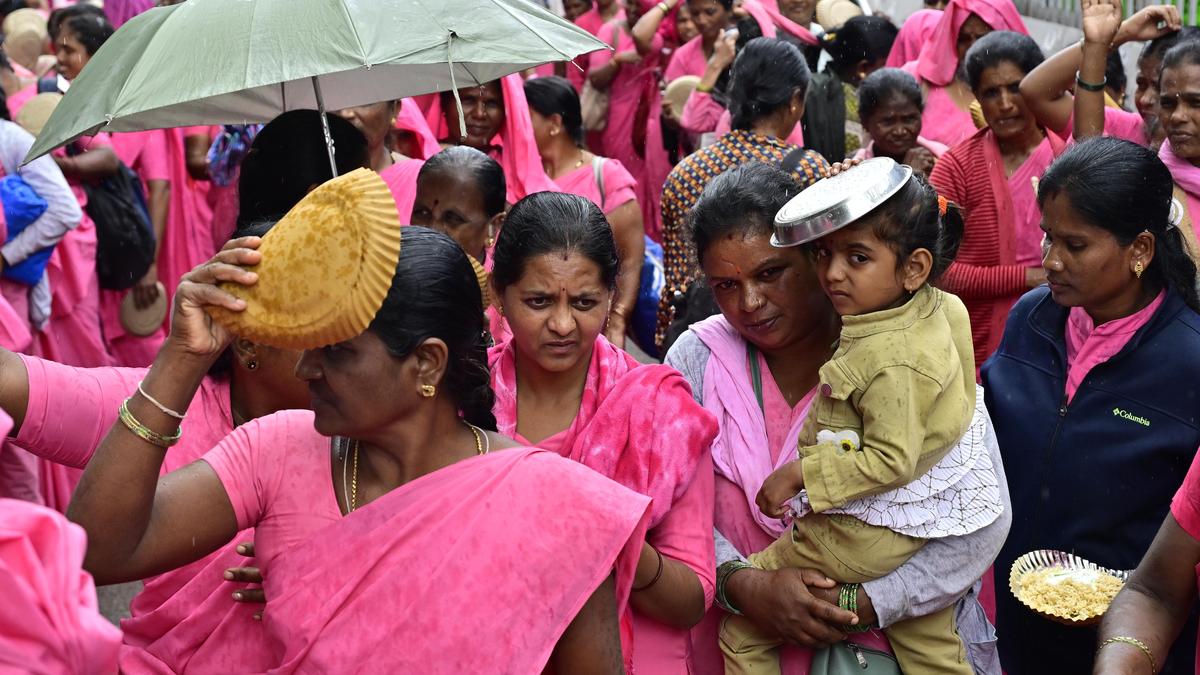
“My 12-year-old son complains that I look after other people’s children more than I look after him. I spend the whole day going from house to house, looking after pregnant women and children. But what do I bring home at the end of the month? Just ₹7,000 to ₹8,000. How am I supposed to run my own family with that?” an Accredited Social Health Activist (ASHA) asked, pointing to her son at Freedom Park in Bengaluru, where thousands of frontline workers have been protesting, demanding a monthly payment of ₹15,000.Her complaint is shared by several ASHAs at the protest, many of whom are the primary breadwinners in their families. They say their work and earnings continue to be undervalued because maternal and infant care is largely seen as “women’s work”, while women’s incomes are often assumed to supplement those of men. For many of these workers, however, their earnings are what their families depend on.Spell of rainAs the protest enters its 10th day on Thursday (November 26), the sit-in at Freedom Park continued despite a sudden spell of rain, with workers taking shelter under tarpaulins that also serve as sleeping spaces for those who have travelled from other districts to Bengaluru to press for their demands. The protest has brought attention to the range of responsibilities ASHAs shoulder in public healthcare, even as they continue to be classified as “volunteers” and seek recognition and remuneration for their work.Describing her daily responsibilities, Renuka B., an ASHA in Shivajinagar, said, “From ensuring that pregnant women receive appropriate care and timely vaccines, and conducting surveys of children to keeping our areas free of diseases such as dengue, we work around the clock. But when we fall sick, or when someone in our family needs help, there is nobody to rely on. The money does not suffice. What can we do with our current salary of ₹8,000 a month?”“Officially, our work is supposed to be for two to three hours, four to five times a week. But in my 10 years as an ASHA, there has not been a day when I have finished within three hours,” Lalitha from Hiriyur in Chitradurga district argued. She added that sometimes, even at night, workers get a call that someone is delivering and that a rare blood group is needed. “We maintain records and make arrangements a week in advance. All this keeps us away from our children and homes, but neither our families nor the government understands,” she lamented.Pointing to the dietary advice they give to lactating mothers, Mamtha showed a diet chart on her phone, which she uses to recommend milk, eggs and vegetables for children. “We advise women on diet but we cannot afford to give our own children the same food even for a week. From milk to rice and vegetables, everything has become expensive but our salaries have remained the same,” she said. Workers also described the additional work involved in disease surveillance. “Even when a single dengue case is reported, ASHAs have to survey the entire area, ask residents to clear stagnant water and remove mosquito larvae. If residents do not cooperate, we sometimes end up cleaning the spots themselves,” said Radha M., who joined the protest from Magadi in Ramanagara district. She added that their remuneration did not reflect the work they were required to do.“During Pulse Polio campaigns, we go door to door to identify beneficiaries, for which we are paid ₹75 a day for three days. Even when collecting “cough samples” from sick people, we are not provided safety equipment such as gloves. We have to collect and handle the samples ourselves. What about our safety?” she asked. More work, same pay.ASHAs receive around ₹7,000 to ₹8,000 a month, comprising a State government component of around ₹5,000 to ₹6,000 and a fixed Union government incentive of ₹2,000. The incentive remains unchanged irrespective of the workload or the number of people served. Workers also complained of irregular payments, with many waiting up to three months to receive their dues.The demand for better remuneration has been raised repeatedly since 2024, with ASHAs staging protests in 2024 and 2025 as well. In January 2025, then Chief Minister Siddaramaiah met representatives of the workers and announced a fixed monthly honorarium of ₹10,000. However, workers said the increase in their actual payments was only around ₹1,000.Alongside better remuneration, the workers are seeking formal recognition of their role. When the National Rural Health Mission was launched in 2005, ASHAs were described as “community health volunteers” and were expected to contribute one to two hours a day. They say the designation has remained unchanged even as their responsibilities have expanded to cover maternal and child health, immunisation, nutrition support and disease surveillance. “Even when we are outside with our families, we have to stop what we are doing to make calls and help a woman at the hospital. Many times, we have to prioritise others. When we pass through our localities, people greet us. There is trust because of the work we have done. There is pride in these,” said Sudha, pointing to her pink saree uniform. “But we need formal recognition and will not move until the Chief Minister issues an order based on our demand,” she added. ‘Approaching Centre too’All India United Trade Union Centre (AIUTUC) State secretary D. Nagalakshmi said the association had written to the State government seeking a revision in wages and was considering approaching the Union government as well, as the payments are jointly borne by the two governments.
Rain or shine, ASHAs continue their protest seeking better pay
Full Article
Original Source
Read the full article at Thehindu →KhanList aggregates and links to publicly available news content. We do not host full articles from third-party sources. Always verify important information with original sources.