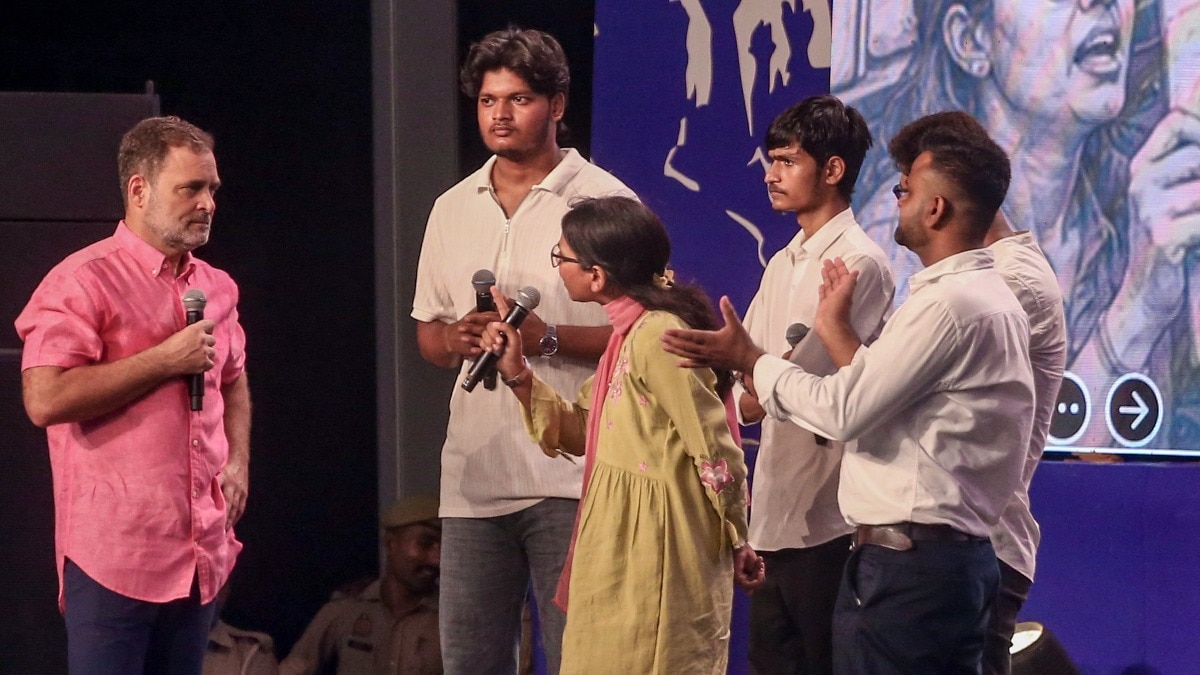
Congress leader Rahul Gandhi on Saturday pitched India’s 40 crore young people as the country’s “greatest strength”, but said they had been trapped in a “chakravyuh” of expensive education, shrinking job opportunities and paper leaks.The BJP immediately hit back, asking why Gandhi was addressing students in Prayagraj instead of visiting protesting aspirants in Congress-ruled Jharkhand.“Rahul Gandhi should have gone to Ranchi instead of Prayagraj,” BJP leader Amit Malviya said, as the Congress leader addressed students and competitive exam aspirants at the ‘Chhatron Ki Goonj’ programme at KP Ground.The Leader of Opposition built his speech around three themes: “dard, data and daulat” — pain, data and wealth — arguing that India possessed an unmatched advantage in its young population but was failing to convert that potential into jobs and economic opportunity. “If this country moves forward, it will do so because of your strength. India has the world’s largest youth population – 40 crore energetic young people. This is the strength of the country,” he said.The event was part of the Congress’s 40-day nationwide ‘Chhatron Ki Goonj’ campaign, launched in June to highlight paper leaks, recruitment irregularities and unemployment and to press for reforms in the examination system.‘DEGREES HAVE NO MEANING IF THEY CANNOT GET YOU A JOB’ Gandhi argued that families were spending lakhs of rupees on higher education only for young people to discover that their degrees did not guarantee employment.“You study engineering, medicine, postgraduate courses or whatever you choose. Lakhs of rupees are taken from your families and then you are given a certificate,” the 56-year-old leader said.“But today that certificate has no meaning in India because it cannot give you employment.”He claimed that only 12 out of every 1,000 young Indians secured permanent jobs.Gandhi also referred to a competitive exam aspirant who said he worked for Blinkit for nearly 10 hours a day before studying for government examinations and had missed clearing an Indian Army test by one mark.The Congress leader used the example to argue that young people were being forced to work long hours simply to fund their preparation, only to face the added uncertainty of paper leaks.According to Gandhi, years of effort could be wiped out if someone with money was able to “buy” access to a leaked examination paper.‘YOUTH PLUS DATA EQUALS 21ST-CENTURY ECONOMY’Gandhi then shifted to what he described as India’s second major advantage after its youth population — data. “Youth plus data is equal to the 21st-century economy,” he said.Drawing a comparison with petroleum in the previous century, the Rae Bareli MP argued that data was the raw material driving artificial intelligence.“If I gave you a petrol engine in the 20th century but refused to give you petrol, you would say the engine was useless. In the same way, AI has no meaning without your data,” he said.Gandhi said the huge volumes of data produced by Indians constituted a national asset.“This data is India’s and it is yours. You create it. It comes from your imagination. It is India’s capital, strength and asset,” he said.He alleged that this data was instead benefiting large corporations, naming Jio, Adani, Facebook and Google.‘REELS ARE THE ADDICTION OF THE 21ST CENTURY’Gandhi also took aim at the social media economy, calling endless consumption of reels the “addiction of the 21st Century”.He said young Indians were encouraged to spend hours consuming and creating content on Instagram and WhatsApp while secure employment remained out of reach.“You are told to watch as many reels as you want, send as many WhatsApp messages as you want and make as many Instagram Reels as you want,” Gandhi said.“This is the addiction of the 21st century. But then you are told that you cannot get a job or employment in this country.”Towards the end of his speech, Gandhi said his political fight was against the system rather than individuals.Referring to images of Prime Minister Narendra Modi, Home Minister Amit Shah, industrialist Gautam Adani and RSS chief Mohan Bhagwat that he had displayed during the address, Gandhi said there was no need to hate anyone.“We only have to change the system. We have to spread love,” he said, before signing off with his familiar “Tata, bye-bye”.BJP QUESTIONS RAHUL OVER JHARKHAND PROTESTSThe BJP sought to turn Gandhi’s student outreach back on the Congress, pointing to the ongoing protests by JPSC and JSSC aspirants in Jharkhand, where the Congress is a junior partner in the JMM-led government.BJP national spokesperson CR Kesavan accused Gandhi of “two-faced political hypocrisy”, saying he had found time to attend the Prayagraj programme but not to meet students protesting and fasting in Ranchi.“Today is the anniversary of the Quit India Movement, and it is high time Rahul Gandhi quit his two-faced political hypocrisy,” Kesavan said.“He has no empathy, nor does he find the time to meet students in Jharkhand who are on a hunger strike, some of whom have even fainted. Yet today, Rahul Gandhi is attending his ‘Chhatron Ki Goonj’ programme in Prayagraj,” he added.The BJP’s criticism came as protests in Jharkhand over alleged irregularities in government recruitment examinations continued, with aspirants demanding action over JPSC and JSSC examinations.GEN Z BECOMES NEW POLITICAL BATTLEGROUNDGandhi’s event came as political parties step up outreach to young voters, with recent student-led protests over paper leaks and examination irregularities pushing Gen Z into the political spotlight.Hours before the Prayagraj programme, Prime Minister Narendra Modi also addressed young people at IIT Delhi’s 57th Convocation.Modi urged graduating students to question accepted ideas and break larger challenges into smaller, manageable parts rather than feel overwhelmed by them.“Keep curiosity alive in life. Keep your learning instinct awakened,” Modi told over 3,000 students and 587 PhD scholars present at the venue.The parallel outreach reflects the growing political importance of young voters as parties increasingly view Gen Z as a potential vote bank.- EndsPublished By: Aprameya RaoPublished On: Aug 8, 2026 21:07 IST
Rahul's 'dard, data, daulat' message to Gen Z; BJP says should've gone to Jharkhand
Full Article
Original Source
Read the full article at Indiatoday →KhanList aggregates and links to publicly available news content. We do not host full articles from third-party sources. Always verify important information with original sources.