
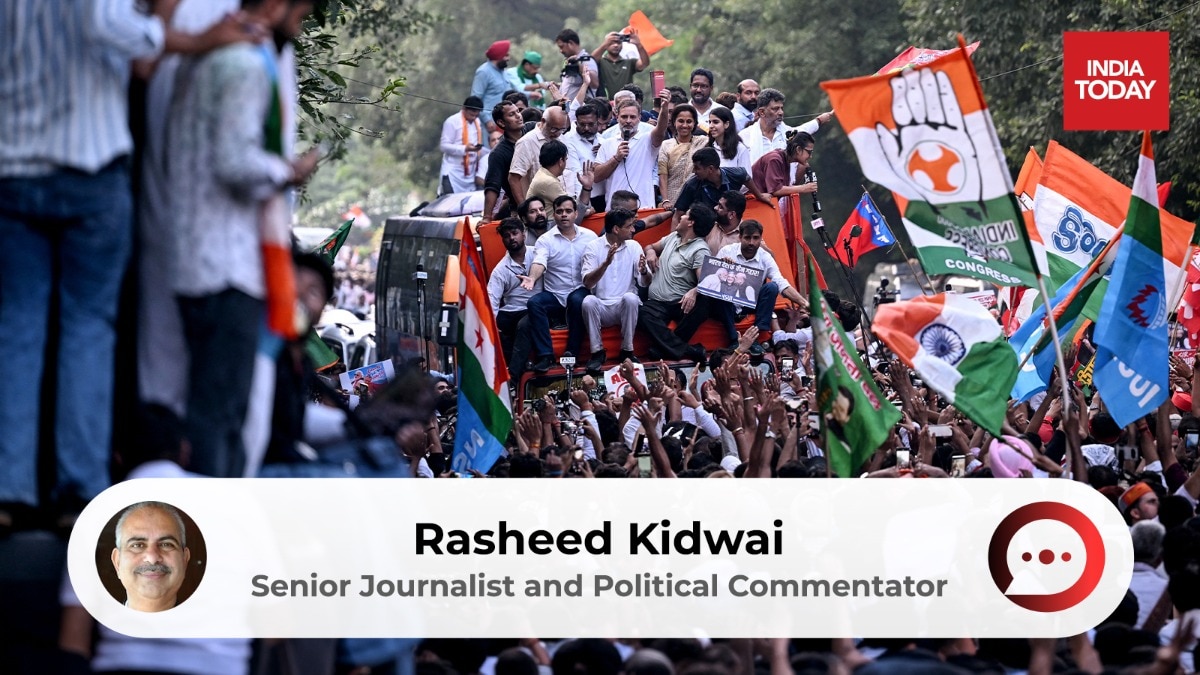
The Congress has spent much of the Narendra Modi era searching for a movement that could take it beyond its familiar political constituency.Now that it appears to have found one, in the form of the ongoing protests against Chief Election Commissioner Gyanesh Kumar and the Special Intensive Revision (SIR) of electoral rolls, an uncomfortable question is beginning to trouble sections of the grand old party: what happens if and when the movement becomes bigger than the organisation?The protests against Gyanesh Kumar and the SIR have acquired a character rarely witnessed in Congress-led or Congress-supported agitations in recent years. Women, students, lawyers, civil liberties activists, Left organisations, and politically unaffiliated young people have joined the mobilisation. Some are marching with Rahul Gandhi. Others are protesting independently, occasionally with greater spontaneity and visibility than the Congress’s own frontal organisations.For Rahul, this widening constituency is a political achievement. For some Congress functionaries, it is also a source of considerable unease. FROM ELECTORAL ROLLS TO THE STREETSThe immediate controversy concerns the Election Commission's nationwide exercise to revise electoral rolls, which the Opposition alleges has resulted in the arbitrary deletion of eligible voters. The removal of approximately 13 crore names has become a political flashpoint, although the Election Commission maintains that the exercise is legitimate and has denied allegations of wrongdoing.The agitation gathered fresh momentum after an Indian Express investigation reported serious disagreements within the Election Commission over decisions relating to the revision exercise. The controversy has moved beyond the technicalities of electoral registration to a larger confrontation over institutional independence and the credibility of India’s electoral processes. In this context, the events of the first half of October have been extraordinary. Rahul and Priyanka Gandhi Vadra participated in demonstrations beginning October 6.Thousands of protesters faced detention during the October 10-11 weekend, as Delhi witnessed sweeping security restrictions. On October 12, Rahul, Congress president Mallikarjun Kharge, and other INDIA bloc leaders marched towards the Supreme Court, while the Opposition pursued a legal challenge to the revision exercise.The agitation has continued despite police action. On October 13, leaders of the youth-driven Cockroach Janta Party (CJP) were detained following another confrontation at Jantar Mantar. Police have also registered cases arising from the Opposition's demonstrations.The government's position is that electoral rolls must be periodically verified and that political parties are attempting to discredit a constitutional institution. The BJP has accused Rahul of undermining democratic processes when electoral outcomes do not favour his party.Yet the political significance of the protests lies not merely in the allegations against the Election Commission. It lies in the widening social composition of those raising them.A dispute over electoral procedure has become a rallying point for anxieties about democratic participation, citizenship, and the relationship between the state and the ordinary voter.A PARTY THAT HAS MARCHED, BUT STRUGGLED TO MOBILISEThe Congress is hardly unfamiliar with street politics. Since 2014, it has organised demonstrations against the Modi government's land acquisition proposals, demonetisation, the Citizenship Amendment Act, the farm laws, unemployment, inflation, and the alleged misuse of investigative agencies.Yet most of these protests remained recognisably Congress affairs, dominated by party leaders, workers, and established organisational networks.The Bharat Jodo Yatra of 2022-23 marked an important departure. Rahul attempted to reposition himself as a political figure willing to engage with civil society, academics, social activists, and ordinary citizens beyond party boundaries. The subsequent Bharat Jodo Nyay Yatra and the Congress’s emphasis on constitutional safeguards during the 2024 general election extended that approach. The results were politically consequential, even if the Congress remained far from regaining its former dominance.The present agitation, however, differs in one crucial respect. The Congress is neither its sole architect nor its undisputed centre of gravity.The emergence of Neha Bora, Abhijeet Dipke, Saurav Das, and Ashutosh Ranka illustrates this transformation. Bora, the 29-year-old president of the Left-affiliated All India Students' Association (AISA), has become an unusually visible face of the protests. Dipke, Das, and Ranka, associated with the CJP, have demonstrated an ability to mobilise young people outside conventional party structures.Their appeal is not derived from electoral politics. It comes from the language of dissent, digital mobilisation, and a willingness to confront authority without the restraints that accompany established political organisations. For the Congress, which has struggled to build a comparable generation of independently influential youth leaders, the development presents both an opportunity and a warning.NEHA BORA ND THE CONGRESS' UNCOMFORTABLE QUESTIONPerhaps the most revealing image of the agitation came during the march on October 12 towards the Supreme Court. Neha Bora walked alongside Priyanka Gandhi, with Rahul close behind. More significantly, Rahul gave Bora an opportunity to address the gathering, placing her prominently before an audience assembled under the Opposition's collective banner.In the Congress's carefully observed hierarchy, such gestures seldom go unnoticed.Why, some Congress insiders may reasonably ask, should a leader from a Left student organisation receive such conspicuous prominence when the National Students' Union of India (NSUI) and Indian Youth Congress have their own leadership structures?The question becomes particularly uncomfortable against the backdrop of the NSUI's recent debacle in the Delhi University student elections. Rahul reportedly sought explanations from Kanhaiya Kumar and NSUI president Vinod Jakhar following the defeat.It would be unfair to suggest that Congress's student wing has been absent from the current agitation. On October 13, Jakhar led an NSUI demonstration at Rajiv Chowk, where protesters were detained. Youth Congress workers, too, have participated actively.But political visibility is not always proportionate to organisational effort.Bora's prominence raises a larger question about Rahul’s leadership preferences. He has frequently appeared more receptive to voices emerging from outside the traditional Congress establishment than to those advancing through its organisational ladder.Yogendra Yadav and CPI(ML) Liberation general secretary Dipankar Bhattacharya are prominent examples of ideological interlocutors and political allies whose influence in Rahul’s wider political ecosystem cannot be measured by Congress membership. Both have participated in the present protests.To describe them as formal advisers would be misleading. Their significance lies in their ability to shape conversations on democracy, social justice, and political mobilisation beyond the Congress’s conventional vocabulary.For Rahul, this openness may be an asset. For party workers who have spent years negotiating factional loyalties and organisational hierarchies, it can seem like another instance of outsiders receiving attention that insiders must struggle to earn.THE PRICE OF A LARGER MOVEMENTRahul's political calculation is not difficult to understand. A Congress-only agitation would be easier for the BJP to dismiss as partisan confrontation. A broader mobilisation involving students, women, lawyers, civil rights organisations, and independent activists is considerably harder to contain within that description.Perhaps Rahul himself offered the most telling description of this unconventional political mobilisation when, on October 12, he likened the protests to Lord Shiva's Tandav and "Shivji ki Baraat", suggesting that such a movement could neither be rigidly planned nor restricted in its participation.For a politician who has repeatedly professed his devotion to Lord Shiva, the metaphor was particularly significant. Shiva's procession, in popular religious imagination, is an extraordinary congregation of the conventional and the unconventional, the celebrated and the marginal, with little regard for social hierarchies. Rahul seemed to be making a similar political argument: that the movement belonged to everyone willing to join it, irrespective of party affiliation or ideological background.The BJP was quick to object to the religious comparison, but the more interesting implications were perhaps internal to the Congress. Rahul's embrace of an unpredictable, inclusive political procession may explain his enthusiasm for emerging outsiders such as Neha Bora, even as his party's established leadership struggles to reconcile itself to their growing prominence. It also raises a question: can a party accustomed to organisational discipline and political hierarchy accommodate a leader who increasingly appears to celebrate the absence of both?The Congress's organisational weaknesses cannot be remedied simply by borrowing the credibility of independent activists. Nor can Rahul afford to alienate those activists by insisting that every protest march must culminate in the Congress’s political ownership.The real test will arrive when the demonstrations subside and the political dividends, if any, have to be distributed. Will leaders such as Bora, Dipke, and Das become durable partners in a larger democratic coalition? Will the NSUI and Youth Congress find renewed purpose, or merely discover that others have occupied the political space they were expected to command? And can Rahul convert the present convergence of grievances into a sustained challenge to the BJP without weakening his own party’s organisational identity?The Congress has long complained that it could not mobilise enough people beyond its committed supporters. Today, a much wider constituency is on the streets. Its predicament is that not everyone on those streets is looking towards the Congress for leadership.Perhaps Rahul Gandhi regards that as a price worth paying. His party may take longer to agree.- Ends(Views expressed in this piece are those of the author and do not necessarily reflect the views of the publication)
Rahul Gandhi's protest has outgrown Congress. Can the party keep up?
Full Article
Original Source
Read the full article at Indiatoday →KhanList aggregates and links to publicly available news content. We do not host full articles from third-party sources. Always verify important information with original sources.