
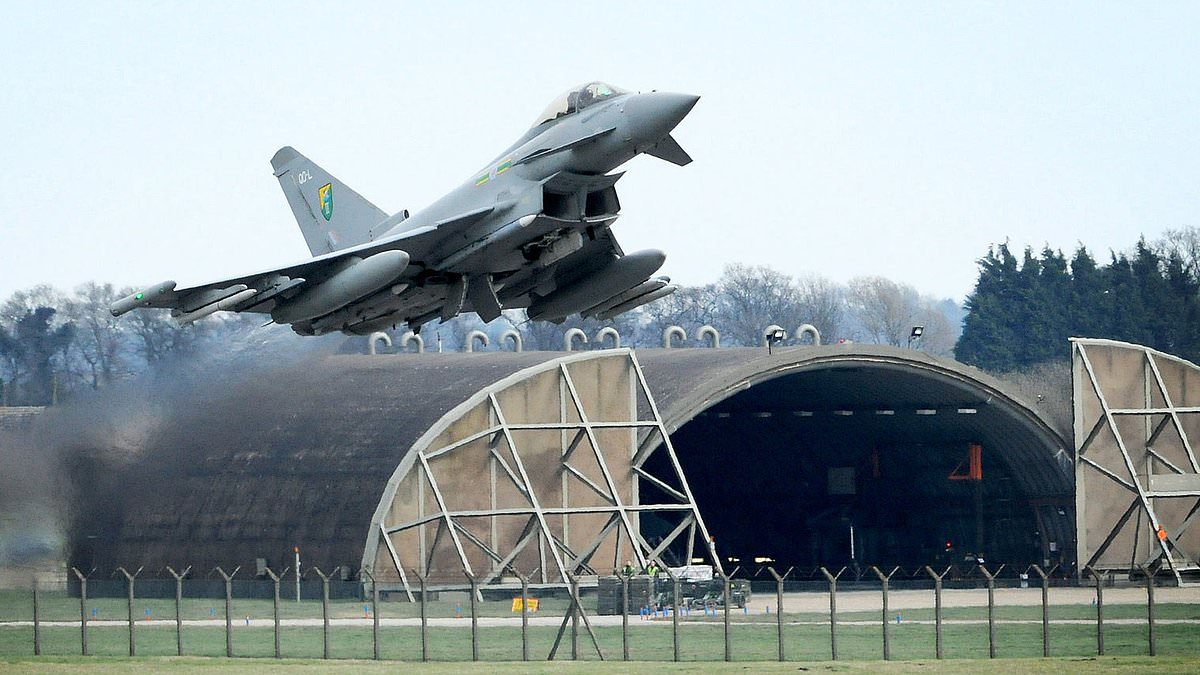
The Royal Air Force is to undertake the most radical security overhaul of its bases since World War Two to prevent Russian and Iranian drone attacks.In another reminder Britain is already involved in hybrid warfare with her enemies, RAF stations will be fortified as part of a £470million nationwide revamp.Upgrades will include physical security, AI-enhanced surveillance systems and specific counter-drone capabilities, possibly including lasers.A recent security review identified that 199 UK military sites, including airbases, require new technologies and rebuilding work to meet modern threats.Troops are also being granted legal powers to intercept any drones threatening military bases, rather than waiting for police assistance.The moves follow an alleged plot involving suspected foreign agents to target RAF Fairford in Gloucestershire in September and suspicious activity at other UK bases in recent weeks.In July, details emerged of a Russian drone operation that targeted RAF Lakenheath and RAF Mildenhall in Suffolk and RAF Feltwell in Norfolk.That incident, in November 2024, involved swarms of at least 20 drones being launched from Kremlin 'shadow fleet' cargo ships in the North Sea and entering those airbases at low altitude to avoid detection. The RAF is moving jets into hardened bunkers overnight to protect them from drone attacks (pictured is a Typhoon fighter jet taking off from RAF Coningsby, with a pictured shelter, rearThe Mail also revealed earlier this month how, following engagement with the security services, security measures are being upgraded at Royal Navy bases used by nuclear submarines.No longer will larger transport aircraft, such as the RAF's A400s and US C-17 Globemasters, remain unprotected on the tarmac. Vast canopies of sophisticated anti-drone netting will be erected and concrete shelters will be built.Hangar capacity will be increased while Electronic Warfare (EW) capabilities will be upgraded in a bid to intercept drones before they reach airbases.While from next year Britain is introducing the DragonFire laser directed-energy weapon designed for short-range air defence and force protection against drones and small surface targets. Where DragonFire will be positioned has not yet been revealed.Earlier this month, the US flew 12 military aircraft out of RAF Mildenhall, a move reflecting their vulnerability while stationed at British bases. Those planes were relocated to US bases in Germany and Italy.A security source said: 'The vulnerability of air and maritime bases has been easily exposed by Britain's enemies. The threat of sabotage is live and the consequences of a successful attack could be devastating.'Even basic, off the shelf drone systems have been found to capable of penetrating aerial security systems at Mildenhall and elsewhere that operate GPS geofencing – because those more primitive drones don't use GPS.'Once inside a base those drones could trigger a huge explosion simply by landing on the wing of an aircraft. The drone only needs to carry a small device. The fuel vapour from the wing tanks would act as a catalyst.' The measures are being implemented to protect British warplanes from drone attack Confirming the upgrades the Ministry of Defence said today: 'National security is the first duty of Government, and we take the security of our people, sites and local communities extremely seriously.'We are investing an additional £470 million to strengthen security at military sites, including better physical protection, surveillance and counter-drone capabilities. We have already invested £15 million in drone and counter-drone technology and introduced restricted airspace over 44 critical Defence sites, with a further 155 to follow.'We are also transforming how we protect our bases, using new digital systems to identify threats and vulnerabilities earlier and ensure our people and investment are targeted where they are needed most.'Air Marshal Greg Bagwell, a former deputy commander of the RAF, welcomed the measures. 'If there is an increased threat, whether from sabotage or drones, then all of that makes good sense,' the veteran commander told the Daily Mail.He added: 'We've known these bases are single points of failure. This is not something that is that new. However, with the state of the world these days you can't be too careful.RAF Akrotiri, a British airbase in Cyprus, was struck by a suicide drone in March, prompting calls for better air defences to be installed across UK military sites.
RAF plans to build anti-drone nets at UK bases as aircraft 'are moved into hardened hangars overnight to keep them safe'
Full Article
Original Source
Read the full article at Dailymail →KhanList aggregates and links to publicly available news content. We do not host full articles from third-party sources. Always verify important information with original sources.