
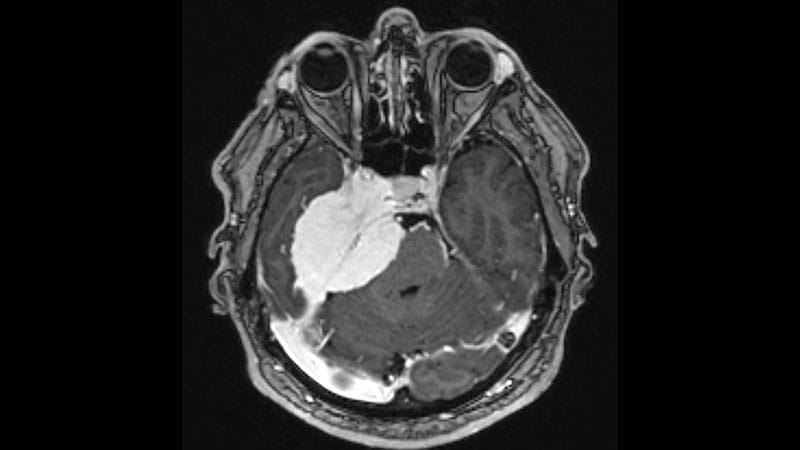
TOPLINEAdjuvant radiotherapy after complete resection of WHO grade 2 atypical meningioma improved disease-free survival compared with observation, with 5-year disease-free survival of 79.9% vs 64.3%.METHODOLOGYResearchers conducted a phase 3, open-label, multicentre trial across 58 hospitals in 11 countries to compare adjuvant radiotherapy with observation after complete resection of newly diagnosed atypical meningiomas.Among 990 patients assessed for eligibility, 157 were randomly assigned to receive radiotherapy (78 patients) or to be kept under observation (79 patients); all were 16 years of age or older and had undergone surgeon-assessed complete resection of an atypical meningioma.Radiotherapy consisted of external-beam intensity-modulated treatment delivering 60 Gy in 30 fractions over 6 weeks; treatment plans were subject to prospective central quality-assurance review before treatment began.Disease-free survival was the primary endpoint; researchers measured it as the interval from surgery to either MRI-confirmed recurrence or death from any cause; participants were followed up for at least 4 years, with a median follow-up of 64 months.TAKEAWAYAt a median follow-up of 64 months, recurrence was documented in 11 of 78 patients who received radiotherapy (14%) vs 24 of 79 patients who were kept under observation (30%).Five-year disease-free survival was 79.9% with radiotherapy vs 64.3% with observation, with radiotherapy associated with a lower hazard of recurrence or death (hazard ratio [HR], 0.51; P = .0396).In post hoc analyses of participants with molecular data, radiotherapy remained associated with improved disease-free survival after adjustment for the DNA methylation class (HR, 0.49; P = .0358) and the integrated molecular risk score (HR, 0.46; P = .0203).Serious adverse events related to radiotherapy occurred in 5 of 66 participants (two early and three late events), with no treatment-related deaths; health-related quality of life and neurocognitive function were similar between the groups.IN PRACTICE"Adjuvant fractionated radiotherapy halves the risk of recurrence, regardless of methylation class, and with minimal late toxicity," the authors wrote.SOURCEThe study was led by Michael D. Jenkinson, PhD, Institute of Systems, Molecular and Integrative Biology, University of Liverpool, Liverpool, UK. It was published online on September 25 in The Lancet.LIMITATIONSThe study was limited by a local assessment of pathology and MRI recurrence without central review and the inability to mask treatment assignment. A total of 41 recurrence or death events were recorded in the trial, a number that was below the prespecified target of 46, and 12 participants assigned to receive radiotherapy did not undergo treatment, possibly understating the treatment effect. Long-term health-related quality-of-life and neurocognitive analyses were also limited by substantial missing data.DISCLOSURESThe study was funded by the National Institute for Health and Care Research Health Technology Assessment programme, the European Organisation for Research and Treatment of Cancer Brain Tumour Group and Radiation Oncology Group, and the National Health and Medical Research Council of Australia. Molecular analyses were partly supported by the Else Kröner-Fresenius-Stiftung Foundation. Several authors reported honoraria, consultancy fees, research grants, or other competing interests.This article was created using several editorial tools, including AI, as part of the process. Human editors reviewed this content before publication.
Radiotherapy Reduces Meningioma Recurrence
Full Article
Original Source
Read the full article at Medscape →KhanList aggregates and links to publicly available news content. We do not host full articles from third-party sources. Always verify important information with original sources.