
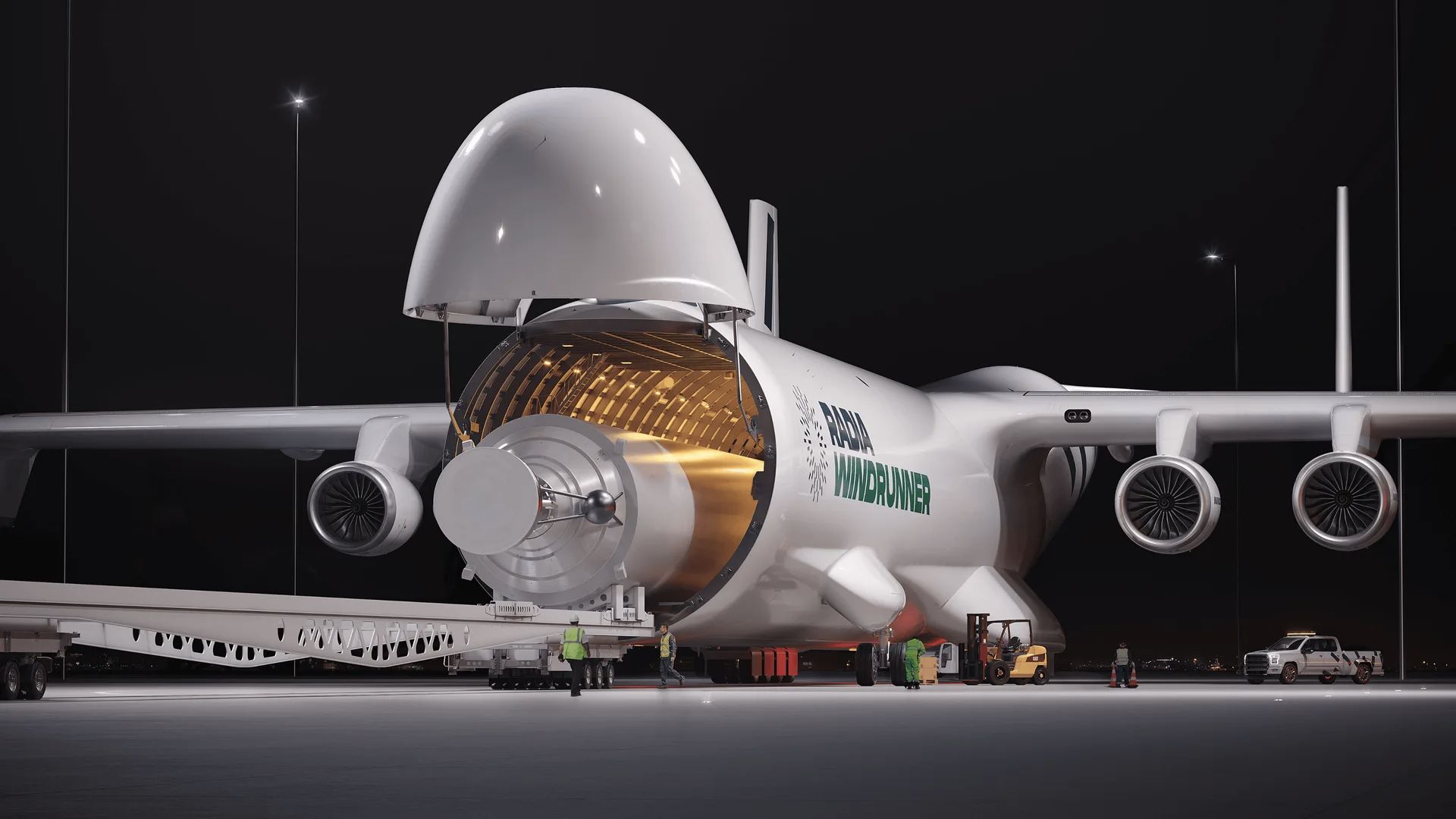
A Colorado-based company is showcasing how WindRunner, the world’s largest aircraft by volume, addresses one of the space industry’s most significant emerging constraints. Purpose built around cargo volume, not simply payload weight, WindRunner enables direct delivery of outsized space systems to launch sites, manufacturing facilities, and austere or distributed locations without disassembly. Designed to move the largest things in the world “The rockets, boosters, and spacecraft that define the space enterprise’s ambitions keep getting larger, more capable, and more valuable. Yet we’re still relying on transportation systems designed decades ago,” said Mark Lundstrom, founder and CEO of Radia. “WindRunner was designed to move the largest things in the world to the hardest places to reach, and that is exactly what the space community needs. Whether it’s a fully assembled booster, a recovered launch vehicle, or a next generation satellite, we can move it intact, in hours instead of days, without disassembly. With a low cargo deck height, nose door, and an innovative cargo loading system, the WindRunner will enable easier loading of outsized space related cargo. That gives the space enterprise an entirely new logistics capability.” WindRunner enables a more responsive, resilient, and flexible space mobility Rather than replacing today’s launch infrastructure or strategic airlift, WindRunner complements and extends both by providing a logistics capability for oversized, volume dominated payloads that no existing aircraft can transport intact. By connecting manufacturing, integration, launch, recovery, and sustainment operations, WindRunner enables a more responsive, resilient, and flexible space mobility architecture for government, allied, and commercial operators.It’s also revealed that modern space programs increasingly run out of transport options before they run out of ambition.Rocket stages, boosters, satellites, and other mission critical systems continue to grow in size, while the roads, ports, and aircraft available to move them have remained largely unchanged. As a result, valuable hardware is often disassembled, constrained by existing transportation limits, or routed by sea and road over several days or even weeks, adding cost, schedule risk, and unnecessary handling to some of the world’s most sensitive aerospace systems.WindRunner can support responsive space operations and enable movement of large launch systems in hours instead of days while supporting the recovery and repositioning of reusable launch vehicles for faster turnaround.WindRunner offers short takeoff and landing capability from approximately 1,800-meter unpaved runways enables access to emerging spaceports, distributed launch locations, and austere operating sites beyond the reach of conventional cargo aircraft.WindRunner is designed to operate using standard cargo handling equipment and conventional airfield infrastructure, eliminating the need for specialized loading systems or bespoke facilities.For military and commercial space operations, this could support a more distributed logistics architecture. Instead of relying exclusively on a small number of major transportation centres, oversized space hardware could potentially be moved closer to emerging spaceports, test facilities or austere operating locations.Radia says WindRunner could accommodate satellites with roughly twice the dimensional envelope of systems that can currently be transported fully assembled. If that capability becomes practical, spacecraft designers could gain greater freedom to build larger systems without being constrained as heavily by transportation requirements.That could have applications across communications, Earth observation, intelligence, surveillance and reconnaissance, as well as national-security space missions. In other words, an aircraft designed to solve a logistics problem could potentially influence how future spacecraft themselves are designed.
Radia showcases WindRunner as new solution for responsive space logistics
Full Article
Original Source
Read the full article at Interestingengineering →KhanList aggregates and links to publicly available news content. We do not host full articles from third-party sources. Always verify important information with original sources.