
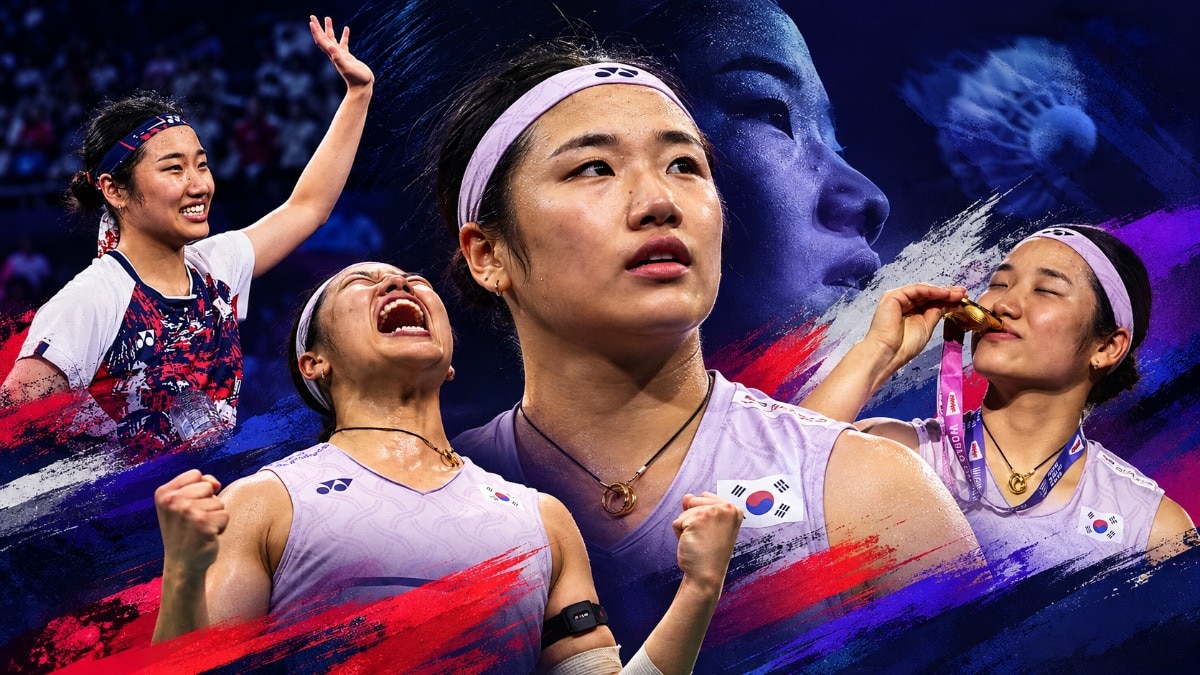
Peace.It is An Se Young’s favourite English word. She has been taking English lessons and, over time, has become more comfortable speaking the language. When she meets the international press, she often uses the word with a smile, pleased to be able to express herself beyond her native Korean. It is an interesting choice for a player who gives her opponents so little peace on the badminton court.On court, the 24-year-old retrieves the impossible, sends opponents scurrying from corner to corner and almost never looks hurried. She seldom runs out of answers. Her opponents are left with questions.After An beat her in the World Championships semi-finals in New Delhi in August, 24-22, 21-16, China’s Wang Zhi Yi turned to her and asked what had been on everyone’s mind. Wang is the reigning All England champion and the only player to have beaten An all year. “How do I beat you?”Reporters had been trying to answer that all week, and An’s coach had been asked about it at the India Open in January. Nobody had a definitive answer. The question now came from one of the finest players in the world, a regular contender at the biggest tournaments and someone who had beaten An before, asking in person. The Indira Gandhi Indoor Stadium offered another measure of how far An’s appeal has travelled. There was no Indian in the finals of the BWF World Championships on Sunday, yet the hall was full: children in the stands, a man who had come all the way from Arunachal Pradesh, schoolgirls from Gurugram holding banners with An’s name on them. After beating Japan’s Akane Yamaguchi 21-17, 21-14 in the final, An threw her familiar bandana into the crowd, returning some of the affection that had come her way.The reigning Olympic champion had arrived in Delhi without a month of competitive badminton behind her, a foot injury having ended her Japan Open in July, with the Asian Games, where she was defending the title, a little over a month away. Her coaching team confirmed that it was An herself who pushed to play. She did not feel she was at 100 per cent, but she wanted to give it a go.She left with the world title without dropping a game, and five weeks later, in Ichinomiya, she became the first woman to defend the Asian Games singles title, beating Yamaguchi again, 21-17, 21-9, to add to the singles and team golds she won at Hangzhou.That, in many ways, is the An Se Young problem.The numbers are hard to take in. After the Paris Open title in October, she stands at 66 wins from 67 matches this year, a win rate of 98.5 per cent, and has won 50 in a row.Her only defeat came in the All England final in Birmingham in March, to Wang, which ended a 37-match winning streak. Last season she won 73 of 77, a success rate of 94.81 per cent, and 11 titles.This year has brought 10 titles, one final defeat and one injury-hit Japan Open, interruptions that have barely disturbed the larger picture. In a sport where the difference between winning and losing can be a handful of points, and where players must travel, recover and adapt to new conditions week after week, she makes it look like routine.There is another way to measure her. These days the scoreboard tells you how well an opponent has played. Reaching 11 in a game is respectable, getting past 15 is an achievement, and taking a game off her means something special has happened. It is no longer entirely about winning. It is about how much resistance you can offer before she takes control.PV Sindhu offered a glimpse of what might be possible in the French Open final. She came out aggressively, drew errors from An, who was not quite finding her range, and took the first game 21-16. Then An tightened, cut the errors and began dictating the exchanges, winning the next two 21-11, 21-12. It was her 11th win in 11 meetings with Sindhu, and a reminder that even when opponents find a way into a match, keeping An there is another challenge altogether.LIKE NADAL ON CLAY Reuters Photo Vimal Kumar, the former chief national coach, has watched that pattern unfold. He likens playing An to facing Rafael Nadal on clay, where opponents could feel that everything they hit would simply come back.“It’s similar to how players used to feel when playing Rafael Nadal on clay, everything just keeps returning,” Vimal told IndiaToday.in during the 2026 India Open.“Our sport is very technical and very physical, so you have to be strong. But An Se Young has the right mixture. She uses her strength very well. She can stay in long rallies and play constructive rallies, not just return the shuttle. She plays with consistency in her shot-making, and that is really affecting the others. They are simply not able to do that.”The distinction between returning a shuttle and playing a constructive rally is the important one. An is not merely surviving exchanges but building them, controlling their length and forcing opponents to play the next shot on her terms, which tells most in the later stages of a match.Length, Vimal believes, is perhaps her biggest weapon. Her deceptive clears from the back of the court push opponents deep even though modern badminton leans towards keeping the shuttle down and attacking, and from the net she has deceptive flicks that catch players who have moved forward in anticipation.“She has perfect control,” Vimal said.“She can maintain length even with the wind or against the wind. That is a very special quality.”It sounds simple and is among the hardest things to do consistently. Add the net play and deception that recall Tai Tzu Ying at her best, the retrieving that brings Yamaguchi to mind, precise placement, exceptional anticipation and a knack for injecting pace at the right moment, and the absence of a big smash hardly matters.“If you look at it, the fundamentals, the basics of her are excellent,” Vimal said.“She has an excellent length. Into the net, her lunges into the net, from the net area, she’s quite sharp. She can play a good tumble at the net.”The weapon he does not rate is the smash.“She doesn’t have a very big smash or anything, but she places it very sharply and accurately. And quite deceptively,” he said.She has the defence of a retriever, the touch of a stroke-maker and the tactical discipline to know exactly when to use each.A PERFECT MIX An Se Young's biggest titles Aparna Popat, former India women’s singles player and Commonwealth Games silver medallist, names footwork, stroke-making and temperament as the three pillars of An’s dominance, but thinks the real strength lies in how they fit together.“When you bring these things together, I think what really runs it is this whole thing of playing the right stroke at the right time. And being consistent with it,” Aparna said.“When you put all this together, then it almost seems like there’s not too much room for anyone to actually expose and exploit.”That completeness means a dip in one department is covered by another, and Aparna points to the demands of back-to-back tournaments across different venues and court conditions.“Her recovery, tournament-to-tournament, physical and mental, it’s just absolutely incredible,” she said.“When you’re great in all different aspects of the game, when one aspect is maybe slightly low, you compensate with something else. I think that gives her that flexibility and hence, the consistency is so much.”Consistency is the word that keeps coming up, and it is easily mistaken for caution. It would be a mistake to confuse it with a lack of ambition or imagination, because she has changed a great deal to become this player.REINVENTING THE RALLY An Se Young lost to Chen Yufei in the Tokyo Olympics quarterfinals (Reuters Photo) To understand how far An has travelled, it helps to know where she started. South Korean women’s singles had long been associated with a defensive, rally-based style, and she initially looked cut from the same cloth. Abhijeet Kulkarni, the senior badminton journalist, author of The Gopichand Factor and now a coach, first saw her play in 2019.“That time she was a completely defensive player. Like, she would rally, she would play,” Abhijeet said. “She was very one-dimensional in that way, the rally player that the Koreans are.”An had talent and could trouble established players, but little suggested what was coming. “I don’t think anybody before 2022 actually thought of An Se Young as the next big name,” he said.“But when she started playing that aggressive game, everybody was surprised and everybody was wondering what happened to her.”The change began around the Covid-19 pandemic. An made herself attack even when it was costing her matches, understanding that defence alone would not carry her at the highest level.“Even when she was losing, she was playing attacking badminton,” Abhijeet said.“Playing in a completely different style and forcing herself to play in that style even if she was losing. Not falling back on the old. So, that showed her mental resilience.”It took time to find the balance.“She settled down as a player who can play the rallies, but can attack,” he said. “That transformation is what then built An Se Young the player she is today.”The point was never simply to hit harder but to learn when to attack without giving up the patience and control that had always been central to her game.What impresses Abhijeet most is the economy of her movement. Badminton is a sport of explosive lunges and desperate dives for a shuttle about to hit the floor, yet An rarely looks as if she is chasing anything. She arrives early, settles her balance and plays her stroke without stretching or throwing herself about. Opponents expecting a scramble find An already waiting for the shuttle.“You hardly see An Se Young running. She’s always in control,” Abhijeet said.It is not a natural gift, he is quick to add. “Credit to her coaches that they built that kind of footwork,” he said.“It is years of hard work. It is not just a natural movement that she has. She has to perfect it.”The efficiency also helps explain how she survives a long season. Other players look as if they are working to reach the shuttle, while she often seems to have worked out where it is going already.There is another layer to the evolution. At the India Open in January she spoke about bulking up as she got older, recognising that the fitness needed to dominate the tour would not stay constant, and Abhijeet noticed that her team was adjusting rather than waiting for the body to force it.“She is not just doing okay. There are a lot of players, something is working for me, why should I change it?” he said. “But she is always looking forward, her coaching staff is looking forward.”Her coach, Lee Hyun-il, a former South Korean men’s singles star, revealed that An had been quietly working with a mental consultant for more than a year, and that the team was preparing her for a more attacking future.“An Se-young wants to play a more attacking game. We are training accordingly,” Lee said. “We are also doing power and weight training for that.”For her opponents, hardly reassuring news. They were already struggling to get past the wall. Now the wall wanted to attack.A WINNING MACHINE An Se Young's head-to-head record against the top 10 women's singles players (As of October 31, 2026) Vinayakk Mohanarangan, senior journalist and badminton enthusiast, sees an almost machine-like player. He remembers a more adventurous An, who experimented with shots and took risks. Over the last three or four years she has refined her approach, choosing solidity over unnecessary variation.“She’s like this monster who doesn’t let a shuttle drop,” Vinayakk said, describing the defensive strength that forces opponents into mistakes. Her greatest achievement, he believes, is learning when to use her variety and when to resist the urge to produce something spectacular.“She knows what the right shot is to play at each point of time,” he said.He contrasts her with Tai Tzu Ying, whose shot-making and deception made her one of the most entertaining players of her generation, although her willingness to attempt the unexpected could also bring errors.“Tai Tzu Ying at her best could play so many different shots,” Vinayakk said. “But An Se Young has now perfected when to play these.”An has cut her mistakes without becoming predictable, and once she decides to tighten her game, finding a clean winner becomes an exhausting business. As Sindhu found in Paris, it is not that opponents stop playing good badminton; An simply makes the margin for error smaller.So what kind of player could trouble her? Vinayakk’s answer is not a conventional one.“Peak Tai Tzu Ying plus Carolina Marin would be a great combination,” he said.Tai brought deception, variety and shots opponents could not anticipate. Marin was an aggressive player who knew when to take the initiative and how to sustain pressure.It is a hypothetical combination, but the size of it is the point. Tai and Marin were not merely good players. Tai was a long-time world No. 1 whose touch made the sport look like a different game, and Marin was an Olympic champion and a three-time world champion who broke opponents with sheer pressure. Each was once in a generation.Whoever beats her regularly would have to make her think differently with every shot while denying her the time to settle into a rally. In other words, you would have to build the player from two legends.Vinayakk has seen glimpses of it in India’s Tanvi Sharma, the 17-year-old.“Tanvi’s game is where every other shot she tries a deception,” he said. “It looked like An had to think a little bit more than she would normally.”Tanvi, then world No. 24, lost to An at both the Denmark Open and the French Open this year, but she made the South Korean work, An finding herself 1-5 down early in Paris.THE GREATEST OF ALL TIME? An Se Young won the BWF World Championships 2026 title in New Delhi (Reuters Photo) There is also the question of the generation An is dominating.Vimal is reluctant to place her among the greatest of all time just yet, though he calls her the outstanding player of her era. He believes the field lacks the depth of a decade ago, when China regularly produced several world-class contenders and Tai, Marin, Ratchanok Intanon, Sindhu and Yamaguchi made for a fiercely competitive tour.“China always had five, six players of very high quality,” Vimal said. “The current girls, I wouldn’t rate them very high. They don’t have the temperament or the sharpness of the earlier lot.”He is careful to separate that from any criticism of An.“It’s no fault of hers. She’s winning that,” he said. “From the younger generation, she’s the outstanding one.”That is a legitimate part of the GOAT debate, but it does not dim what she has done against the players available to her. She has turned around her head-to-head against Chen Yufei, once trailing 0-7 and now leading 18-14. She leads Wang Zhi Yi 21-5, Sindhu 11-0 and Yamaguchi, one of her most persistent rivals, 24-15. These are not players who watched her rise from a distance. They have competed against her at the highest level and repeatedly failed to find a lasting solution. An Se Young's head-to-head record against the last five world champions “When opponents are coming out and saying, ‘We don’t know what to do’, that is the biggest compliment you can have,” Aparna said.Even the jokes have changed. Asked recently, with a straight face or close to it, whether she might try men’s singles, An laughed it off. The question was cheeky, but nobody asks it of a player who is merely very good.NO PEACE TREATY An Se Young won the Paris Olympics women's singles badminton Gold medal (Reuters Photo) There is a stubbornness to An that extends beyond the court. After winning Olympic gold in Paris in August 2024, she used the moment to question the Badminton Korea Association in public: its handling of her knee injury after the Asian Games, the national team’s training and management practices, the restrictions placed on athletes, and its preference for doubles players in the support structure. She could have enjoyed the biggest victory of her career and left the difficult conversations for another day.“When you win the biggest medal and then you don’t talk about the medal, but talk about the system that needs a reform,” Abhijeet said.The reforms that followed gave national team players greater freedom to sign personal equipment deals and choose their gear.An signed her own deal with Yonex in 2025, having been allowed to wear Asics shoes while the restrictions were being challenged. It was never only about shoes. It was about an athlete wanting control over the conditions in which she competes, and it extended the same freedom to her teammates.Abhijeet sees the same mentality at work on court: An has her own mind, will not accept things because they have always been done a certain way, and is ready to challenge authority when she believes something needs to change.There is a certain irony in all this. An’s favourite English word is peace, yet she has spent the better part of three years denying it to the best players in the world. She has rebuilt her game, refined her movement and strengthened her body, but even after reaching the top, she has refused to stop looking for ways to get better.She does not play like someone who believes she has found her finished product. There is always something to learn, something to adjust, another detail to sharpen. Her coach knows it. Her former opponents know it. So do the players who have begun asking her the question that once seemed unthinkable: how do you beat An Se Young?For now, there is no easy answer. An seems in no hurry to provide one. At just 24, the most dominant player in badminton may still have her best years ahead of her.- Ends
Racket Science: Inside An Se Young's extraordinary badminton dominance
Full Article
Original Source
Read the full article at Indiatoday →KhanList aggregates and links to publicly available news content. We do not host full articles from third-party sources. Always verify important information with original sources.