
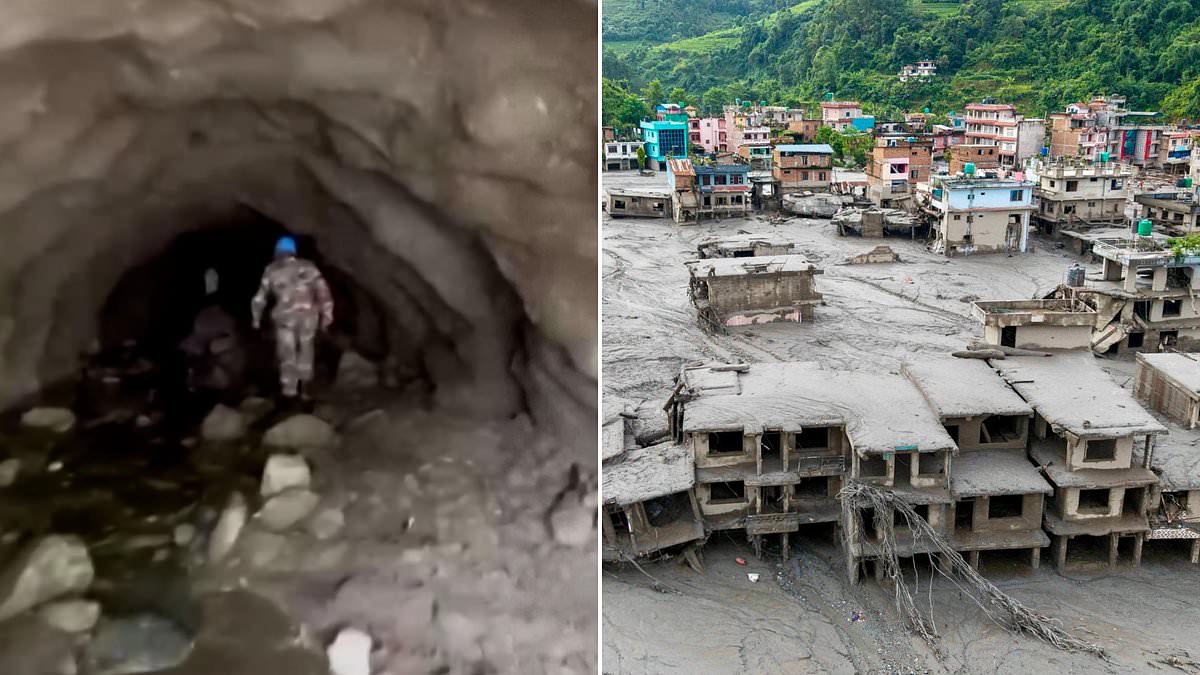
Rescue teams worked overnight to reach hundreds of people believed to be stuck inside blocked hydropower project tunnels in the aftermath of last week's flood in Nepal, as terrifying new videos of the disaster have emerged.The unprecedented deluge of ice, rock, mud and debris on the Nepal-Tibet border on Wednesday – blamed on a glacier collapse – has killed more than 900 people with 4,250 still missing.Hundreds of bodies, many unidentified, have been buried in shallow graves as they began decomposing in the humid weather in the plains of the Himalayan country after being swept down the mountains by the torrent.Nepali officials said that the focus was on reaching the hundreds of workers believed to be trapped inside about half a dozen hydropower project tunnels that had been blocked by mud and rock debris.Pictures and videos shared by rescue teams showed earth-moving equipment digging and shovelling mud and rocks under lights in the dark of the night as workers watched. Soldiers used torchlight in a big pit they had created to look for space to get into one tunnel.Teams had used a pipe to begin 'sending air through the small opening', Nepali Home Minister Sudan Gurung said in a statement. Nepal Army personnel rescuing a man, following deadly flash floods and mudslides Rescue workers taking part in a rescue operation near the tunnel of the Trishuli 3A Hydropower Project Nepali soldier walks inside a tunnel amid rescue operations to free workers believed to be trapped at the scene of the Langtang hydropower project Nepali soldiers inside a tunnel amid rescue operations to free workers believed to be trapped at the scene of the Langtang hydropower projectNepal's disaster management authority said that 933 people were missing from hydropower projects in the flood-hit region.At the Upper Trishuli 3A site, rescuers broke through into the upper part of a mud-swamped tunnel, pumping air inside, then using drilling and excavator machines to dig down.'When members of the team descended using ropes and called out to those inside, there was no response,' Prime Minister Balendra Shah said in an update on Sunday night.The Nepal Army said on Monday morning that work continues to 'clear water, mud, and sediment from inside the tunnel'.Specialised Indian, Chinese and South Korean tunnel-rescue teams are also helping.At another site, Upper Trishuli-1, a Chinese team 'entered approximately 300 meters (984 feet) into the tunnel and conducted a search, recovering one body', the Nepali Army said.At the Chilime Hydro tunnel, where Indian teams are deployed, rescuers entered 100m inside, but then said it was blocked.'Farther inside, was buried with mud and soil,' the statement added. 'During the operation, two bodies were recovered.'Nepali expert mountain rescue teams – who regularly aid climbers on the world's highest peaks, including Everest – are also taking part.The Nepal Electricity Authority said 11 hydropower stations and one solar power station, with a combined capacity of 431.1 megawatts, had stopped operating, about 10 per cent of the country's installed electricity generation capacity.Another 15 power projects under construction, with a planned capacity of 470 megawatts, were damaged.The Red Cross has estimated that more than 90,000 people are likely to have been affected by the disaster, which China has linked to the effects of climate change.On Monday, Nepali authorities said 903 people had died, with 4,247 missing, including the 933 at hydropower projects. On the Chinese side, authorities said 16 people were killed in Gyirong County and 546 were missing.'A large amount of debris has been deposited and that is posing us a big challenge to open the tunnels,' Nepal army spokesman Raja Ram Basnet told Reuters. 'Our main focus is on opening the tunnels.'Prime Minister Balendra Shah said the flood was an 'unprecedented and devastating natural disaster' and it remained challenging to compile a complete assessment of the damage.'Despite the adverse weather, difficult terrain and continuing risks, we are moving forward with determination to save the lives of our citizens,' he said in a Facebook post late on Sunday.He added that nearly 21,000 security personnel were involved in the rescue operations, besides civilian workers and volunteers. An aerial view shows houses lying deluged in sludge after flash floods Relatives console Muna Khadka, center, who lost her son Aayush Khada, in flash floods Firefighters and sniffer dogs conduct a search for missing people along a road leading towards Gyirong PortChinese President Xi Jinping, on a visit to Kyrgyzstan, said Beijing is making every effort to search for missing people following the disaster, Xinhua reported on Monday.Beijing has said 261 foreign nationals from 23 countries were unaccounted for in Tibet, near a key border crossing with Nepal.China's state-run CCTV reported Beijing has mobilised more than 2,100 rescue workers and allocated at least 220 million yuan ($33million) to support relief efforts.China has also been airdropping equipment and supplies to frontline rescuers, while its soldiers used life-detection equipment to look for the missing. Although Nepal has said that it does not need foreign help in general rescue and search, it has leaned on giant neighbours India and China for their expertise in tunnel rescue.Rescue operations have been suspended several times since Friday because of bad weather and concerns that a lake formed across the Nepal-China border by the disaster could trigger fresh flooding after it began overflowing into Nepal's rivers.China's state television CCTV said that another lake formed upstream by a landslide had largely drained as water flowed out naturally.The landslide occurred 2.8km downstream from the first lake formed by debris of the glacier collapse.Authorities are now monitoring an impact crater carved out near the site of the glacier collapse on the Nepalese side, which had expanded to 174,000 square metres by Saturday evening, state media said.The crater had an estimated reservoir of 2.5 million cubic metres, which if breached, could lead to a chain reaction to lakes further downstream, authorities warned.CCTV said there is risk of further landslides along the river that could create additional lakes, as investigators identified eight high-risk locations for geological disasters.The flood was 'caused by glacier instability under the long-term effects of global warming', the state broadcaster reported, saying it was a 'new and prominent feature of cryosphere disasters' on the Tibetan plateau.Two Nepali officials told Reuters that China had not shared much information on glacier risks and water levels following a meeting to strengthen co-operation earlier this year, and they feared that a lack of data sharing could hamper future disaster preparedness. Three months before the wall of water, mud and rock killed hundreds when it hurtled down a Himalayan valley bordering Nepal and China, experts and officials from both countries met in Kathmandu to discuss the risk of such disasters.At the May 27 meeting in Nepal's capital, ten officials from Nepal and about a dozen from China, including the Tibet region where the disaster struck, discussed strengthening co-operation to monitor and respond to floods, weather and glacier-related hazards, according to an agenda prepared by the Nepali side. People salvage belongings from their home following flash floods at Devighat in Nepal's Nuwakot district Drone view of people inspecting a damaged house after the deadly flash floods and mudslide Damaged houses stand precariously near the swollen, debris-choked banks of the Trishuli RiverThe participants called for joint risk-reduction measures, including inventories of glacial lakes and hazard mapping.But the Nepali officials told Reuters they did not receive as much information as they wanted from China on glacier risks and water levels after the meeting and they feared insufficient data sharing could hamper their ability to anticipate and prepare for major disasters.'What we actually wanted from them, and still want, is if there are early movements of glaciers and early movements around that area, we would want to know a bit early,' said Sauhardra Joshi, a hydrologist at Nepal's Flood Forecasting Division, who was in the May meeting.No officials or experts have blamed either side for the natural disaster, which will cost an estimated tenth of Nepal's annual economic output to recover from. Nepali officials say the priority is to deepen co-operation with China.
Race to save hundreds trapped in hydro tunnels after Nepal flash flood disaster as terrifying new videos emerge and death toll passes 900 with 4,250 missing
Full Article
Original Source
Read the full article at Dailymail →KhanList aggregates and links to publicly available news content. We do not host full articles from third-party sources. Always verify important information with original sources.