
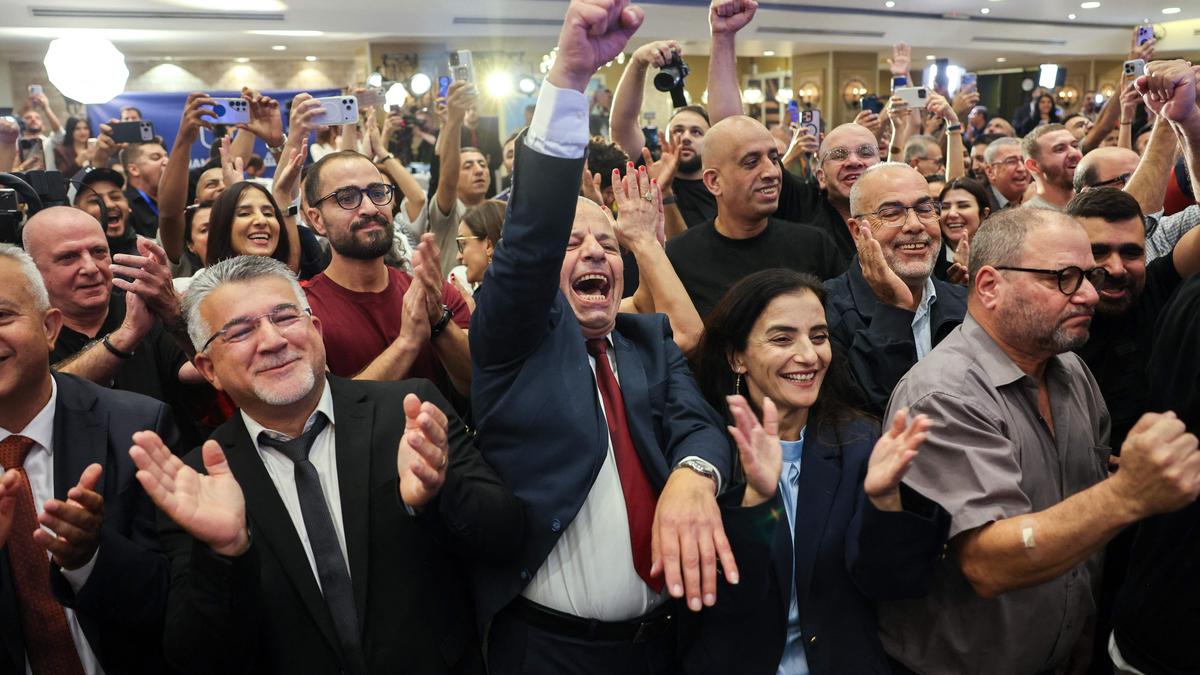
Yousef Jabareen, leader of Israel's Arab-led Joint List political alliance, and other members cheer at the alliance's campaign headquarters in the northern Israeli city of Nazareth on October 27, 2026, as the first exit polls are announced on television during Israel's legislative election. | Photo Credit: AFP On October 27, the day Israel went to the polls, the first election since the October 7, 2023 Hamas attack, the country recorded its highest voter turnout since 1999, at 77.7% But this was not the only story about the turnout.Israel’s often overlooked Arab citizens, who make up some 20% of the population, made an overwhelming case for representation and change that day by turning out in massive numbers to vote. Exit polls recorded by Channel 12 estimated their turnout at nearly 80%, the highest in at least a decade.For the far-right coalition led by Prime Minister Benjamin Netanyahu, the election was a “war for our home”, but for Arab parties, the political mobilisation meant meaningful representation in the Knesset, the Israeli parliament.This mobilisation seems to have paid off. Arab parties have emerged as the third bloc after the elections. The Joint List and the United Arab List (Ra’am) have secured a combined 19 seats in the 120-member Parliament, their highest-ever tally.Part of the credit goes to the Arab parties, which have actively mobilised their communities to vote. But much of it also goes to Mr. Netanyahu’s far-right government, whose policies and rhetoric, including the war on Gaza and escalating violence in the occupied West Bank, have heightened fears among Arab citizens.While Arab citizens are affected like any other Israelis when it comes to national security, they’ve also borne the brunt of racism and violence. According to polls by the Israeli Democracy Institute, a party’s position related to crime in Arab society was one of the most important factors determining their vote.Prime motivationFear, as many experts have pointed out, has been their prime motivation, which Arab parties have been able to mobilise given the divisive campaigns launched by Mr. Netanyahu’s bloc. During the campaign, the Netanyahu camp put up billboards, saying it was ‘either the right or Palestine’. Even on the day of polling, the Prime Minister urged his supporters to go and vote, pointing to an Arab voter surge and calling it a matter of “life and death”.While leaders of Arab parties have called Mr. Netanyahu’s attempts racist, they, too, have borne the brunt of discrimination. Like in the cases of previous elections, an attempt was made for disqualification of the Ra’am party and the Joint List (an alliance of Balad, Hadash and Ta’al) before the polls. The surge in voter turnout has helped them gain a significant number of seats, which would have made them kingmakers in a hung Parliament where no bloc has a clear majority. But neither side has expressed any willingness to form a government with Arab parties.Mr. Netanyahu has accused the Arab parties of “stealing” the elections and has vowed to keep them out of power, while Gadi Eisenkot, leader of the opposition coalition, has been reluctant to join hands with them.This reluctance is not new. The Ra’am party, led by Mansour Abbas, became the first Arab party in nearly 44 years to be part of a government in 2021 when they backed the Bennett-Yair Lapid government. Ra’am broke off from the Joint List. However, this experiment was short-lived as the coalition collapsed within a year. Ra’am returned to the opposition fold after Mr. Netanyahu’s coalition won the elections in 2022.Arab parties had previously supported governments from outside, especially under Labour Prime Minister Yitzhak Rabin.For Arab parties, the question of coalition is not an easy take either. Any alliance with Jewish parties is challenging given how much they differ in their views on Palestine. Most Jewish parties, including Mr. Netanyahu’s Likud and Mr. Eisenkot’s Yashar, are opposed to the establishment of a Palestinian State and support the occupation of the West Bank.This is in contrast to what the Arab parties envision. The Joint List has stated that it is committed to ending the occupation and establishing a Palestinian state along the 1967 borders and lifting the siege on Gaza. Ra’am supports an end of the occupation and the establishment of a Palestinian state with Jerusalem as its capital. However, they differ on priorities. While Mansour Abbas’s Ra’am party prioritises tackling immediate, practical resources for Arab towns, the Joint List maintains that Arab citizens cannot achieve true equality inside Israel without also ending the military occupation of Palestinians in the West Bank and Gaza. Published - November 01, 2026 01:31 am IST
Ra’am and Joint List | The surge of the other
Full Article
Original Source
Read the full article at Thehindu →KhanList aggregates and links to publicly available news content. We do not host full articles from third-party sources. Always verify important information with original sources.