
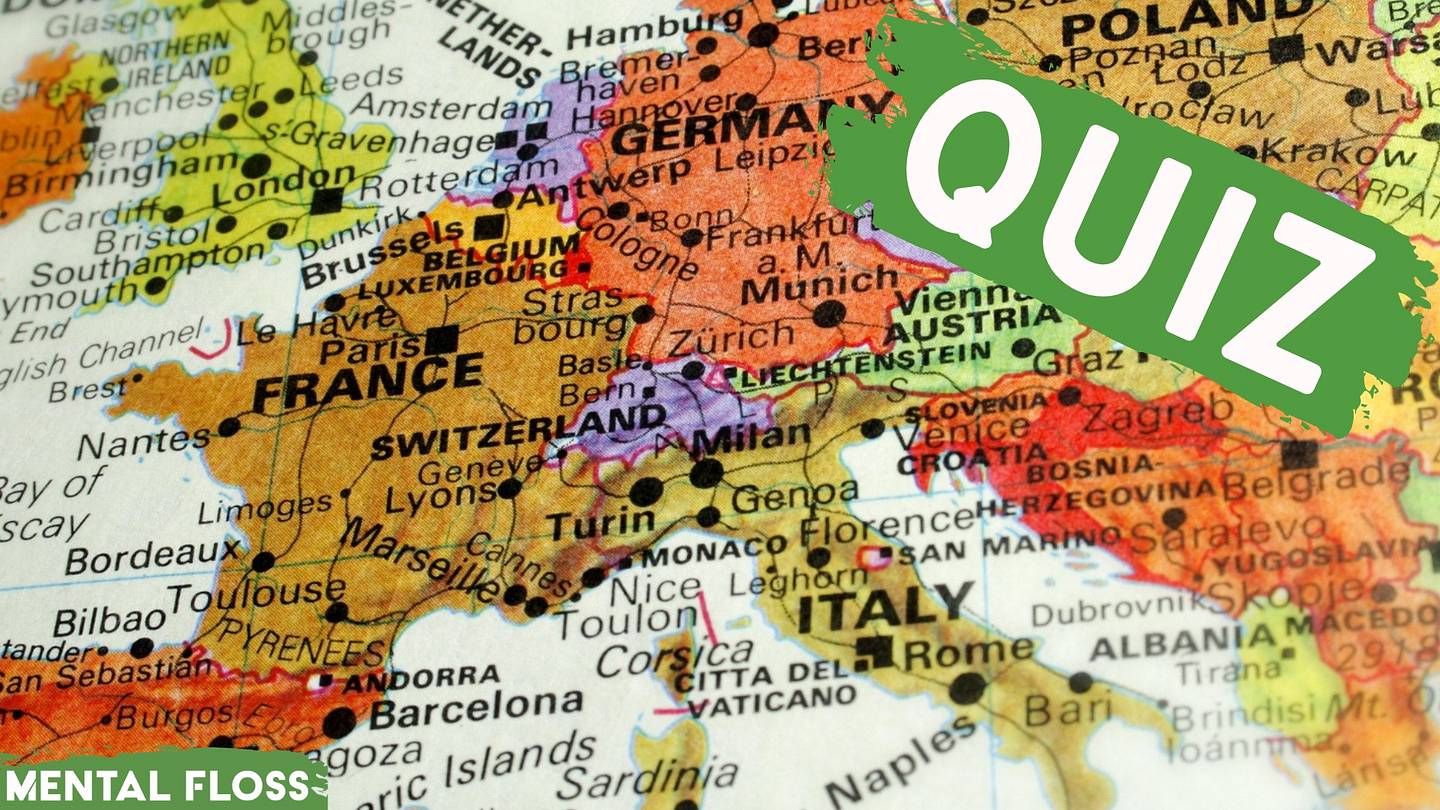
When you think of Europe, which countries come to mind?The United Kingdom, France, and Italy might be the first countries that pop into your head (especially if you're not a European citizen) thanks to popular tourist cities like London, Paris, and Rome. But the continent is much more than its most-visited metropolises. According to the United Nations, Europe has 44 countries. Some of these countries have staggering populations, while others are small in both population and area. A few countries with less land area rival their neighbors in population, while some larger countries have fewer residents than the smaller ones.Ten of these countries have the highest populations on the continent. The question is: how quickly can you name them? Most people miss at least one!Could you name all 10 of Europe's largest countries by population in record time? A few are no-brainers, while others are harder to name. Send this quiz to the geography whiz in your life and see how many they can name!EUROPE'S THREE LARGEST COUNTRIES BY POPULATIONThe three most populous countries in Europe are Russia, Germany, and the United Kingdom, in that order. RussiaRussia | FotografiaBasica/GettyImagesRussia, the world’s largest country. It’s so massive that it spans two continents: Europe and Asia. Although it isn't entirely in Europe, it's still the continent's largest country, spanning 16,377,742 square kilometers. As of 2026, Russia has 143,394,458 residents, millions more than any other European country.Interestingly, despite having the most residents, Russia has Europe's second-lowest population density, at nine people per square kilometer. Only Iceland is less densely populated, with four people per square kilometer.Largest cities by population: Moscow, Saint Petersburg, NovosibirskPrimary language: Russian GermanyGermany | akinbostanci/GettyImagesGermany ranks second, with a population of 83,644,258 and an area of 348,672 square kilometers. Unlike Russia, Germany is more densely populated, with 240 people per square kilometer.Germany boasts diverse terrain, from the northern lowlands to the Bavarian Alps in the south and the uplands in the middle, according to Worldometer. Its median age is just over 45.Largest cities by population: Berlin, Hamburg, MunichPrimary language: GermanUnited KingdomDestination United Kingdom | akinbostanci/GettyImagesThe United Kingdom ranks third in population, with 69,931,528 residents and a land area of 241,930 square kilometers, significantly smaller than several less populous countries, including France, Spain, Poland, and Ukraine.The United Kingdom includes England, Scotland, Wales, and Northern Ireland. Great Britain, which cannot be used interchangeably with the UK, is defined by Ordnance Survey as “the official collective name of England, Scotland and Wales and their associated islands.”Largest cities by population: London, Birmingham, LeedsPrimary language: EnglishVisit Mental Floss for more challenging geography quizzes! Read More:
Quiz: How Fast Can You Name Europe's 10 Largest Countries?
Full Article
Original Source
Read the full article at Mentalfloss →KhanList aggregates and links to publicly available news content. We do not host full articles from third-party sources. Always verify important information with original sources.