
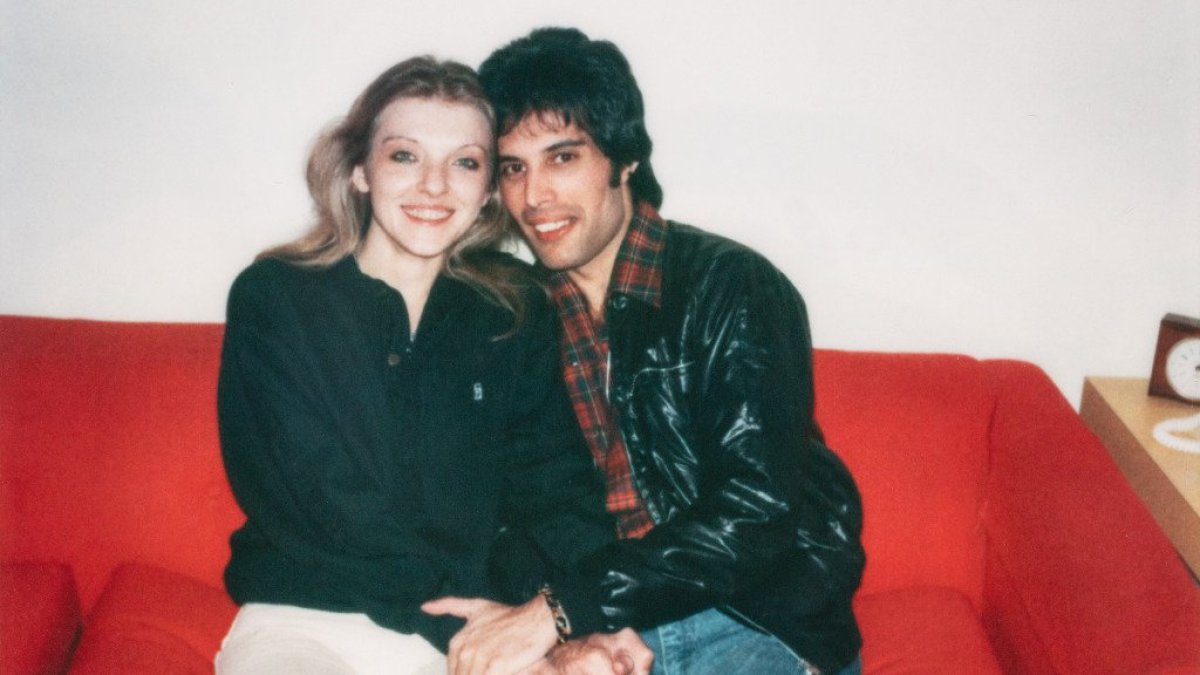
If you’re the sort of Queen fan who took a dim view of Mary Austin selling Freddie Mercury’s personal possessions at auction (as she did at Sotheby’s in 2023), then her first book will be like a red rag to a bull. And it wasn’t just fans who disapproved of Austin’s decision to move on artefacts and personal writings she was bequeathed by Mercury when he died in 1991: even Brian May pushed back, writing about his disappointment that the items were “to be knocked down to the highest bidder and dispersed for ever… I can’t look. To us, his closest friends and family, it’s too sad.” Although if Austin – famously Mercury’s ex-fiancée and lifelong confidante, whom he once called “the only real friend I have” – doesn’t count as closest friends and family, then it’s hard to imagine who does. You don’t leave half of a £37.5m estate – including your Garden Lodge mansion – and 50 per cent of your future Queen royalties to a casual acquaintance. So what to make of A Life in Lyrics by Freddie Mercury with Mary Austin, a book that annotates Mercury’s unseen personal archives and handwritten lyrics with stories about their relationship and Mercury’s creative journey? Austin has maintained a safely guarded privacy since Mercury died, which makes the publication of the book noteworthy in itself. And it seems Austin is well aware that among some fans of Queen, she is a divisive figure, both for the auction and for her supposed frosty relationship with Mercury’s long-term partner Jim Hutton: in Mercury’s will, he left just £500,000 to Hutton; Austin asked him to leave Garden Lodge with what critics say was indecent haste. As such, in the introduction to the book, Austin makes the case that sharing its contents is what Mercury would have wanted. The more parasocial Queen fans will never accept such an explanation. But far from being exploitative or some kind of cash-in – and lots of the money in the auction went to charity, including the Elton John Aids Foundation – Queen fans should be thanking Austin for showing them the real Mercury. A Life in Lyrics is not just a lovingly personal and often revealing account of a life spent in devotion to Mercury in both life and death, but a first-hand account of Mercury’s creative blossoming. “The world knew him as Freddie Mercury,” Austin writes. “But for me, the person captured within the pages of his lyrics, doodles and notes is Freddie Bulsara.” Mary Austin first met Freddie Mercury (right) through her friend Brian May (left) (Photo: Courtesy of Mary Austin) It was as good as love at first sight for Mary Austin. In the first of some slight corrections to established stories, Austin’s first meeting with Freddie Mercury in 1970 was not at Biba, the fashion store where Austin worked in Kensington, west London, when Mercury himself worked a nearby market stall, but at a house in Barnes. Brought by her friend Brian May before a visit to the pub, Austin walked in on an impromptu band meeting where the group’s name was being discussed (May apparently wanted Build Your Own Boa; Mercury, naturally, argued for Queen). The story of a pre-fame Mercury is relayed with unseen personal photographs. Austin’s take on how their relationship developed is affectionately drawn: friendly working in Kensington before a first date of sorts on 6 September 1970. “The nervous energy I witnessed in Barnes had softened; he was gentle, almost mellow. And although there was no instant romantic connection, there was… something.” They were soon living together, with money so tight in a £5-a-week rented flat near High Street Kensington that they could only afford one pair of curtains; Mercury, unable to cook, lived on cheese on toast or tomato soup. Austin writes of his obsessiveness over things he was interested in: “When Cabaret came out, we practically lived in the cinema. Liza Minnelli on that stage… he couldn’t get enough.” Mercury took Austin to The Tate to see Victorian artist Richard Dadd’s painting The Fairy Feller’s Master-Stroke “week after week”. It’s well known that his love of Lord of the Rings gave him an interest in the fantasy aspect that he drew on in his work; Austin writes that it was the only book she ever saw him read. But she writes that Mercury “could veer between intensity and uncertainty” in those early days as he found his feet as both an adult and an artist – that his buying a piano for the flat was a critical juncture in his life (“over the following months, a new playfulness emerged in Freddie”). He would sit in solitude at the piano for hours and days on end in what seemed like a very trad-wife situation: Mercury working on his art, Austin cooking, cleaning or ironing. “He could be so focused and inward-looking… he didn’t pace about or talk things through – he just seemed to disappear into his own head.” Freddie Mercury’s notebooks showing lyrics for ‘Don’t Stop Me Now’ (left) and ‘Killer Queen’ (Photo: Courtesy of Queen Music Ltd/Sony Music Publishing Ltd) He became so focused that he kept a notebook on the bedside table and would wake himself up in the middle of the night to write lyrics. When he bought a bigger, more expansive piano, not only did he treat it immaculately, not smoking or drinking near it, “Freddie changed with it. He seemed to rise to the challenge, aligning himself completely with the instrument… deeply absorbed… almost fevered.” The first thing he did on it was write “Bohemian Rhapsody”. Austin speculates that a Chopin record she’d just bought him, plus being exposed to classical music during a lengthy and frustrating search through many piano showrooms to find his new instrument, played into its composition. She notes the changes in him as Queen began to have hits. The fur jacket he wore during Queen’s breakthrough performance of “Killer Queen” on Top of the Pops in 1974 became a regular. “Freddie was growing into something larger than himself. He was becoming Mercury, and the jacket was part of that transformation, long before the rest of us caught up.” After the success of “Bohemian Rhapsody”, Austin writes of “a real change in him then… I see someone centred and happy. He was joyful… he seemed newly assured – as though he’d found a space he hadn’t quite been in before, and knew he belonged there.” But their romantic relationship was strained, and Austin writes of a sense of Mercury changing into something different. Austin noted this was coming out in the songs: she recalls a meeting in the pub when someone asked Mercury if he’d ever written a song about Austin. He replied just one, “Lily of the Valley”, a song of internal conflict about who he was, which declared, “but the Lily of the Valley doesn’t know”. “He was trying to say something he didn’t yet know how to resolve – and I was the lily who didn’t know.” Austin remembers Mercury as playful but also sometimes obsessive about his creative process (Photo: Courtesy of Mary Austin) And while most Queen fans think “Love of my Life” is about Austin, she isn’t sure. “At least not in the way people imagine,” she writes. But it predicts how their relationship would go. “The closing lines, ‘When I grow older/ I will be there at your side to remind you/ how I still love you’, echo a conversation we’d had one evening.” Eventually their engagement was called off after Mercury confided to Austin that he was bisexual. She famously replied: “No, you’re gay.” “He didn’t reply to that,” she writes. “It wasn’t said to wound him, nor to deny him anything, just that I knew immediately what his proclamation meant for me. From that moment on, the relationship I had believed in was over.” Austin writes about a “slow unravelling”, but she remained true to Mercury and committed to his life and work, taking a job as his PA. Austin turned down a job with CBS and a new life in America. “Am I ever not going to worry about him?” she asked. The answer was no, and their relationship developed into something deeper that she thought was almost unclassifiable. “People love to simplify our story into a neat little narrative – romance, loyal friend, tragedy – and I’ve tried so hard to liken it to something people recognise. Lover doesn’t work. Brother doesn’t work. Even best friend feels too neat for what it actually was.” Austin is so dedicated and accepting of Mercury – and such a crutch for him – it was a surprise to read her reveal that they fell out over Live Aid. Austin talked Mercury into doing it, which he seemed to hold against her to the point that Mercury never offered her tickets to Wembley. She bought them like a normal punter; afterwards they carried on as normal and it was never spoken of again. It’s the only moment of rancour. No doubt deliberately, the book avoids any controversy. The creative or personal fall-outs with his Queen band members are barely hinted at, while Mercury’s excessive party lifestyle is only touched on as a means for Austin to emphasise the distance she sometimes felt from him, something she calls “the wilderness years… Fame arrived, and in some ways, I lost him before I ever lost him. The Freddie I first knew – relaxed, silly, domestic in his own way, stitching cushions – didn’t disappear, but he became harder to reach.” In fact, the most contentious issues are ones that she totally omits. Hutton is not mentioned once in the entire book, even in final sections of the get-togethers and huge Christmas soirees that Mercury would throw at Garden Lodge in the last years of his life, which Austin writes about movingly. The claim in another book Love, Freddie by Lesley-Ann Jones that Mercury had fathered a secret daughter in 1976 – a claim Austin pushed back on firmly – is not addressed here, even to deny it. The epilogue is particularly poignant. Austin discloses the recent auction and indeed the book is about more than just Mercury, but a way of her moving on as her adult children left home and she faced an empty house with memories of Mercury everywhere she looked. But she also wanted fans to have a piece of Mercury, “to carry a memory outward, into other lives”. Mercury himself loved an auction for vintage stuff. “He made people feel included,” she resolves. None more so than Austin herself. ‘A Life in Lyrics’ by Freddie Mercury with Mary Austin is out on Tuesday (HarperNonFiction £30)
Queen fans should thank Mary Austin for showing the real Freddie Mercury
Full Article
Original Source
Read the full article at Inews →KhanList aggregates and links to publicly available news content. We do not host full articles from third-party sources. Always verify important information with original sources.