
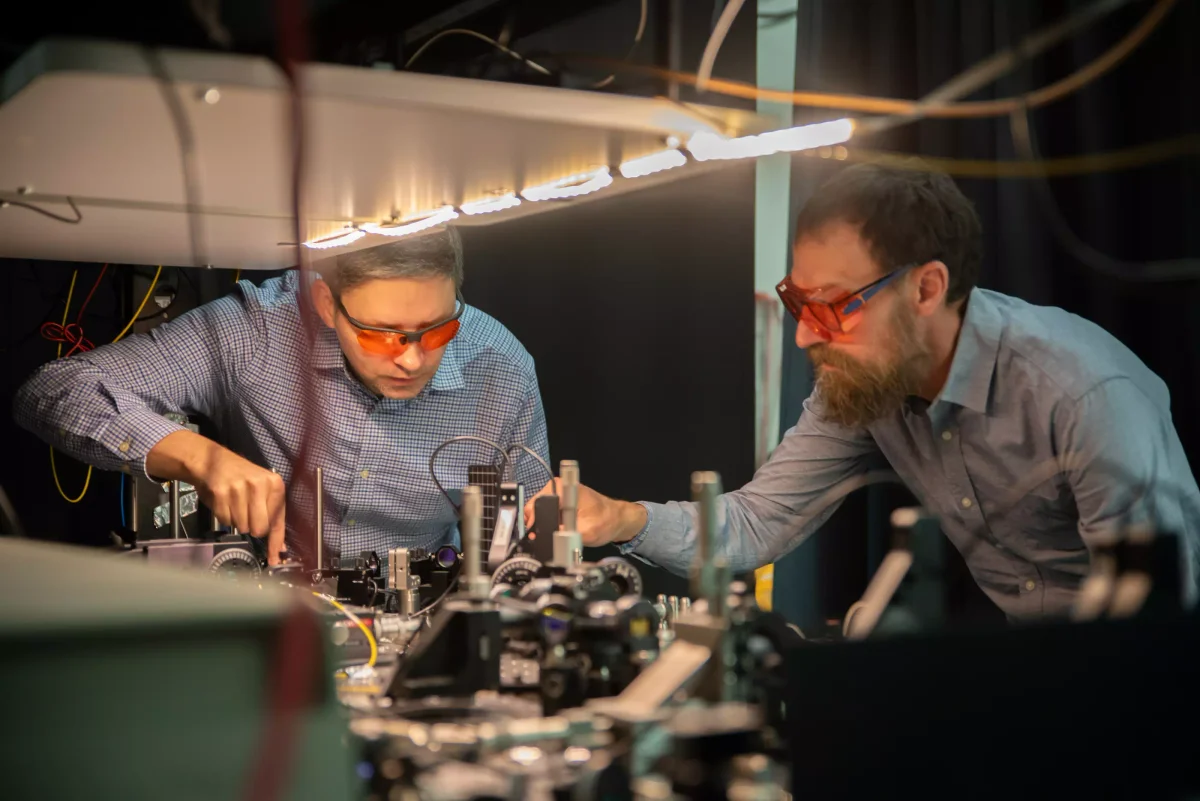
November 22, 20263 min read Add Us On GoogleAdd SciAmQuantum physics can catch you lying about where you areIn a first-of-its-kind experiment, researchers used a single photon and some-second timing to verify a location—a potential new defense against digital impostersResearchers at NIST Krister Shalm (left) and Marty Stevens (right) guide entangled photons through optical fiber as part of the quantum pinpointing experiment. Riley Wilson/NISTYour “bank” is texting again: You’ve been hacked, and you need to send your information over immediately. You’re 99 percent sure it’s a scam. It’s the other 1 percent that keeps your thumb hovering over the reply button. Nothing on your screen can tell you whether the sender is who—or where—they claim to be. Physicists now have a way to determine the “where,” at least in the lab. In a new experiment led by the National Institute of Standards and Technology (NIST) and described in Nature on Wednesday, researchers confirmed someone’s location by having them catch a photon fired right at them through a fiber-optic cable.See, a vault can keep a physical object in its place, and cryptography is pretty good at showing digital information is what it claims to be. Bridging the gap between the digital and physical is much harder. A password can be cracked, an identity can be faked, and even security camera footage shipped over the internet can be spoofed. Location falls into the same gap, which is how a scammer on another continent can pass for bank,On supporting science journalismIf you're enjoying this article, consider supporting our award-winning journalism by subscribing. By purchasing a subscription you are helping to ensure the future of impactful stories about the discoveries and ideas shaping our world today.The NIST team found its answer in quantum physics. Quantum information, like the polarization of the fired photon’s electric field, obeys different rules than the bits and code that make up standard computer communications. For instance, “They can’t be copied, so they have to be measured at one location,” says Krister Shalm, a NIST physicist who led the experiment. A photon that can’t be copied can still be intercepted, though, and measured somewhere else. So the researchers built two stations on NIST’s Boulder campus nearly 200 meters apart and put the person in question somewhere in between. One station sent the photon down the fiber, and both fired off random bits dictating how to measure it. Then they timed how long it took the person to catch the photon, measure it and send back a response to both stations. “By measuring that round trip time from when they sent the bits to when they got the answer, they can actually localize where that signal had to have come from,” says Shalm. Shalm and his collaborators created a sort of quantum echolocation, pinging signals from different locations to triangulate a position. Only the photon sender and the pinpointee need any sort of quantum technology. So the other “ear”—as in, the average person’s computer—could check locations without any quantum capability. The hope is that a network of optical fiber could let anyone prove where they are to anyone else in the same city. That idea has excited quantum researchers for years. “I’ve been telling everyone for the last two years that this is my new obsession,” says Henry Yuen, an associate professor of computer science at Columbia University. He says he used to be very skeptical of the need for this kind of work. The rise of AI agents and AI-enabled scamming changed his mind, and making sure someone actually is where they say they are strikes him as urgent. The experiment isn’t scalable yet, though. NIST cautions that real-world use may be more than a decade away. Yuen believes the holdup is mainly a matter of engineering and building out quantum-friendly networks. “We went from zero to one this year with this NIST experiment,” he says. “It’ll take a few years, but it seems like this is going to happen.”Others are less bullish on such a quick timeline. George Siopsis, a physics professor at the University of Tennessee, Knoxville, notes that the scheme only works if whoever sends the photon is much more technically advanced than any would-be spoofer. He also warns that the speedy photons may be harder to measure precisely outside a lab. After all, he says, “Light travels at the speed of light.” Quantum technology usually makes headlines for its promises of faster computers. Shalm’s photon suggests it could also make lying about your location a lot harder. And it would be a relief to know that the next text from your bank actually came from, well, the bank.Subscribe to Support Independent JournalismGreat science journalism requires human expertise, time, effort and creativity. And it costs money. That’s why I and the journalists here at Scientific American hope you’ll join our community.When you subscribe, you are supporting staff and freelance journalists who are passionate about telling science stories that are true, important and compelling. Our editors and reporters are often experts in their fields, which means they understand the nuances of big discoveries and can untangle the breakthroughs from the hype. With a subscription, you are also supporting rigorous fact-checking to ensure the words we publish are precise and accurate. And you’re supporting original illustrations, graphics and photos that bring you closer to an advanced laboratory, an ice sheet in Antarctica or a space mission in orbit. You’re helping us craft other types of high-quality journalism as well: Our newsletters are carefully written, edited and curated by staffers you have or will come to know and love. Our Science Quickly podcast is based on original reporting, collaboration with editors and scientists and exacting production.Subscriptions keep this engine running so we can continue to deliver thoughtful, rigorous and independent science journalism to you. In an era of viral misinformation, this work is crucial. If you value what we do, I hope you’ll consider joining us as a subscriber
Quantum physics can now prove where you really are
Full Article
Original Source
Read the full article at Scientificamerican →KhanList aggregates and links to publicly available news content. We do not host full articles from third-party sources. Always verify important information with original sources.