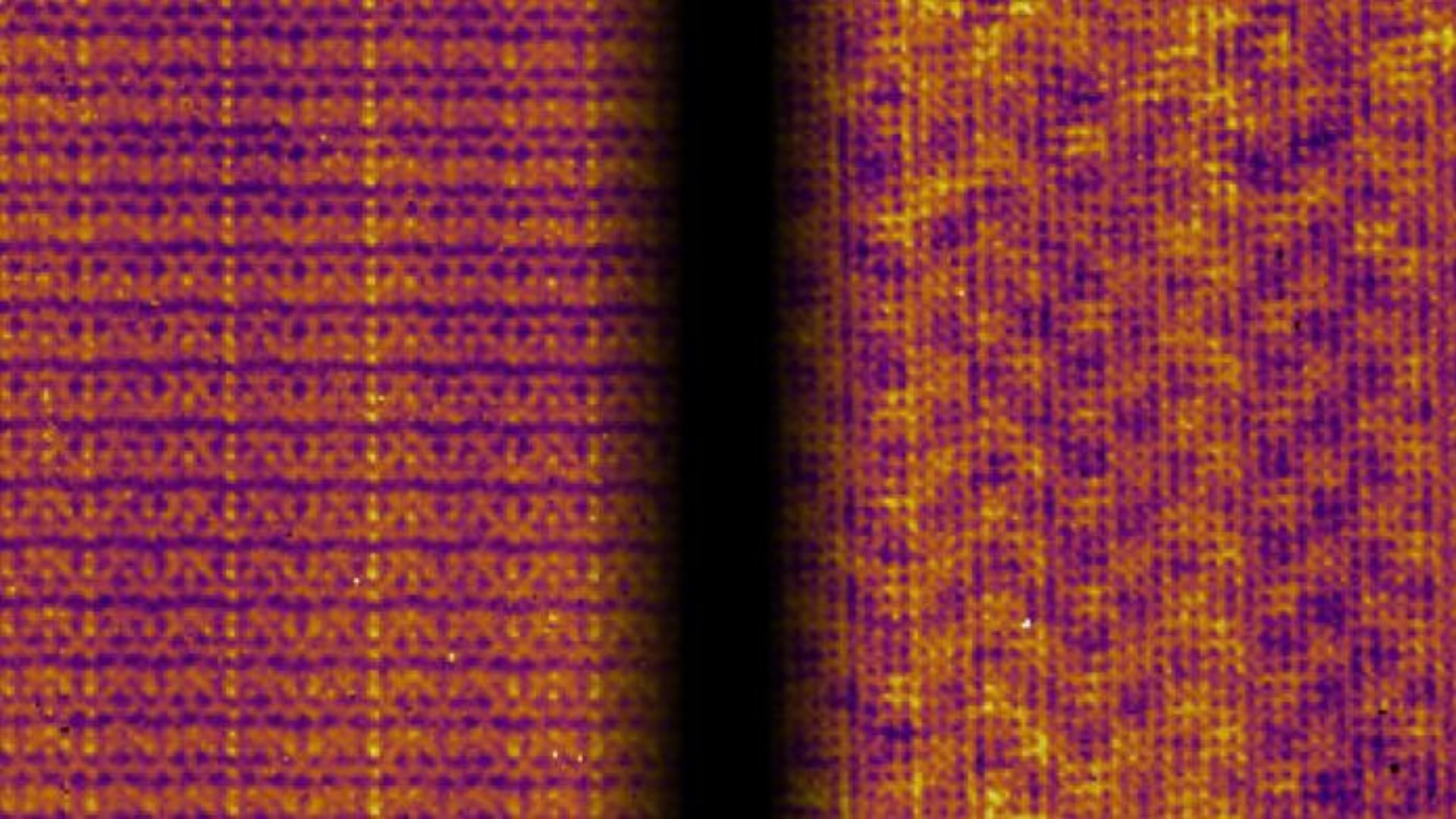
In the quantum realm, getting electrons to march to the same beat is famously difficult. But forcing them to adopt a completely new formation usually takes a heavy hit of power. Until now. Researchers at the Okinawa Institute of Science and Technology (OIST) and Hiroshima University have discovered that a tiny magnetic nudge can rewrite the rules inside a layered quantum material called cerium tritelluride (CeTe₃). With just a gentle tilt of a magnetic field, an entire electronic landscape transforms from a series of parallel stripes into a neat checkerboard. The findings offer a playbook for how future spintronics and quantum computing architectures might control information at the atomic scale. A tale of two atoms In materials like copper, silver, and silicon, electrons behave in predictable ways. Whereas in quantum materials, complex interactions give rise to remarkable collective electronic states. A primary goal in quantum materials research is to understand how these emergent states develop so we can manipulate and control them. To understand why this happens, you have to look closely at how CeTe₃ is built. Much like graphene, CeTe₃ is a two-dimensional, layered material with ultrafast, mobile electrons. But it has a twist. In CeTe₃, the workload is divided between two types of atoms. Tellurium (Te) and Cerium (Ce). The tellurium layers act as highways where mobile electrons zip around and naturally organize into repeating wave-like patterns. On the other hand, cerium layers host stationary electrons that stay put, or “remain localized.” Thanks to a quantum property called spin, these fixed electrons act like tiny bar magnets anchored in place. It was long wondered how these two distinct worlds influence each other. Could the stationary magnetic spins alter the path of the fast-moving electrons? The short answer is yes — and far more dramatically than anyone anticipated. “CeTe₃ offers a rare opportunity to watch mobile electrons and localized spins work together. We wanted to directly visualize how this cooperation gives rise to collective electronic states,” said Yuita Fujisawa, co-first author and an assistant professor at Hiroshima University. Magnetic-electronic coupling Using scanning tunneling microscopy (STM) at temperatures cooled near absolute zero, the material’s surface was mapped at atomic resolution. Initially, the mobile electrons lined up in crisp, parallel stripes. Then came the magnetic field. “I immediately went to Professor Okada’s office and said, ‘Look at this!’” recalled Dr. Yuita Fujisawa, co-first author. “We were astonished because it is extremely rare for a material to host multiple competing electronic patterns that can be switched so dramatically by such a small magnetic field.” The secret behind this sudden transformation comes down to a concept known as “electronic frustration.” In CeTe3, electrons experience electronic frustration, meaning they can adopt multiple low-energy patterns without preferring any single one. Like a ball resting on a landscape of nearly identical valleys, a tiny nudge from a weak magnetic field is all it takes to shift the material’s internal balance and switch its arrangement from a striped pattern to a checkerboard state. In a complementary study published simultaneously in Physical Review B, a companion team led by Dr. Ryutaro Okuma used neutron scattering to probe the material’s underlying magnetic core. Their study showed that the material develops an unexpectedly complex magnetic order that directly supports and drives these shifting electronic states at near absolute zero. “CeTe₃ is antiferromagnetic, which usually means that neighboring spins point in opposite directions. But in this case, we found that the magnetic moments form a much more intricate repeating pattern,” said Okuma. This precise alignment provides strong evidence that the magnetic order and electronic states in CeTe3 are intimately linked. The findings were published in the journal Nature Communications. Recommended ArticlesGet the latest in engineering, tech, space & science - delivered daily to your inbox.Mrigakshi is a science journalist who enjoys writing about space exploration, biology, and technological innovations. Her work has been featured in well-known publications including Nature India, Supercluster, The Weather Channel and Astronomy magazine. If you have pitches in mind, please do not hesitate to email her.
Quantum material’s electronic states can be flipped with magnetic field, study finds
Full Article
Original Source
Read the full article at Interestingengineering →KhanList aggregates and links to publicly available news content. We do not host full articles from third-party sources. Always verify important information with original sources.